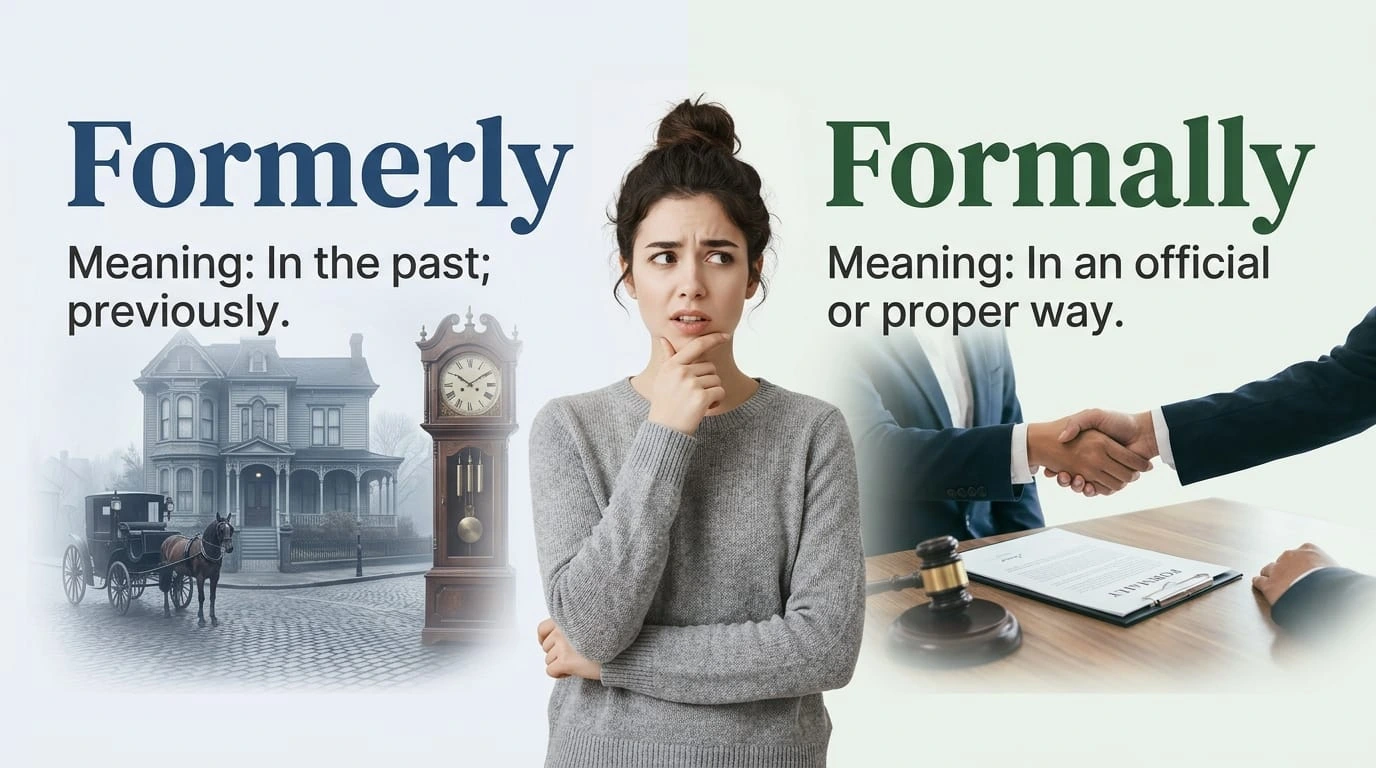
“Formerly means previously or in the past, while formally means officially or in a proper, polite manner. Although they look similar, they have different meanings and are not interchangeable.“
Have you ever written a sentence like “She was formerly the CEO” and wondered if it should be formally instead? Or perhaps you’ve seen both words online and assumed they’re just different spellings of the same word.
You’re not alone.
Many English learners, students, writers, and even native speakers confuse formerly and formally because they look almost identical. The difference is only one letter, but their meanings are completely different. Using the wrong one can change the meaning of your sentence and make your writing confusing.
The good news is that this isn’t a British vs American English issue. Formerly and formally are both correct English words, but they serve different purposes. One refers to the past, while the other relates to official or proper manners.
In this guide, you’ll learn the difference between formerly or formally, discover their origins, see real-life examples, avoid common mistakes, and know exactly which word to use every time.
Formerly or Formally: Quick Answer
Formerly means in the past or previously.
Formally means officially, according to rules, or in a proper manner.
Examples
| Word | Meaning | Example |
| Formerly | Previously; in the past | She was formerly a teacher. |
| Formally | Officially or politely | The company was formally announced yesterday. |
Quick Memory Trick
- Formerly = Former = Past
- Formally = Formal = Official
These words are not interchangeable.
The Origin of Formerly or Formally
Although these words look alike, they come from different root words.
Formerly
The word formerly comes from former, meaning earlier or previous. The suffix -ly turns it into an adverb meaning previously.
Example:
- He was formerly known as John Smith.
The word has been used in English for hundreds of years to describe something that existed in the past.
Formally
The word formally comes from formal, which comes from the Latin word forma, meaning shape or form.
It later developed the meaning of something done according to official rules, traditions, or accepted standards.
Example:
- The agreement was formally signed on Monday.
Why the Confusion?
People confuse these words because:
- They differ by only one letter.
- Both end in -ly.
- Both are adverbs.
- They sound somewhat similar in fast speech.
However, their meanings are entirely different.
British English vs American English Spelling
Unlike many English words, formerly and formally are not British and American spelling variants.
Both British English and American English use exactly the same spellings.
| Feature | British English | American English |
| Formerly | ✅ Formerly | ✅ Formerly |
| Formally | ✅ Formally | ✅ Formally |
| Meaning | Same | Same |
| Usage | Same | Same |
There is no regional preference.
The only challenge is choosing the correct word based on meaning.
Which Word Should You Use?
Choose the word according to what you want to say.
| If you mean… | Use |
| Previously | Formerly |
| Once known as | Formerly |
| Officially | Formally |
| Properly | Formally |
| According to rules | Formally |
For US Readers
Use both words exactly as American dictionaries define them.
For UK Readers
British English follows the same rule.
For International English
Whether you’re writing for Canada, Australia, New Zealand, India, or elsewhere, the distinction remains identical.
There is no regional spelling difference.
Common Mistakes with Formerly or Formally
Here are mistakes people make most often.
| Incorrect | Correct |
| She was formally known as Sarah. | She was formerly known as Sarah. |
| The contract was formerly signed yesterday. | The contract was formally signed yesterday. |
| He formally lived in Paris. | He formerly lived in Paris. |
| They formerly announced the merger. | They formally announced the merger. |
Why These Mistakes Happen
Many writers associate formal with “old-fashioned” and accidentally use formally when talking about the past.
Remember:
- Formerly = Past
- Formally = Official
Formerly or Formally in Everyday Examples
Emails
✅ The employee was formerly part of our marketing team.
✅ The proposal was formally approved yesterday.
News
✅ The company, formerly called Tech World, has changed its name.
✅ The president formally opened the conference.
Social Media
✅ This restaurant was formerly a bookstore.
✅ The couple formally announced their engagement online.
Academic Writing
✅ The species was formerly classified differently.
✅ The research was formally published in 2025.
Business Writing
✅ The employee was formerly the finance director.
✅ The agreement was formally accepted by both parties.
Formerly or Formally: Google Trends & Usage Data
Search interest for formerly or formally remains steady because thousands of English learners search for the difference every month.
The keyword is especially popular in:
- United States
- United Kingdom
- Canada
- Australia
- India
Most searches happen because users:
- confuse the two words
- want the correct word for writing
- check grammar before sending emails
- improve academic writing
- prepare for English exams
Although both words are common, formally appears more often in legal, business, and government writing, while formerly is frequently used in biographies, history, news articles, and descriptions of past names or roles.
Formerly vs Formally Comparison Table
| Feature | Formerly | Formally |
| Meaning | Previously | Officially |
| Refers to | Past | Rules or official actions |
| Part of Speech | Adverb | Adverb |
| Based on | Former | Formal |
| Used for Time | ✅ Yes | ❌ No |
| Used for Official Actions | ❌ No | ✅ Yes |
| British English | Same | Same |
| American English | Same | Same |
FAQs
Q: Is it formerly or formally known as?
A: Use formerly known as.
Example:
- Twitter was formerly known as Twitter before becoming X.
Q: Is formally ever used to mean previously?
A: No.
Formally never means previously. It means officially or in a proper way.
Q: Why are formerly and formally confusing?
A: They differ by only one letter and have similar pronunciation, but their meanings are completely different.
Q: Are formerly and formally interchangeable?
A: No.
Replacing one with the other changes the meaning of the sentence.
Q: Is this a British vs American spelling difference?
No.
Both countries use formerly and formally with the same meanings.
Q: Which word is more common?
A: Both are common, but they appear in different contexts.
- Formerly is common in history and biographies.
- Formally is common in legal, academic, and business writing.
Q: How can I remember the difference?
A: Think:
- Former = Past → Formerly
- Formal = Official → Formally
This simple trick helps you choose the correct word quickly.
Conclusion
Although formerly and formally look almost identical, they have very different meanings. Formerly refers to something that happened in the past or describes a previous identity, name, or position. Formally, on the other hand, describes something done officially, properly, or according to established rules and procedures.
The confusion isn’t caused by British and American English because both varieties use the same spellings and meanings. Instead, the mistake happens because the words differ by only one letter. A simple memory trick can help: former = past, so formerly means previously. Formal = official, so formally means officially or properly. Before using either word, ask yourself whether you’re talking about time or official action. Choosing the correct word will make your writing clearer, more accurate, and more professional in emails, reports, academic papers, and everyday conversations.
Formerly or formally explained clearly with meanings, examples, comparison tables, FAQs, and simple tips to choose the correct word every time.
Accept or Except: What’s The Difference?

As an English language enthusiast, I love diving into the tricky details of word differences and spelling variations. My mission is to explain confusing terms and make them accessible to everyone, helping readers to communicate with clarity and confidence.