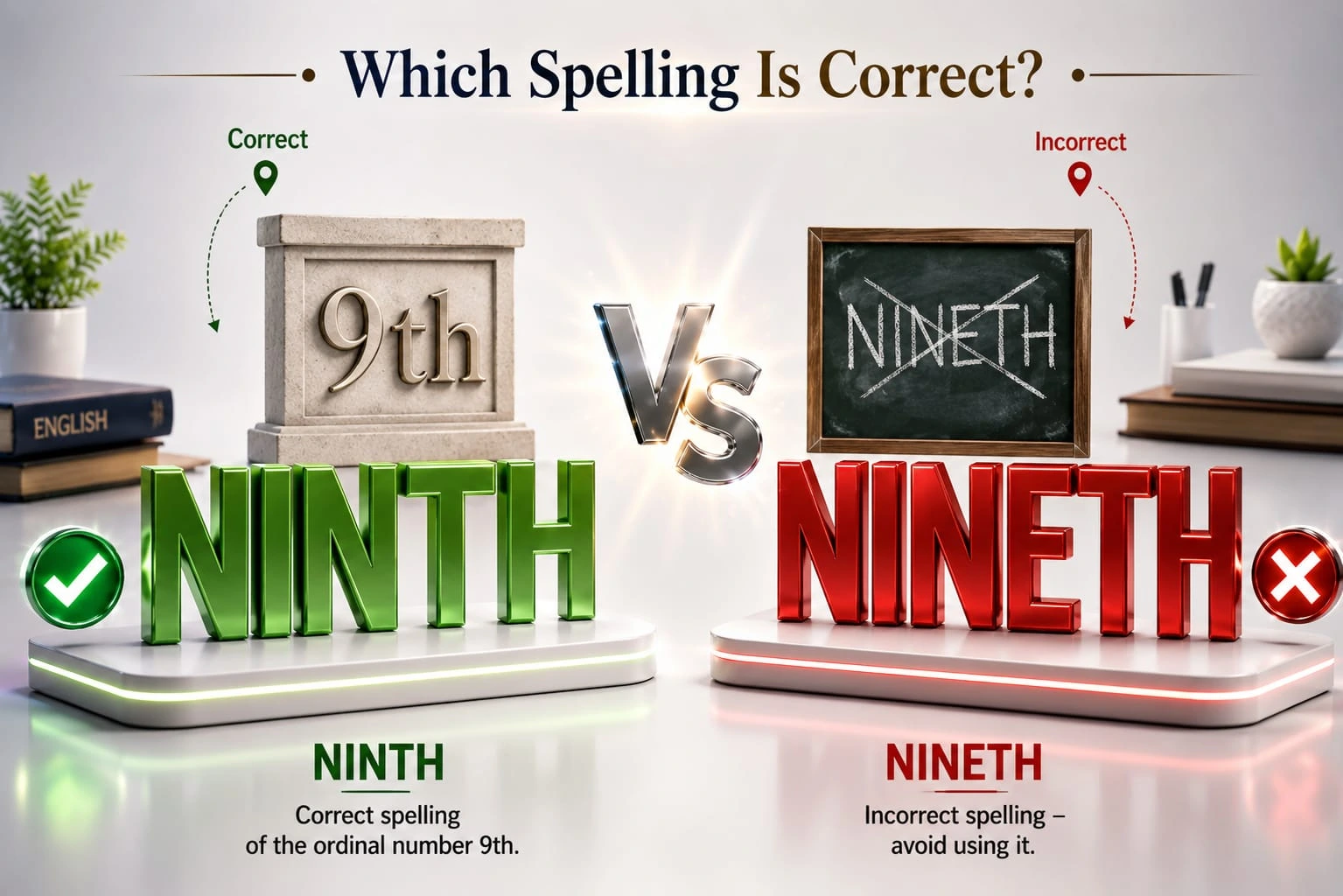
"Ninth" is the correct spelling in all English dialects. "Nineth" is a common misspelling, not an accepted variant in American or British English.
Years ago, I filled out an enrollment form and wrote “nineth grade” without thinking twice. The school secretary paused, then gently pointed out the mistake. I felt silly, since I’d read the word “nine” my whole life and just assumed the ordinal followed the same spelling.
If you’ve ever hesitated over this word, you’re not alone. It’s one of the most commonly misspelled ordinal numbers in English, and the reason is simpler than you’d expect.
This guide clears up exactly why “ninth” drops the e that “nine” keeps, whether British and American English handle it differently, and how to spell it correctly every time, in essays, forms, or emails.
Ninth or Nineth: Quick Answer
“Ninth” is always correct. “Nineth” is a spelling error, not a real word in any dictionary.
- ✅ She finished in ninth place.
- ❌ She finished in nineth place.
The confusion happens because “nine” keeps its e, but “ninth” drops it. This is a small but consistent rule that trips up writers who assume every related word keeps the same spelling.
The Origin of Ninth
“Ninth” comes from Old English nigoða, related to the base number “nine.” As English spelling evolved through Middle English, ordinal numbers (first, second, third, and so on) often shortened or adjusted their spelling compared to the cardinal number they came from.
This pattern shows up across several number words:
- nine → ninth (drops the e)
- five → fifth (changes the v to an f)
- twelve → twelfth (drops the e, adds th)
“Ninth” simply follows this well-established habit of English ordinals trimming letters for smoother pronunciation. Saying “nineth” out loud feels natural, which is exactly why so many writers assume it’s spelled that way, even though it isn’t.
British English vs American English Spelling
Unlike words such as “colour” or “favourite,” “ninth” does not have a regional spelling split. Both British and American English use the exact same spelling.
| Context | American English | British English | Example |
|---|---|---|---|
| Ordinal number | Ninth | Ninth | She placed ninth in the race. |
| Date writing | Ninth | Ninth | The meeting is on the ninth of May. |
| Fractions | Ninth | Ninth | He ate one ninth of the pie. |
| Common misspelling | Nineth (incorrect) | Nineth (incorrect) | Wrong in both dialects. |
This makes “ninth” one of the more reliable words in English. There’s no need to adjust your spelling based on your audience’s country, since the correct form never changes.
Which Spelling Should You Use?
For American audiences
Use ninth. It’s the only accepted spelling in American English, with no regional alternative.
For British or Commonwealth audiences
Use ninth as well. British, Australian, Canadian, and Indian English all follow the same spelling.
For global or mixed audiences
Ninth works everywhere, since this word doesn’t split by dialect like many other English spelling pairs.
For academic or professional writing
Stick with ninth in every context, from school assignments to formal reports. There’s no style guide anywhere that lists “nineth” as acceptable.
Common Mistakes with Ninth
Mistake 1: Writing “nineth” instead of “ninth”
✅ This is our ninth anniversary.
❌ This is our nineth anniversary.
Why it happens: Writers assume “ninth” keeps the same spelling as “nine,” since most ordinals seem to follow the base number closely.
Mistake 2: Misspelling compound ordinals
✅ twenty-ninth, thirty-ninth, ninety-ninth
❌ twenty-nineth, thirty-nineth, ninety-nineth
Why it happens: The same mistake repeats in every compound number built from “nine.”
Mistake 3: Confusing “ninth” with “ninety”
✅ He turned ninety on his ninth of September birthday.
❌ He turned nineth on his ninety of September birthday. (spellings swapped)
Why it happens: The words look similar and both come from “nine,” so writers occasionally mix them up.
Mistake 4: Using “nineth” in dates and formal documents
✅ The contract is dated the ninth of June.
❌ The contract is dated the nineth of June.
Why it happens: Handwritten dates and quick typing get less spellcheck support than formal typed documents.
Mistake 5: Assuming spellcheck always catches it
✅ Always proofread ordinal numbers written out in full.
❌ Relying only on autocorrect, which doesn’t always flag “nineth.”
Why it happens: Some spellcheck tools and browser extensions miss this error depending on language settings.
Ninth in Everyday Examples
Professional email:
“Our team meeting has been moved to the ninth of next month, please update your calendars.”
News headline:
“City Celebrates Ninth Annual Charity Run This Weekend”
Social media post:
“Celebrating our ninth year in business today! Thank you for the support. 🎉”
Formal document:
“This agreement shall take effect on the ninth day of the signing month.”
In every case, ninth is the only correct spelling, regardless of tone or formality.
Ninth: Google Trends & Usage Data
Search interest in “ninth vs nineth” stays fairly steady year-round, with noticeable spikes around school enrollment periods, anniversaries, and event planning, when people write out ordinal numbers more often. This falls into the informational search category, with students, parents, and writers checking spelling before submitting forms or publishing content.
Search data shows this mistake appears most often among students and non-native English speakers, since the e-dropping pattern in ordinals isn’t intuitive. Unlike many other spelling debates, there’s no country or region where “nineth” is considered acceptable, making this one of the more universally agreed-upon corrections in English.
Ninth vs Nineth: Comparison Table
| Term/Variant | Meaning | Region/Context | Best Used When |
|---|---|---|---|
| Ninth | Correct ordinal form of nine | Universal, all English dialects | Always, in any writing context |
| Nineth | Misspelling, not a real word | None, incorrect everywhere | Never, avoid entirely |
| 9th | Numeral form | Universal | Casual writing, lists, dates, forms |
Frequently Asked Questions
Q: What does “ninth” mean?
A: “Ninth” is the ordinal form of the number nine, used to describe position, order, or fractions, such as finishing ninth in a race or eating a ninth of a pizza.
Q: How do you use “ninth” correctly in a sentence?
A: Use “ninth” any time you’re describing order or position, such as “This is her ninth book” or “We met on the ninth of April.”
Q: Ninth vs nineth, what’s the difference?
A: There’s no real difference in meaning, since “nineth” isn’t a correct word at all. “Ninth” is the only accepted spelling.
Q: Is “ninth” acceptable in formal writing?
A: Yes, completely. “Ninth” is the standard spelling in legal documents, academic writing, contracts, and professional reports.
Q: Which version is correct, ninth or nineth?
A: “Ninth” is correct. “Nineth” is a spelling error that doesn’t appear in any English dictionary, in any dialect.
Q: Where does the word “ninth” come from?
A: It comes from Old English nigoða, related to “nine.” Over time, the spelling shortened, dropping the e found in the base number.
Q: Can “ninth” be used in casual conversation and texting?
A: Yes. The spelling never changes based on tone, it’s “ninth” whether you’re texting a friend or signing a legal contract.
Final Takeaway
“Ninth” is always correct. “Nineth” is always wrong, in every English-speaking country.
Key points to remember:
- The rule: “Ninth” drops the e that “nine” keeps, following the same pattern as other English ordinals
- No regional split: Unlike many spelling pairs, “ninth” is identical in American, British, and all other English dialects
- Watch compound numbers too: It’s “twenty-ninth,” never “twenty-nineth”
- No exceptions: “Ninth” is standard everywhere, formal or casual
Once you remember that ordinals often trim letters from their base number, you’ll never write “nineth” again.
Bookmark this guide so you never second-guess “ninth” vs “nineth” again, and share it with anyone filling out a form or writing a date.

As an English language enthusiast, I love diving into the tricky details of word differences and spelling variations. My mission is to explain confusing terms and make them accessible to everyone, helping readers to communicate with clarity and confidence.