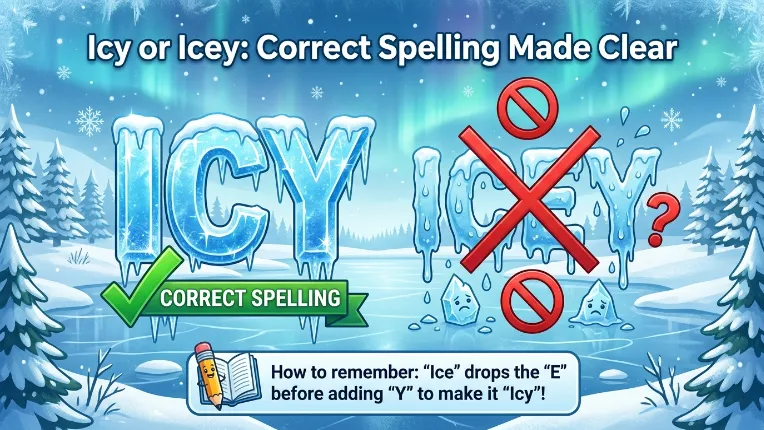
“Icy” is the correct spelling; “icey” is a common mistake and should be avoided.
On a cold winter morning, Bilal typed a message: “The road is very icey today.” His friend quickly replied, “You mean icy.” That small correction is something many people experience. Words like icy and icey sound the same, so it’s easy to assume both spellings are correct.
This is why people often search for “icy or icey.” The confusion comes from the base word “ice.” When we add a “y” to describe something covered with ice, many people instinctively write “icey.” It feels logical but English does not always follow simple logic.
In reality, only one spelling is correct in standard English. Using the wrong one can make your writing look unprofessional, especially in exams, emails, or online content.
In this guide, you will clearly learn the correct spelling, why the confusion happens, how the word developed, and how to use it confidently in everyday writing.
Icy or Icey – Quick Answer
- Icy = correct spelling
- Icey = incorrect spelling
Examples:
- The road is very icy today.
- Be careful, the steps are icy.
👉 Simple rule:
Always use icy, never icey.
The Origin of Icy or Icey
The word icy comes from the noun “ice.” In English, when we add the suffix “-y” to some words, the spelling changes slightly.
Instead of writing ice + y = icey, English rules simplify it to icy.
This change makes the word easier to read and pronounce. Similar patterns exist in other words, which is why “icey” never became standard.
So:
- Base word: ice
- Correct adjective: icy
British English vs American English Spelling
There is no difference between British and American English for this word.
Comparison Table
| Word | British English | American English |
|---|---|---|
| Icy | Icy | Icy |
| Icey | Incorrect | Incorrect |
Both regions follow the same rule: icy is correct everywhere.
Which Spelling Should You Use?
There is only one correct choice:
- Use icy in all situations
When to use “icy”:
- Weather descriptions
- Roads, surfaces, or objects covered with ice
- Figurative meaning (cold attitude)
Examples:
- The weather is icy
- She gave him an icy look
Pro Tip:
If you are adding “-y” to “ice,” drop the “e” → icy
Common Mistakes with Icy or Icey
Mistake 1:
❌ The road is icey
✔️ The road is icy
Mistake 2:
❌ Icey wind is blowing
✔️ Icy wind is blowing
Mistake 3:
❌ Mixing both spellings
✔️ Always use icy consistently
Mistake 4:
❌ Thinking icey is British spelling
✔️ It is incorrect in all forms of English
Icy or Icey in Everyday Examples
In Daily Life:
- Be careful, the floor is icy
- The lake looks icy today
In Weather Reports:
- Expect icy conditions on roads
- Drivers should avoid icy areas
In Social Media:
- “Such an icy morning today”
- “Her reply was cold and icy”
In Formal Writing:
- The region experienced icy temperatures
- Roads remained icy throughout the night
Icy or Icey – Google Trends & Usage Data
Search data shows:
- “Icy” is the correct and widely used spelling
- “Icey” is frequently searched due to confusion
- Many users search both terms to confirm correctness
Usage Insight:
- “Icy” dominates in books, media, and education
- “Icey” appears mostly as a spelling error
Comparison Table: Icy vs Icey
| Feature | Icy | Icey |
|---|---|---|
| Correctness | Correct | Incorrect |
| Usage | Standard English | Non-standard |
| Meaning | Covered with ice / cold | Intended same but wrong |
| Frequency | Very high | Low (mistake-based) |
| Example | Icy roads | (Avoid usage) |
FAQs
1. Is it icy or icey?
The correct spelling is icy.
2. Why is icey incorrect?
Because English drops the “e” before adding “-y.”
3. Is icey ever acceptable?
No, it is considered a spelling mistake.
4. Do British people use icey?
No, both British and American English use icy.
5. What does icy mean?
It means covered with ice or very cold.
6. Can icy be used for emotions?
Yes, it can describe a cold or unfriendly attitude.
7. How can I remember the correct spelling?
Just remember: drop the “e” → icy.
Conclusion
The confusion between icy or icey is very common, mainly because both words sound exactly the same. However, only one spelling is correct in standard English. Icy is the accepted form, while icey is simply a mistake that should be avoided in all types of writing.
The rule behind this spelling is simple. When adding the suffix “-y” to the word “ice,” the “e” is dropped, resulting in icy. This pattern helps keep the word clean and easy to read. Once you understand this rule, the confusion disappears.
Using the correct spelling is important, especially in formal writing, exams, and professional communication. Even small spelling errors can affect how your writing is perceived.
By remembering this simple rule and practicing correct usage, you can confidently use icy in any context. Whether you are describing weather, surfaces, or even emotions, you now know the correct and professional way to write it.

Hi, I’m Liam Rivers, author at Engglory.com.
I’m an English grammar expert who simplifies spelling confusion and tricky grammar rules to help readers write and speak with confidence.