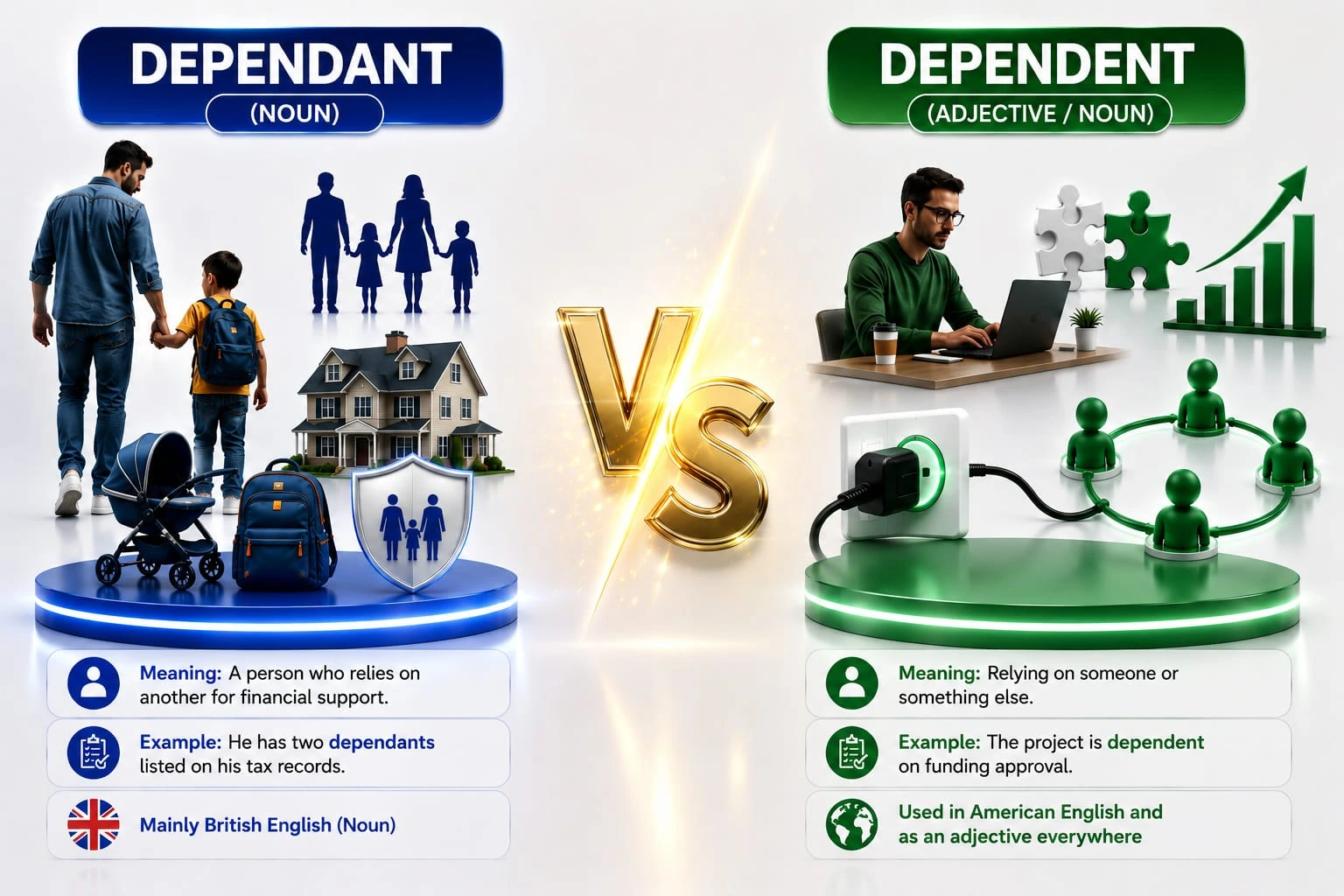
Dependent and dependant both refer to a person who relies on someone else for support, such as money, care, or help. Dependent is the standard American spelling, while dependant is mainly used as a noun in British English. _________________________________________________________________________________________________
Have you ever stopped while writing and wondered: Is it dependant or dependent? You are not alone. Many people search for this keyword because both words look correct, both appear online, and both seem to have the same meaning. This creates confusion for students, writers, job applicants, business professionals, and anyone writing emails or documents.
The problem becomes bigger because English has different spelling rules in different countries. A person in the United States may use one spelling, while someone in the United Kingdom may use another. You might also see both versions in forms, immigration documents, news articles, and social media posts.
People want a quick answer because using the wrong spelling can make writing look less professional. The good news is that the difference is easy to understand. Once you know where each spelling is used and why it exists, choosing the correct word becomes simple.
This guide gives a quick answer first, then explains the history, spelling rules, examples, common mistakes, and usage tips.
Dependant or Dependent: Quick Answer
The short answer is simple:
Dependent is the preferred spelling in American English for both nouns and adjectives.
Dependant is mainly used in British English as a noun. British English still uses dependent as an adjective.
Examples:
- Dependent (adjective): “The child is dependent on her parents.”
- Dependent (US noun): “He listed his wife as a dependent.”
- Dependant (UK noun): “He listed his wife as a dependant.”
Quick comparison:
| Word | Meaning | Main Usage |
| Dependent | Adjective and noun | American English |
| Dependant | Noun only | British English |
The Origin of Dependant or Dependent
The words came from the Latin word dependere, which means “to hang from” or “to rely on.”
Later, the word moved into French and then English. Over time, English spelling changed in different places. British and American English started using different forms for some words.
The spelling dependent became the main form in the United States. British English kept dependant for people who rely on others, while keeping dependent as an adjective.
This difference is similar to other English spelling changes.
Examples:
- Colour / Color
- Centre / Center
- Favourite / Favorite
Because English changed in different countries, both spellings exist today.
British English vs American English Spelling
British and American English often follow different spelling rules. The same idea applies to dependant and dependent.
In American English:
- Dependent = noun
- Dependent = adjective
In British English:
- Dependant = noun
- Dependent = adjective
Examples:
American English
- “She claimed two dependents on her tax form.”
- “He is dependent on financial support.”
British English
- “She claimed two dependants on her tax form.”
- “He is dependent on financial support.”
Comparison Table
| Feature | American English | British English |
| Noun spelling | Dependent | Dependant |
| Adjective spelling | Dependent | Dependent |
| Used in tax forms | Dependent | Dependant |
| Used in formal writing | Dependent | Depends on context |
Which Spelling Should You Use?
Your audience should guide your choice.
If your audience is in the United States:
Use dependent.
If your audience is in the United Kingdom, Australia, New Zealand, or other Commonwealth countries:
Use dependant for nouns and dependent for adjectives.
If your audience is global:
Use dependent because it is more widely understood.
Professional advice:
- Academic writing → Follow your style guide.
- Business writing → Match your audience location.
- Websites with global readers → Use dependent.
Consistency matters more than mixing styles.
Common Mistakes with Dependant or Dependent
People often make these errors:
Mistake 1
Incorrect:
“He is a dependent on his parents.”
Correct in UK noun form:
“He is a dependant on his parents.”
Correct in US noun form:
“He is a dependent on his parents.”
Mistake 2
Incorrect:
“She is dependant on coffee.”
Correct:
“She is dependent on coffee.”
Reason: Adjective use always takes dependent.
Mistake 3
Incorrect:
Using both spellings in the same article.
Correct:
Choose one style and stay consistent.
Dependant or Dependent in Everyday Examples
Here is how these words appear in daily life.
Emails
“Please list all dependents on the insurance form.”
News
“The government announced support for families with dependants.”
Social Media
“I’m still financially dependent on my parents.”
Formal Writing
“The employee declared two dependents for tax purposes.”
Legal Documents
“The applicant must provide information about each dependant.”
Dependant or Dependent: Google Trends & Usage Data
Search and usage patterns show interesting differences.
Dependent is more popular worldwide because the United States produces a large amount of online content.
Countries where dependent is more common:
- United States
- Canada
- Global business websites
Countries where dependant appears more often:
- United Kingdom
- Australia
- New Zealand
Context also matters:
- Tax forms often use local spelling rules.
- Immigration documents follow country standards.
- News websites match their regional style guide.
Keyword Comparison Table
| Variation | Main Region | Usage Type |
| Dependent | US and global | Noun and adjective |
| Dependant | UK/Commonwealth | Mainly noun |
| Financial dependent | Global | Legal and tax use |
| Financial dependant | UK | Legal and tax use |
| Child dependent | US | Family documents |
| Child dependant | UK | Family documents |
FAQs
Is dependant or dependent correct?
Both are correct. The correct choice depends on your country and usage.
Which spelling does the US use?
American English uses dependent for nouns and adjectives.
Which spelling does the UK use?
British English usually uses dependant as a noun and dependent as an adjective.
Is “dependent on” always correct?
Yes. When describing reliance, dependent on is the correct form.
Example:
“The company is dependent on investors.”
Is dependant used as an adjective?
No. Dependant is mainly used as a noun in British English.
Which spelling should I use for SEO?
Use dependent if your audience is global because it has broader recognition.
Can I use both spellings in one article?
You should avoid mixing them unless you are explaining the difference.
Conclusion
The confusion around dependant or dependent happens because English changes across regions. At first glance, the words seem identical, but there is a simple rule behind them. American English uses dependent for almost everything. British English uses dependant mainly as a noun and dependent as an adjective.
If you write for a US audience, choose dependent. If you write for a UK or Commonwealth audience, follow local spelling rules. For global content, websites, and general communication, dependent is usually the safest option because more readers recognize it.
The most important thing is consistency. Switching between spellings can confuse readers and make content look less polished. Think about who will read your writing before making your choice.
Once you know the difference, you no longer need to stop and wonder which spelling is correct. You can choose the right word with confidence and keep your writing clear, professional, and easy to understand.
Specter or Spectre: Which Spelling Is Correct?

As an English language enthusiast, I love diving into the tricky details of word differences and spelling variations. My mission is to explain confusing terms and make them accessible to everyone, helping readers to communicate with clarity and confidence.