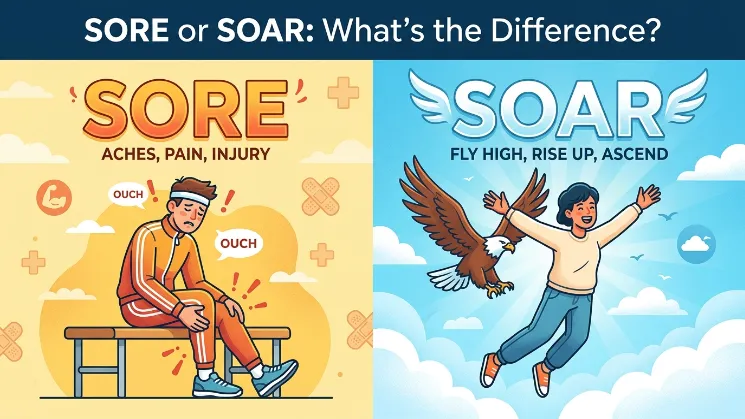
“Sore” relates to pain or irritation, while “soar” means to fly high or rise quickly. Their meanings are completely different.
You finish a long workout and say, “My legs are soar.” Someone quickly corrects you: “You mean sore.” Now you stop and wonder what exactly is the difference between sore and soar?
This confusion is extremely common because both words sound exactly the same. They are homophones, which means they share pronunciation but have different meanings and spellings. In spoken English, there’s no difference in sound, so many people accidentally mix them up in writing.
People search for “sore or soar” because they want to avoid embarrassing mistakes in school, professional writing, texting, or social media posts. Using the wrong word can completely change the meaning of a sentence.
The good news is that the difference is actually very easy once you understand the meanings. In this complete guide, you’ll learn the definitions, origins, grammar rules, common mistakes, real-life examples, and simple tricks to remember when to use sore and soar correctly.
Sore or Soar – Quick Answer
👉 Sore = Pain, irritation, or discomfort
👉 Soar = Fly high or rise rapidly
Examples:
- My muscles feel sore after exercise. ✅
- Eagles soar through the sky. ✅
❌ My muscles feel soar.
❌ Birds sore across the sky.
✔ Same pronunciation
✔ Different meanings
The Origin of Sore or Soar
Although these words sound alike today, they come from different origins.
Origin of “Sore”
The word sore comes from Old English:
- sār → meaning painful or injured
It has long been connected with:
- Pain
- Wounds
- Physical discomfort
Origin of “Soar”
The word soar comes from Old French:
- essorer → meaning to rise or fly upward
It became associated with:
- Birds flying high
- Rapid growth or increase
Even though the words evolved differently, modern pronunciation made them sound identical.
Sore vs Soar – Meaning Explained
What Does “Sore” Mean?
“Sore” describes:
- Physical pain
- Irritation
- Emotional hurt
Examples:
- I have a sore throat.
- Her feet feel sore after walking.
- He is still sore about losing the game.
What Does “Soar” Mean?
“Soar” means:
- To fly high in the air
- To increase rapidly
- To rise dramatically
Examples:
- Birds soar above mountains.
- Prices continue to soar.
- Her confidence began to soar.
British English vs American English Usage
Unlike spelling differences, this is a meaning difference, not a regional variation.
Key Point:
👉 Both British and American English use the same spellings and meanings.
Comparison Table
| Word | Meaning | Example |
|---|---|---|
| Sore | Pain or irritation | Sore muscles |
| Soar | Fly high or rise rapidly | Soar in the sky |
✔ Same rule worldwide
Which Word Should You Use?
Choosing between sore or soar depends entirely on meaning.
Use “sore” when talking about:
- Pain
- Injury
- Irritation
- Emotional hurt
Use “soar” when talking about:
- Flying
- Rising
- Rapid growth
- Success increasing
Quick Memory Trick:
👉 Sore = suffering
👉 Soar = sky
Common Mistakes with Sore or Soar
Mistake 1:
❌ My legs are soar after running.
✔️ My legs are sore after running.
Mistake 2:
❌ Birds sore through the clouds.
✔️ Birds soar through the clouds.
Mistake 3:
❌ Sales are sore this month.
✔️ Sales are soaring this month.
Mistake 4:
❌ I have a soar throat.
✔️ I have a sore throat.
Sore or Soar in Everyday Examples
Daily Life:
- My back feels sore today.
- The airplane began to soar.
Fitness:
- Your muscles may feel sore after exercise.
- Motivation can soar after progress.
Business:
- Profits continue to soar this year.
- Investors are still sore about losses.
Social Media:
- “Leg day got me so sore 😩”
- “Dream big and soar high ✨”
Sore or Soar – Google Trends & Usage Data
Search patterns show:
- “Sore throat” and “sore muscles” are highly searched health terms
- “Soar” appears frequently in:
- Business news
- Motivation quotes
- Aviation content
Key Insight:
👉 Confusion happens because pronunciation is identical
Common Search Errors:
- soar throat ❌
- muscles soar ❌
Comparison Table: Sore vs Soar
| Feature | Sore | Soar |
|---|---|---|
| Meaning | Pain or irritation | Fly high or rise |
| Word Type | Adjective | Verb |
| Context | Health/emotion | Movement/growth |
| Example | Sore muscles | Soar through sky |
| Pronunciation | Same as “soar” | Same as “sore” |
Sore vs Soar in Professional Writing
Healthcare:
- Patients may experience sore muscles
- “Soar” would be incorrect here
Business:
- Company profits continue to soar
- “Sore profits” would sound wrong
Academic Writing:
Correct usage matters because these words change sentence meaning completely.
Simple Trick to Remember the Difference
Remember This:
👉 Sore = pain
👉 Soar = sky
Visual Memory:
- “Sore” has “ore” like “hurt more”
- “Soar” has “oa” like “up and away”
These simple tricks help prevent mistakes quickly.
FAQs
1. Is it sore or soar muscles?
The correct phrase is sore muscles.
2. What does soar mean?
“Soar” means to fly high or rise rapidly.
3. Why are sore and soar confusing?
Because they sound exactly the same.
4. Is sore a noun or adjective?
“Sore” is usually an adjective.
5. Can soar mean emotional growth?
Yes, confidence or success can “soar.”
6. Is soar throat correct?
No, the correct phrase is sore throat.
7. Are sore and soar homophones?
Yes, they are homophones.
Conclusion
The confusion between sore or soar is very common because both words sound identical in spoken English. However, their meanings are completely different.
Use sore when talking about pain, irritation, injury, or emotional discomfort. Use soar when describing flying high, rising quickly, or increasing dramatically.
Even though the pronunciation is the same, choosing the wrong spelling can completely change the meaning of a sentence. That’s why understanding the difference is important for clear and professional communication.
The easiest way to remember is simple:
👉 Sore = pain
👉 Soar = rise
Once you connect each word with its meaning, the confusion disappears completely. Now you can confidently use sore or soar correctly in any situation.

Hi, I’m Evelyn Hartley. I love writing short stories that explore everyday life and the little emotions we all feel. I try to keep my words simple but meaningful, so readers can really connect with them.