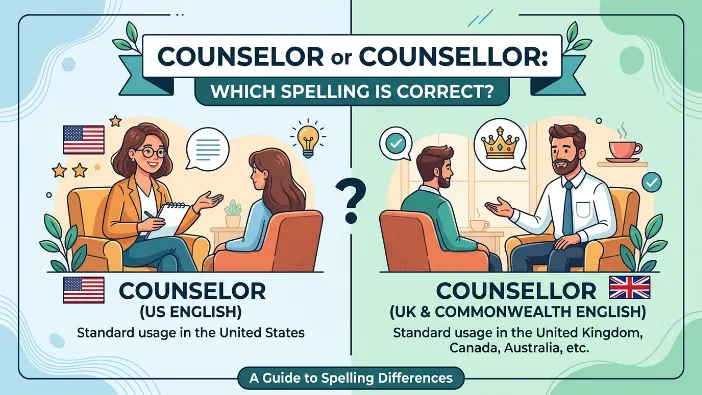
Both “counselor” and “counsellor” are correct. “Counselor” is used in American English, while “counsellor” is preferred in British English.
You are filling out a university application, searching for mental health support, or reading a job listing when you suddenly notice two spellings:
- counselor
- counsellor
Both seem professional. Both appear online. Both are used by real organizations.
So which one is actually correct?
This is one of the most common English spelling confusions because the answer depends on the type of English being used. Many people search for “counselor or counsellor” because they see both versions in schools, therapy services, government offices, and career guidance programs.
The confusion becomes even bigger online because American websites usually write “counselor,” while British, Canadian, and many Commonwealth countries often prefer “counsellor.” Since the words sound identical, many writers assume one spelling must be wrong.
But the reality is more interesting.
Both spellings are correct. The difference is mainly regional.
However, using the wrong spelling for your audience can make writing look inconsistent or unprofessional. That is especially important in academic writing, resumes, healthcare communication, SEO content, and official documents.
In this complete guide, you will learn:
- The correct spelling
- The difference between counselor and counsellor
- British vs American English rules
- Historical origins
- Professional usage examples
- Common writing mistakes
- SEO and Google trends
- Which spelling you should use for your audience
By the end, you will confidently know when to use counselor and when to use counsellor.
Counselor or Counsellor – Quick Answer
👉 Counselor = American English ✅
👉 Counsellor = British English ✅
Meaning:
Both words mean:
👉 A person who gives advice, guidance, therapy, or professional support.
Examples:
- The school counselor helped students choose careers. ✅
- The counsellor offered emotional support. ✅
✔ Both spellings are correct
✔ The difference is regional English usage
What Does Counselor or Counsellor Mean?
A counselor/counsellor is someone who provides:
- advice
- guidance
- therapy
- emotional support
- professional consultation
The word is commonly used in:
- schools
- psychology
- healthcare
- career guidance
- marriage therapy
- legal advising
- government roles
Common Types of Counselors/Counsellors:
| Type | Role |
|---|---|
| School counselor | Helps students academically and emotionally |
| Career counselor | Guides career decisions |
| Mental health counsellor | Provides emotional support |
| Marriage counsellor | Helps couples resolve problems |
| Camp counselor | Supervises children at camps |
The meaning stays the same regardless of spelling.
The Origin of Counselor and Counsellor
The word comes from the Latin root:
👉 consilium
Meaning:
👉 advice or consultation
Later, it moved into Old French and Middle English as forms related to:
- counsel
- counselor
- counsellor
The spelling difference developed over time as British and American English evolved separately.
Why Are There Two Spellings?
The difference follows a common English spelling pattern.
British English:
British English often keeps double consonants before suffixes.
Examples:
| British English | American English |
|---|---|
| Traveller | Traveler |
| Jewellery | Jewelry |
| Cancelled | Canceled |
| Counsellor | Counselor |
American English:
American English usually simplifies spelling.
That is why:
✔ counselor
becomes the preferred American form.
British English vs American English Spelling
This is the main difference.
American English
Preferred spelling:
✔ Counselor
Common in:
- United States
- American schools
- U.S. healthcare systems
- American psychology associations
British English
Preferred spelling:
✔ Counsellor
Common in:
- United Kingdom
- Canada
- Australia
- New Zealand
- Commonwealth countries
Counselor vs Counsellor – Comparison Table
| Feature | Counselor | Counsellor |
|---|---|---|
| English Type | American English | British English |
| Meaning | Same | Same |
| Pronunciation | Same | Same |
| Usage Region | USA | UK/Commonwealth |
| Correctness | Correct | Correct |
| Formal Writing | Accepted in US | Accepted in UK |
Which Spelling Should You Use?
Use “Counselor” When:
- writing for American audiences
- applying to U.S. schools
- creating U.S.-focused SEO content
- following American style guides
Use “Counsellor” When:
- writing for UK audiences
- writing in Canada or Australia
- following British English rules
- publishing in Commonwealth countries
For Global Audiences
Choose one style and stay consistent.
Do not mix:
❌ counselor + counsellor in the same article
Consistency improves professionalism and SEO quality.
Counselor vs Counsellor in Professional Contexts
In Schools
United States:
- school counselor
- guidance counselor
United Kingdom:
- school counsellor
- student counsellor
In Mental Health
American organizations prefer:
✔ licensed professional counselor
British organizations often use:
✔ mental health counsellor
In Career Services
Both spellings appear depending on country.
Examples:
- career counselor (US)
- career counsellor (UK)
In Government and Law
Some legal systems use:
- counselor-at-law
especially in American English.
Common Mistakes with Counselor or Counsellor
Mistake 1: Thinking One Is Wrong
Many people think only one spelling is correct.
Reality:
✔ Both are correct.
Mistake 2: Mixing English Styles
❌ The school counselor met the student counsellor.
This creates inconsistency.
Mistake 3: Ignoring Audience Location
Using British spelling for American institutions may look unusual.
Example:
❌ Harvard University counsellor
✔ Harvard University counselor
Mistake 4: Using Spell-Check Incorrectly
American spell-check tools may flag “counsellor.”
British spell-check tools may prefer “counsellor.”
Always match your regional language settings.
Counselor or Counsellor in Everyday Examples
In American English
- The counselor helped students prepare for college.
- She became a licensed mental health counselor.
- The camp counselor organized activities.
In British English
- The counsellor provided emotional guidance.
- The school counsellor met parents.
- She works as a marriage counsellor.
In Emails
- Please contact your academic counselor.
- Speak with the student counsellor for support.
In Job Listings
- Hiring: Career Counselor
- Vacancy: School Counsellor
Counselor vs Counsellor in SEO Writing
This topic is important in SEO because users search both spellings.
Search Intent Difference
American users often search:
- counselor near me
- school counselor
- mental health counselor
British/Commonwealth users search:
- counsellor near me
- relationship counsellor
- grief counsellor
SEO Strategy
Strong SEO articles usually:
- explain both spellings
- target both search variations
- clarify regional usage
- maintain one consistent style afterward
This improves:
- keyword coverage
- topical authority
- user trust
- search visibility
Google Trends & Usage Data
Usage patterns show:
“Counselor” dominates in:
- United States
- American universities
- U.S. mental health systems
- American websites
“Counsellor” dominates in:
- United Kingdom
- Canada
- Australia
- Commonwealth education systems
Trend Insight
Global search traffic contains both versions because English audiences are international.
That is why understanding regional spelling matters.
Why the Spelling Difference Matters
Some people think spelling differences are unimportant.
But they affect:
- professionalism
- audience trust
- SEO localization
- academic consistency
- brand voice
Example:
A UK therapy website using “counselor” everywhere may appear less localized to British readers.
Similarly, an American university using “counsellor” may look stylistically inconsistent.
Counselor vs Counsellor in Academic Writing
In American Academic Style
Use:
✔ counselor
Following:
- APA style
- American university standards
- U.S. educational systems
In British Academic Style
Use:
✔ counsellor
Following:
- Oxford-style spelling
- UK educational systems
- Commonwealth English rules
Related Word Differences
This spelling pattern appears in many English words.
Similar Examples
| American English | British English |
|---|---|
| Traveler | Traveller |
| Modeling | Modelling |
| Counseling | Counselling |
| Labeled | Labelled |
| Counselor | Counsellor |
Learning these patterns helps improve advanced English writing skills.
How Dictionaries Treat the Word
Major dictionaries recognize both spellings.
American dictionaries:
Usually prioritize:
✔ counselor
British dictionaries:
Usually prioritize:
✔ counsellor
This confirms that both forms are officially accepted.
Pronunciation Difference
There is no pronunciation difference.
Both are pronounced the same way.
Pronunciation:
👉 /ˈkaʊn.səl.ər/
That is another reason many people become confused.
The spelling changes, but the spoken sound stays identical.
Memory Tricks to Remember the Difference
Trick 1: Think About Country
- USA → simpler spelling → counselor
- UK → double consonants → counsellor
Trick 2: British English Loves Double Letters
Examples:
- traveller
- cancelled
- counsellor
Trick 3: Match the Audience
Always ask:
👉 “Am I writing for American or British readers?”
That instantly solves the confusion.
Counselor vs Counsellor in Formal and Informal Writing
Formal Writing
Always follow your regional style guide.
Examples:
- academic papers
- therapy websites
- official forms
- government communication
Informal Writing
Both are accepted as long as spelling stays consistent.
Examples:
- blogs
- social media
- casual emails
FAQs
1. Is it counselor or counsellor?
Both are correct. “Counselor” is American English, while “counsellor” is British English.
2. Which spelling is more common?
Globally, both are widely used depending on region.
3. Is counsellor incorrect in America?
Not technically, but “counselor” is strongly preferred.
4. Is counselor wrong in British English?
It is understood, but “counsellor” is preferred in UK English.
5. Do both words mean the same thing?
Yes. Both refer to someone who gives guidance or advice.
6. Which spelling should I use for SEO?
Use the version matching your target audience.
7. Why does British English use double “l”?
Because British spelling often keeps doubled consonants before suffixes.
8. Can I mix both spellings in one article?
No. Choose one style and stay consistent.
Conclusion
The confusion between counselor or counsellor is common because both spellings are correct and widely used. Unlike many spelling mistakes, this difference is not about right versus wrong it is about regional English style.
✔ “Counselor” is preferred in American English.
✔ “Counsellor” is preferred in British English and many Commonwealth countries.
Both words have the same pronunciation and meaning. They describe someone who provides advice, guidance, therapy, or emotional support.
The most important thing is consistency.
If you are writing for American readers, use “counselor.” If your audience is British, Canadian, Australian, or international Commonwealth readers, “counsellor” is usually the better choice.
Understanding this difference improves:
- professional writing
- academic accuracy
- SEO localization
- audience trust
- editorial consistency
The easiest way to remember the rule is:
👉 American English simplifies → counselor
👉 British English doubles letters → counsellor
Once you understand the regional pattern, choosing the correct spelling becomes easy.

Hi, I’m Evelyn Hartley. I love writing short stories that explore everyday life and the little emotions we all feel. I try to keep my words simple but meaningful, so readers can really connect with them.