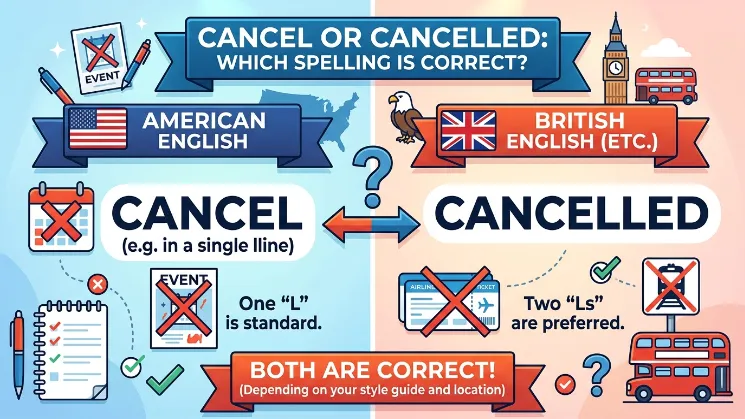
“Canceled” is American English, while “cancelled” is British English both are correct depending on your audience.
You’re writing an email: “The meeting has been cancelled.” Then your spell checker changes it to “canceled.” Now you’re stuck which one is actually correct?
This is one of the most common spelling confusions in English. People search for “cancel or cancelled” because both versions appear in real life on websites, in emails, in news articles, and even in official documents. The confusion usually comes from differences between British and American English, especially when dealing with words that double consonants.
At first glance, it seems like one must be wrong. But the truth is more nuanced. Both spellings are correct—they simply belong to different regional writing systems.
Understanding this difference is important, especially if you write professionally, create SEO content, or communicate with a global audience. Inconsistent spelling can affect credibility and clarity.
In this in-depth guide, you’ll learn the exact rule, origin, usage differences, real-world examples, common mistakes, and how to confidently choose between cancel or cancelled every time.
Cancel or Cancelled – Quick Answer
👉 Cancel = Base verb (same in US & UK)
👉 Canceled = American English past tense
👉 Cancelled = British English past tense
Meaning:
👉 To decide that something will not happen or continue
Examples:
- US: The event was canceled. ✅
- UK: The event was cancelled. ✅
✔ Both are correct
✔ Depends on region
The Origin of Cancel or Cancelled
The word cancel comes from Latin:
- Latin: cancellare (to cross out)
- Old French: canceler
Over time, it entered English as cancel, meaning to stop or nullify something.
Why does the spelling change?
The difference happens when adding -ed or -ing endings.
- American English → simplifies spelling
- British English → often doubles the consonant
British English vs American English Spelling
This is a classic spelling variation between US and UK English.
Key Rule:
- US English → canceled, canceling
- UK English → cancelled, cancelling
Comparison Table
| Form | British English | American English |
|---|---|---|
| Base Verb | Cancel | Cancel |
| Past Tense | Cancelled | Canceled |
| Continuous | Cancelling | Canceling |
Why Does British English Double the “L”?
This follows a broader spelling rule:
Rule:
👉 If a word ends in -l, British English often doubles it before adding a suffix.
Examples:
| British | American |
|---|---|
| Travelled | Traveled |
| Labelled | Labeled |
| Cancelled | Canceled |
Reason:
British English preserves older spelling patterns, while American English simplifies them.
Which Spelling Should You Use?
Choosing between canceled and cancelled depends on your audience.
Use “canceled” if:
- Writing for American audience
- Creating US-based SEO content
- Writing for US companies
Use “cancelled” if:
- Writing for UK, Pakistan, India, Australia
- Following British English rules
- Writing academic or formal content in Commonwealth countries
If your audience is global:
- Choose one style and stay consistent
- Many global platforms prefer canceled for simplicity
Common Mistakes with Cancel or Cancelled
Mistake 1:
❌ Mixing both spellings
✔️ Stay consistent
Mistake 2:
❌ Using “cancelled” in US-focused writing
✔️ Use canceled
Mistake 3:
❌ Using “canceled” in British exams
✔️ Use cancelled
Mistake 4:
❌ Thinking one is wrong
✔️ Both are correct
Cancel or Cancelled in Everyday Examples
In Emails:
- The meeting has been canceled (US)
- The meeting has been cancelled (UK)
In Business:
- The order was canceled
- The order was cancelled
On Social Media:
- “My plans got canceled 😢”
- “Trip cancelled due to weather”
In News:
- Flights were cancelled due to storms
- Events were canceled nationwide
Cancel or Cancelled – Google Trends & Usage Data
Usage patterns show:
- “Canceled” dominates in US-based searches
- “Cancelled” is widely used in UK and Commonwealth countries
Key Insight:
👉 Both are equally correct globally
👉 Usage depends on region and audience
Comparison Table: Cancel vs Cancelled
| Feature | Cancelled | Canceled |
|---|---|---|
| Spelling Style | British English | American English |
| “L” Usage | Double “ll” | Single “l” |
| Meaning | Same | Same |
| Usage Region | UK & Commonwealth | USA |
| Formality | Standard | Standard |
Cancel vs Other Similar Words
This pattern appears in many words:
| British | American |
|---|---|
| Cancelled | Canceled |
| Travelling | Traveling |
| Labelled | Labeled |
Understanding this pattern helps avoid similar mistakes.
FAQs
1. Is it cancel or cancelled?
“Cancel” is the base verb. “Cancelled” is the British past tense.
2. Is canceled correct?
Yes, it is correct in American English.
3. Which spelling is more common?
“Canceled” is more common globally online.
4. Can I use both in one article?
No, stay consistent with one style.
5. Which should I use in Pakistan?
British English is common, so cancelled is preferred.
6. Why does American English use one “l”?
To simplify spelling.
7. Are both accepted internationally?
Yes, both are correct depending on context.
Conclusion
The confusion between cancel or cancelled is very common, but once you understand the rule, it becomes simple. The base verb cancel remains the same in both British and American English. The difference appears when forming past tense or continuous forms.
In American English, the spelling is simplified to canceled and canceling, using a single “l.” In British English, the traditional form cancelled and cancelling is used, with a double “l.”
Neither spelling is wrong. The correct choice depends entirely on your audience and the writing style you are following. The most important rule is consistency mixing both styles in one document can make your writing look unprofessional.
If you are writing for a global audience, many writers choose canceled because of its wider online usage. However, in countries that follow British English, cancelled remains the preferred standard.
Now you can confidently use cancel or cancelled in any context, knowing exactly which form to choose and why.

Hi, I’m Liam Rivers, author at Engglory.com.
I’m an English grammar expert who simplifies spelling confusion and tricky grammar rules to help readers write and speak with confidence.