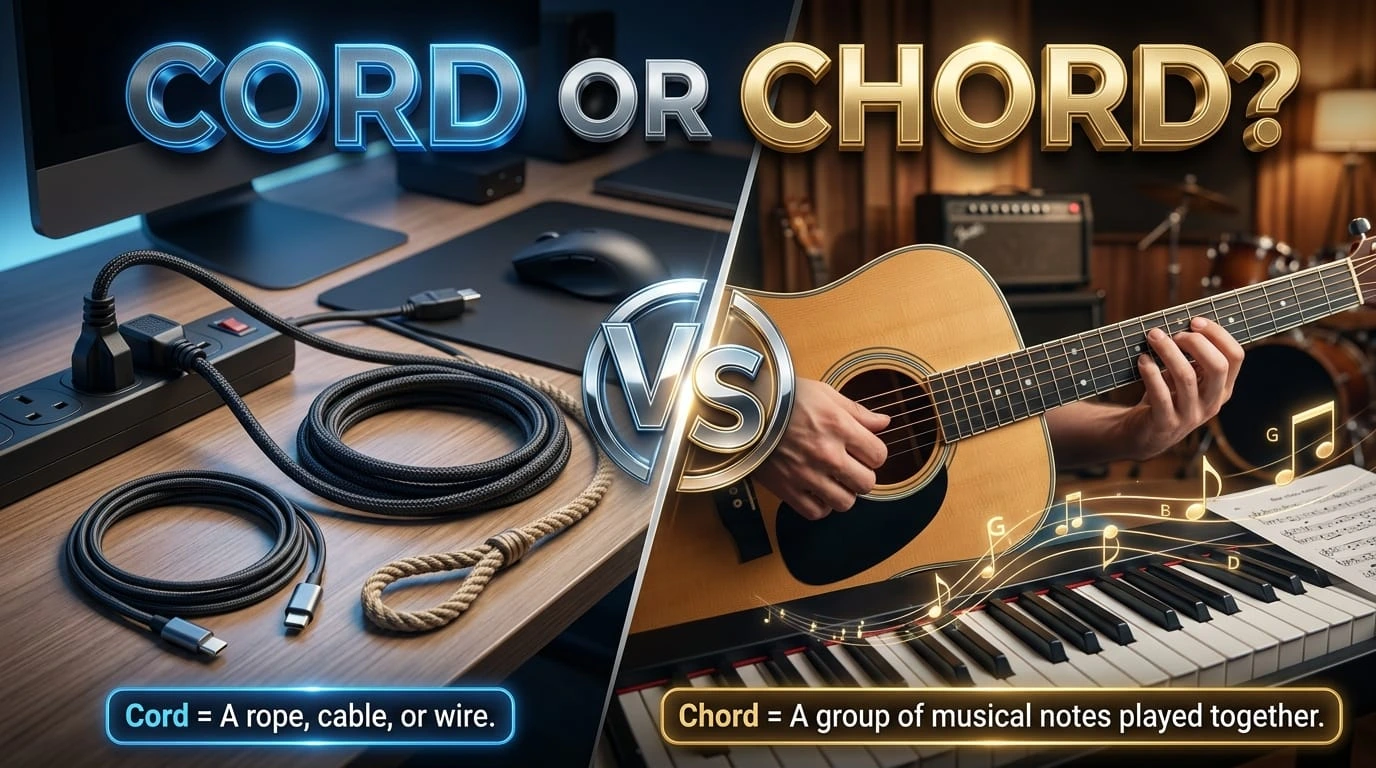
“Cord and chord are both correct English words, but they have completely different meanings. A cord is a rope, cable, or flexible string. A chord is a group of musical notes played together or, in mathematics, a straight line connecting two points on a curve.”
Have you ever typed “cord or chord” and wondered which spelling is correct? You’re not alone. These two words sound exactly the same, making them a common source of confusion for students, writers, musicians, and English learners.
The problem is simple. Since cord and chord are homophones, people often choose the wrong spelling without realizing it. A musician might accidentally write “guitar cord” instead of “guitar chord,” while someone talking about an extension cable may mistakenly write “extension chord.”
Fortunately, the difference is easy to remember once you understand what each word means and where it is used. In this guide, you’ll learn the meaning, history, spelling rules, examples, common mistakes, and practical tips to help you use the correct word every time.
By the end of this article, you’ll never have to second-guess cord or chord again.
Cord or Chord: Quick Answer
| Word | Meaning | Example |
| Cord | A rope, string, cable, or flexible wire | Please plug the power cord into the outlet. |
| Chord | A group of musical notes played together or a line joining two points on a curve | She learned a new guitar chord today. |
Quick Examples
✅ The extension cord is too short.
✅ She played a beautiful piano chord.
Simple rule:
- Cord = Rope, wire, cable
- Chord = Music or geometry
The Origin of Cord or Chord
Although these words sound identical today, they come from different historical roots.
Origin of “Cord”
The word cord comes from the Latin word chorda, meaning rope or string. It entered English through Old French and has referred to ropes, strings, cables, and flexible bindings for hundreds of years.
Examples include:
- Power cord
- Extension cord
- Rope cord
- Telephone cord
Origin of “Chord”
The word chord also traces back to the Greek and Latin word chorda, meaning string. In music, the meaning evolved because musical instruments used strings, and several strings played together created harmony.
Later, mathematicians borrowed the word to describe a straight line joining two points on a circle.
Today, chord has two main meanings:
- Musical harmony
- Geometric line segment
Although both words share ancient roots, English eventually gave them different spellings to separate their meanings.
British English vs American English Spelling
Unlike words such as colour/color or centre/center, cord and chord are not British and American spelling variations.
Both countries use exactly the same spellings.
| Meaning | British English | American English |
| Rope or cable | Cord | Cord |
| Musical notes | Chord | Chord |
Examples
British English:
- Please replace the power cord.
- She learned a piano chord.
American English:
- The charging cord is broken.
- Play the next guitar chord.
There is no regional spelling difference.
Which Spelling Should You Use?
The correct spelling depends entirely on the meaning you want to express.
Use Cord when talking about:
- Electrical cables
- Ropes
- Strings
- Flexible bindings
- Fabric trimming
Examples:
- Charging cord
- Extension cord
- Curtain cord
- Rope cord
Use Chord when talking about:
- Guitar music
- Piano music
- Singing harmony
- Music theory
- Geometry
Examples:
- C major chord
- Minor chord
- Guitar chord
- Chord progression
- Circle chord
Advice by Audience
| Audience | Recommended Word |
| US writers | Use the correct word based on meaning |
| UK writers | Same rule |
| Australia | Same rule |
| Canada | Same rule |
| International English | Same rule |
There is no regional preference.
Common Mistakes with Cord or Chord
These homophones often cause spelling mistakes.
Mistake 1
❌ Guitar cord
✅ Guitar chord
Mistake 2
❌ Extension chord
✅ Extension cord
Mistake 3
❌ Piano cord
✅ Piano chord
Mistake 4
❌ Charging chord
✅ Charging cord
Mistake 5
❌ Tie it with a chord.
✅ Tie it with a cord.
Easy Memory Trick
Think of the extra “H” in chord.
H = Harmony
Harmony belongs to music.
No H?
Then it’s probably cord.
Cord or Chord in Everyday Examples
Here are examples from everyday writing.
In Emails
Cord
Please bring the power cord for the projector.
Chord
Could you send me the guitar chord chart?
In News
Cord
Officials replaced damaged electrical cords after the storm.
Chord
The musician ended the concert with a powerful final chord.
On Social Media
Cord
I finally found my charging cord!
Chord
Just learned my first guitar chord!
In School Writing
Cord
The lamp uses a long power cord.
Chord
A major chord contains three musical notes.
In Professional Writing
Cord
Inspect the power cord before operating the machine.
Chord
The composition begins with a simple piano chord.
Cord or Chord: Google Trends & Usage Data
Search data shows that both words are popular, but people search for them in different situations.
“Cord” is commonly searched with:
- Extension cord
- Power cord
- Charging cord
- HDMI cord
- Electric cord
Countries with high usage include:
- United States
- Canada
- Australia
- United Kingdom
“Chord” is commonly searched with:
- Guitar chord
- Piano chord
- Chord chart
- Chord progression
- Major chord
Popular in countries with active music communities such as:
- United States
- United Kingdom
- Australia
- India
- Canada
Most searches for “cord or chord” happen because people hear the words spoken but are unsure which spelling matches the meaning.
Cord vs Chord Comparison Table
| Feature | Cord | Chord |
| Part of Speech | Noun | Noun |
| Pronunciation | /kɔːrd/ | /kɔːrd/ |
| Sounds the Same | Yes | Yes |
| Meaning | Rope, cable, string | Musical notes or geometric line |
| Used in Music | No | Yes |
| Used in Electronics | Yes | No |
| Used in Geometry | No | Yes |
| British Spelling | Cord | Chord |
| American Spelling | Cord | Chord |
Frequently Asked Questions
Q: Is it cord or chord for a guitar?
It is chord because music uses chords, not cords.
Q: Is it extension cord or extension chord?
The correct phrase is extension cord because it refers to an electrical cable.
Q: Why do cord and chord sound the same?
They are homophones, meaning they have the same pronunciation but different meanings and spellings.
Q: Is chord only used in music?
No. Besides music, chord is also used in geometry to describe a straight line connecting two points on a curve.
Q: Is cord ever used in music?
Not for musical harmony. However, a musical instrument may have a cord if it refers to a physical string or cable rather than musical notes.
Q: Are cord and chord interchangeable?
No. They have different meanings and cannot replace each other.
Q: How can I remember the difference?
Remember this simple trick:
Chord has an H for Harmony.
If you’re talking about music, use chord.
If you’re talking about ropes or cables, use cord.
Conclusion
Understanding the difference between cord or chord is much easier once you know what each word represents. Although they sound exactly alike, they belong in completely different contexts. A cord refers to a rope, cable, wire, or string used for physical purposes, while a chord refers to multiple musical notes played together or, in geometry, a line connecting two points on a curve.
The good news is that there is no British versus American spelling difference to remember. Writers around the world use the same spellings. The only thing that matters is the meaning of your sentence. If you’re talking about electricity, ropes, or cables, choose cord. If you’re discussing music or geometry, choose chord.
Whenever you’re unsure, use the simple memory trick: Chord has an “H” for Harmony. Keeping that one tip in mind will help you choose the correct spelling confidently in emails, school assignments, professional writing, and everyday conversations.

As an English language enthusiast, I love diving into the tricky details of word differences and spelling variations. My mission is to explain confusing terms and make them accessible to everyone, helping readers to communicate with clarity and confidence.