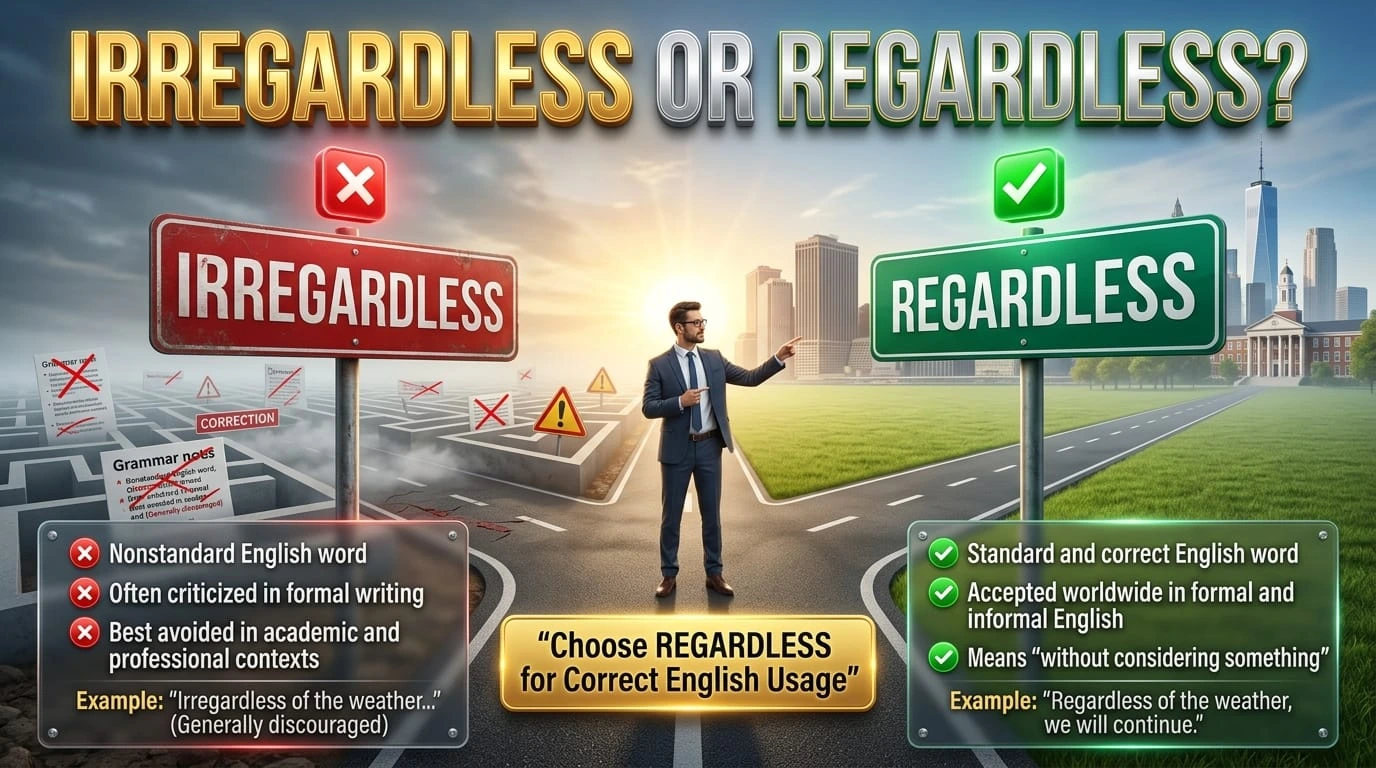
Regardless is the correct and standard English word meaning “despite conditions” or “without concern.”Irregardless exists but is considered non-standard and should be avoided in formal writing.
Many people stop while writing and wonder, “Should I use irregardless or regardless?” The confusion is very common because both words look similar and seem to carry the same meaning. If you break the words apart, regardless already means “without concern,” while irregardless adds another negative prefix. This makes many people question whether both words are correct or whether one should be avoided.
Students, bloggers, business writers, and English learners often search for this keyword because they want a fast answer and a clear rule. Some people hear irregardless in daily conversations and assume it is a proper word. Others see style guides warning against it and become unsure. This creates confusion in school work, business communication, and online content.
The good news is that the answer is simple. One word is standard and accepted everywhere. The other exists in dictionaries but is still widely viewed as non-standard in formal writing. In this guide, you will learn the correct usage, word history, common mistakes, regional usage patterns, and which choice works best for your audience.
Irregardless or Regardless: Quick Answer
Regardless is the correct and standard word in English.
It means without paying attention to something or despite conditions.
Examples:
- We will continue regardless of the weather.
- She finished the work regardless of the problems.
Irregardless exists, but it is usually considered non-standard and should be avoided in formal writing.
Example:
❌ We will continue irregardless of the weather.
✔ We will continue regardless of the weather.
The Origin of Irregardless or Regardless
The word regardless came into English many years ago and means without regard or concern.
Word parts:
- Regard = attention or concern
- Less = without
Together:
Regardless = without concern
Irregardless appeared later in everyday speech. Many language experts believe it developed by mixing words such as:
- Irrespective
- Regardless
People combined the forms and created irregardless.
Major dictionaries such as Merriam-Webster include irregardless because it is widely used in speech. However, style guides and editors still recommend using regardless in formal writing.
British English vs American English Spelling
There is no spelling difference between British and American English.
The issue is about standard versus non-standard usage, not regional spelling.
Comparison Table
| Feature | British English | American English |
| Regardless | Standard | Standard |
| Irregardless | Non-standard | Non-standard |
| Formal writing use | Yes | Yes |
Both regions strongly prefer regardless.
Which Spelling Should You Use?
The answer is very simple.
For US readers
Use regardless.
For UK and Commonwealth readers
Use regardless.
For global audiences
Use regardless.
Use it in:
- School writing
- Business communication
- Blogs
- News articles
- Academic papers
- Social media captions
Avoid irregardless if you want your writing to look polished and professional.
Common Mistakes with Irregardless or Regardless
People often make these mistakes:
| Mistake | Correction |
| Irregardless of the cost | Regardless of the cost |
| Irregardless of the result | Regardless of the result |
| Thinking both words are equal | Use regardless in standard writing |
| Using irregardless in formal work | Use regardless |
Examples:
❌ We moved forward irregardless of the delay.
✔ We moved forward regardless of the delay.
❌ She smiled irregardless of criticism.
✔ She smiled regardless of criticism.
Irregardless or Regardless in Everyday Examples
Emails
“We will proceed regardless of schedule changes.”
News
“The event continued regardless of heavy rain.”
Social Media
“I’m going on vacation regardless!”
Formal Writing
“The study continued regardless of external conditions.”
Daily Conversation
“I’ll support you regardless of what happens.”
Affective or Effective: Difference Explained With Examples (2026)
Why “Irregardless” Still Appears in Dictionaries
Many people are surprised to find irregardless in modern dictionaries. They assume that if a word appears in a dictionary, it must be correct for every situation. However, dictionaries and style guides have different purposes.
A dictionary records words that people actually use, even if those words are considered informal, non-standard, or controversial. Since irregardless has been used in spoken and written English for many years, dictionaries include it to describe its usage and meaning.
Style guides, on the other hand, tell writers which words are best for clear and professional communication. Most editors, teachers, and writing experts recommend regardless because it is the standard English form and is accepted in academic, business, and formal writing.
Irregardless or Regardless: Google Trends & Usage Data
Search behavior shows that many people look for irregardless or regardless because they hear both words in conversations.
General usage patterns show:
- United States: regardless is dominant
- United Kingdom: regardless is dominant
- Canada: regardless is preferred
- Australia: regardless is preferred
- Online speech and casual discussion: irregardless appears occasionally
People usually search this keyword for:
- Grammar questions
- School assignments
- Writing help
- Professional communication
- Language learning
Keyword Variation Comparison Table
| Feature | Regardless | Irregardless |
|---|---|---|
| Dictionary Status | Yes | Yes (non-standard) |
| Formal Writing | ✅ | ❌ |
| Business Emails | ✅ | ❌ |
| Academic Writing | ✅ | ❌ |
| Everyday Speech | ✅ | Sometimes |
| Recommended | ✅ | No |
FAQs
Is irregardless a real word?
Yes. Some dictionaries list it because people use it, but many style guides discourage it.
Which is correct, irregardless or regardless?
Regardless is the correct and standard choice.
Why do people say irregardless?
It likely developed by mixing words like irrespective and regardless.
Is irregardless grammatically wrong?
Many people consider it non-standard and avoid it in formal writing.
Can I use irregardless in business writing?
No. Use regardless instead.
Do British and American English use different versions?
No. Both prefer regardless.
Is regardless formal?
Yes. It is acceptable in both formal and informal writing.
Conclusion
The confusion between irregardless or regardless happens because both words sound natural and carry similar meanings. Many people hear irregardless in everyday speech and assume it is fully accepted. However, standard English writing follows a different rule.
Regardless is the correct and preferred word. It appears in dictionaries, schools, newspapers, professional documents, and business communication. It clearly means without concern or despite conditions. While irregardless does appear in some dictionaries because of its use in speech, many editors and style experts still consider it non-standard.
The safest approach is easy to remember. If you want writing that looks clear and professional, use regardless every time. This works for American English, British English, and international audiences. A simple choice helps your writing stay strong, natural, and correct.
Tennant or Tenant: Which Spelling Is Correct?

As an English language enthusiast, I love diving into the tricky details of word differences and spelling variations. My mission is to explain confusing terms and make them accessible to everyone, helping readers to communicate with clarity and confidence.