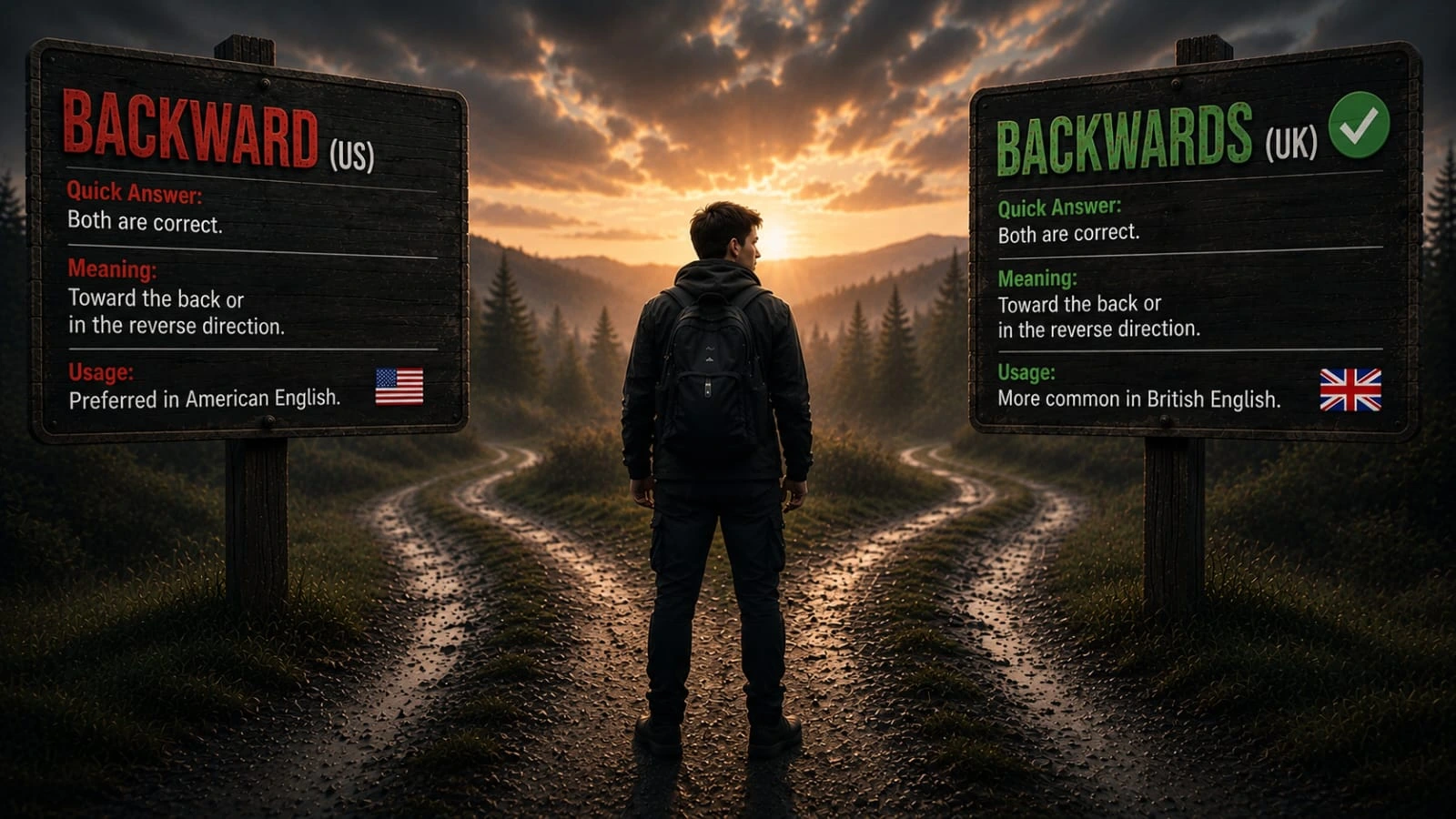
Both "backward" and "backwards" are correct. "Backward" is preferred in American English, while "backwards" is more common in British and Commonwealth English but only "backward" works as an adjective.
A few years ago, my friend from London texted me, “I walked backwards into the meeting room.” I almost replied, “It’s backward, not backwards.” Then I paused. Was I actually right?
Turns out, I wasn’t wrong but neither was she. Both spellings exist, and both are correct, depending on where you’re writing from.
This is one of those words that trips people up because dictionaries list both forms, style guides disagree, and nobody explains the actual rule clearly. If you’ve ever paused mid-sentence wondering which one to type, you’re not alone.
This guide breaks down exactly when to use “backward,” when to use “backwards,” and the one rule that never changes no matter which dialect you speak.
Backward or Backwards: Quick Answer
Both words are correct, but they split along regional lines.
- ✅ American English: “He looked backward before crossing the street.”
- ✅ British English: “He looked backwards before crossing the street.”
The real rule to remember: “backward” is always correct as an adjective, in both dialects. “Backwards” is never used as an adjective; only as an adverb.
- ✅ a backward glance (adjective)
- ❌ a backwards glance
The Origin of Backward/Backwards
“Backward” comes from Old English, combining “back” with the directional suffix “-weard,” meaning “in the direction of.” Over time, English speakers in different regions added an extra -s to some directional words, creating a second adverb form: “backwards.”
This -s pattern shows up in a whole family of words:
- toward → towards
- forward → forwards
- upward → upwards
- backward → backwards
American English mostly dropped the extra -s in the 1800s, favoring the shorter form. British English kept it, which is why the split still exists today. Neither version is “more correct”; they simply evolved along different paths on either side of the Atlantic.
British English vs American English Spelling
The core difference comes down to adverb usage, since the adjective form never changes.
| Context | American English | British English | Example |
| Adverb (action) | Backward | Backwards | He stepped backward(s) off the curb. |
| Adjective (describing) | Backward | Backward | A backward step in negotiations. |
| Formal/academic writing | Backward | Backwards | Both accepted, region-dependent |
| Idiomatic phrases | Backward | Backwards | “Bend over backwards” uses -s in both. |
Notice the idiom “bend over backwards” keeps the -s even in American English — idioms often resist the regional spelling rule entirely.
Which Spelling Should You Use?
- For American audiences → Use backward as your default adverb, and always as the adjective.
- For British or Commonwealth audiences (UK, Australia, Canada, India) → Use backwards as the adverb; the adjective still stays “backward.”
- For global or mixed audiences → Either works, but stay consistent throughout the same document.
- For academic or professional writing → Match your style guide (AP favors “backward”; many British style guides favor “backwards”).
Common Mistakes with Backward/Backwards
Mistake 1
Using “backwards” as an adjective
✅ That was a backward decision.
❌ That was a backwards decision.
Why it happens: Writers assume both forms work everywhere, without realizing the adjective never takes an -s.
Mistake 2
Mixing spellings within the same document
✅ He walked backward, then made another backward move.
❌ He walked backwards, then made another backward move.
Why it happens: Switching between American and British habits mid-document, often from copy-pasting or multiple writers.
Mistake 3
Assuming one spelling is simply “wrong”
✅ Both “backward” and “backwards” are correct, depending on dialect.
❌ “Backwards” is a typo for “backward.”
Why it happens: People assume American English spelling rules apply universally.
Mistake 4
Dropping the -s in a British idiom
✅ She bent over backwards to help.
❌ She bent over backward to help.
Why it happens: Some fixed idioms keep the -s regardless of dialect, and writers forget the exception.
Mistake 5
Overcorrecting in professional documents
✅ Check your house style guide, then stay consistent.
❌ Randomly switching between “backward” and “backwards” in the same report.
Why it happens: Writers aren’t aware their organization has a preferred style.
Backward/Backwards in Everyday Examples
Professional email
“Please don’t move the launch date backward; the client is expecting delivery by Friday.”
News headline
“Economists Warn of Backward Slide in Manufacturing Growth”
Social media post
“Sometimes you have to take one step backward to take two steps forward. 💪”
Formal document
“The committee noted a backward trend in quarterly revenue compared to last year.”
In each case, the word works whether you write “backward” or “backwards” as the adverb — just stay consistent with your dialect.
Backward/Backwards: Google Trends & Usage Data
Search interest for “backward vs backwards” is consistently informational, driven by writers, students, and editors double-checking usage before publishing. American users search “backward” more often, while UK, Australian, and Indian users lean toward “backwards” in everyday queries.
This mirrors broader regional spelling patterns seen in pairs like “toward/towards” and “forward/forwards”: proof that this isn’t a random inconsistency, but a consistent dialect-based pattern across English. Content aimed at global audiences benefits from acknowledging both forms rather than picking a “winner.”
Backward vs Backwards: Comparison Table
| Term/Variant | Meaning | Region/Context | Best Used When |
| Backward | Toward the back (adverb); describing something regressive (adjective) | American English (adverb); universal (adjective) | Adjective use; American adverb use |
| Backwards | Toward the back (adverb only) | British and Commonwealth English | UK/Australian/Canadian adverb use |
| Backwardly | Rare, informal variant | Uncommon in modern usage | Avoid in professional writing |
Frequently Asked Questions
Q: What does “backward” or “backwards” mean?
A: Both words describe movement or direction toward the back, or something regressive or old-fashioned. The meaning is identical: only the spelling differs by region.
Q: How do you use “backward” correctly in a sentence?
A: Use “backward” as the adjective in any dialect (“a backward step”) and as the adverb in American English (“he stepped backward”).
Q: Backward vs backwards: what’s the difference?
A: The difference is regional, not grammatical. American English favors “backward” as the adverb, while British English favors “backwards.” The adjective is always “backward.”
Q: Is “backwards” acceptable in formal writing?
A: Yes, especially in British, Australian, or Commonwealth contexts. American style guides like AP typically prefer “backward” instead.
Q: Which version is correct: backward or backwards?
A: Both are correct. Choose based on your audience’s dialect, and stay consistent throughout your writing.
Q: Where does “backward” come from?
A: It comes from Old English, combining “back” with the suffix “-weard,” meaning “in the direction of.” The extra -s in “backwards” developed later in some English dialects.
Q: Can “backwards” be used in idioms in American English?
A: Yes. Fixed idioms like “bend over backwards” keep the -s even in American writing, regardless of the usual adverb preference.
Final Takeaway
Here’s the short version. Both “backward” and “backwards” are correct: the choice depends on your audience, not on right versus wrong.
Key points to remember:
- The rule: “Backward” works everywhere as an adjective; “backwards” only works as an adverb
- Regional split: American English favors “backward”; British and Commonwealth English favor “backwards”
- Idioms are the exception: Phrases like “bend over backwards” keep the -s in every dialect
- Consistency matters: Pick one style per document and stick with it
Once you know your audience, choosing between “backward” and “backwards” becomes automatic.
Bookmark this guide so you never second-guess “backward” vs “backwards” again, and share it with anyone writing for an international audience.

As an English language enthusiast, I love diving into the tricky details of word differences and spelling variations. My mission is to explain confusing terms and make them accessible to everyone, helping readers to communicate with clarity and confidence.