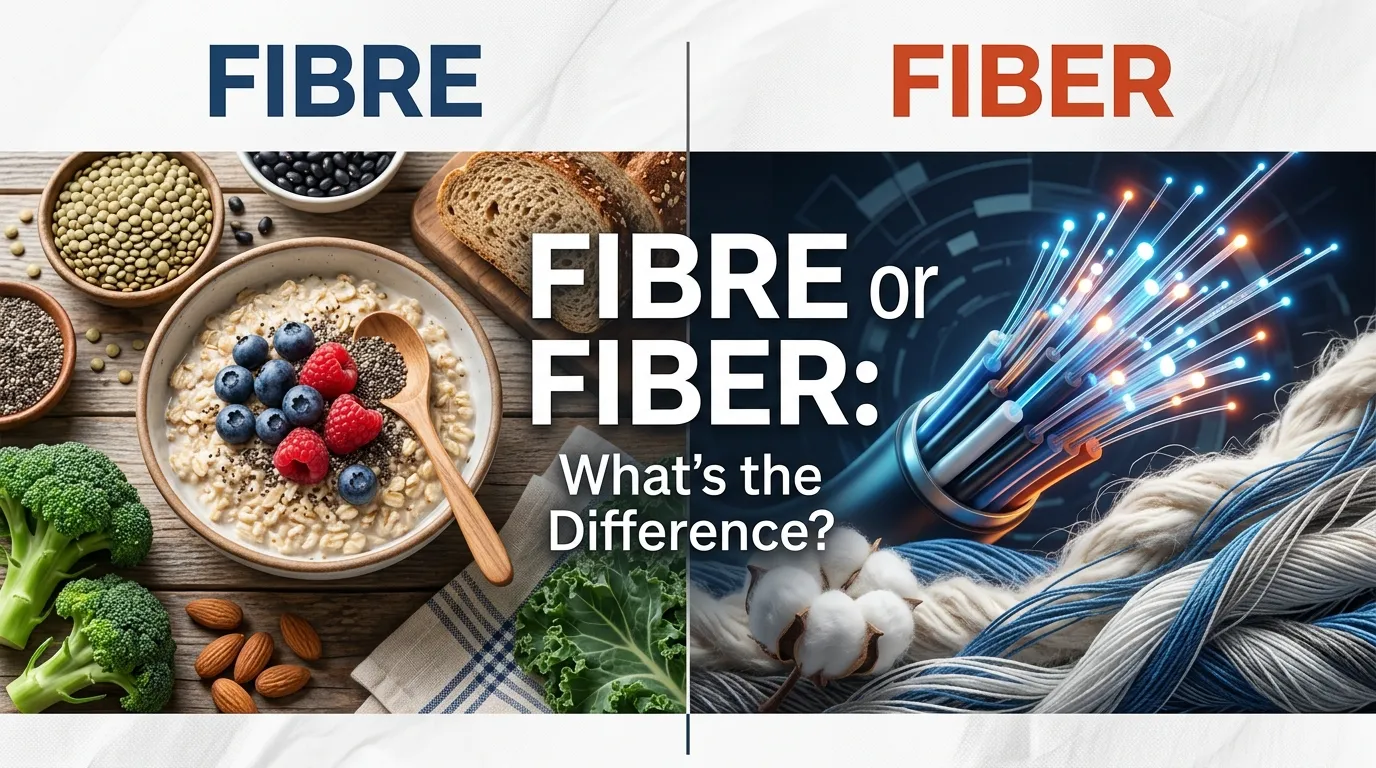
Both fibre and fiber are correct. Fibre is the preferred spelling in British English, while fiber is the standard spelling in American English. They have the same meaning and pronunciation.
You’re reading a nutrition label from the UK that says “high in fibre.” Later, you pick up an American health magazine recommending more “fiber” in your diet. Which spelling is correct?
The answer is simple: both are correct. The difference isn’t about meaning it’s about the variety of English you’re using.
Like colour/color, centre/center, and theatre/theater, fibre and fiber are regional spelling variations. Whether you’re talking about dietary fiber, optical fiber cables, or textile fibers, the spelling depends on your audience.
People search for “fibre or fiber” because they want to know:
- Which spelling is correct?
- Is fibre different from fiber?
- Which spelling is British?
- Which spelling is American?
- Which should I use in my writing?
In this guide, you’ll learn the meanings, regional differences, examples, common mistakes, and practical tips for choosing the correct spelling.
Fibre or Fiber: Quick Answer
| Word | British English | American English |
|---|---|---|
| Fibre | ✅ Standard | ❌ Less common |
| Fiber | ❌ Less common | ✅ Standard |
Examples
🇬🇧 A healthy diet contains plenty of fibre.
🇺🇸 A healthy diet contains plenty of fiber.
Both sentences are correct—they simply follow different spelling conventions.
Do Fibre and Fiber Mean the Same Thing?
Yes.
Both words refer to:
- dietary material found in plant foods
- thin strands used in textiles
- optical communication cables
- structural materials in plants and animals
The only difference is the spelling.
What Does Fibre/Fiber Mean?
The word can have several meanings depending on the context.
1. Nutrition
Dietary fibre (fiber) is the part of plant foods that helps digestion.
Example 1
Eating more fibre can improve digestive health.
Example 2
Doctors recommend increasing fiber intake.
2. Textiles
Fibres (fibers) are thin strands used to make fabric.
Example
Cotton fiber is widely used in clothing.
3. Technology
Fiber-optic cables transmit information using light.
British English usually writes:
fibre-optic cable
American English writes:
fiber-optic cable
Fibre vs Fiber: Comparison Table
| Feature | Fibre | Fiber |
|---|---|---|
| Correct spelling | ✅ | ✅ |
| British English | ✅ | ❌ |
| American English | ❌ | ✅ |
| Meaning | Same | Same |
| Pronunciation | Same | Same |
| Formal writing | Yes | Yes |
Which Spelling Should You Use?
The answer depends on your audience.
Use Fibre If You’re Writing For:
- the United Kingdom
- Australia
- New Zealand
- Ireland
- many Commonwealth countries
Examples
- Dietary fibre
- Fibre supplement
- Fibre broadband
Use Fiber If You’re Writing For:
- the United States
- American businesses
- U.S. publications
Examples
- Dietary fiber
- Fiber supplement
- Fiber optic cable
British vs American English
This is one of the classic spelling differences.
| British English | American English |
|---|---|
| Fibre | Fiber |
| Centre | Center |
| Theatre | Theater |
| Colour | Color |
| Favourite | Favorite |
If your article follows British English, use fibre consistently. If it follows American English, use fiber throughout.
Why People Confuse Fibre and Fiber
The confusion happens because:
Same Pronunciation
Both spellings sound identical.
Same Meaning
There is no difference in definition.
Regional Usage
Readers often encounter both spellings online.
International Websites
Many websites mix British and American spelling, causing uncertainty.
Common Uses of Fibre/Fiber
Nutrition
- dietary fibre
- soluble fibre
- insoluble fibre
Technology
- fibre optic cable
- fiber optic internet
Clothing
- natural fibres
- synthetic fibers
Construction
- glass fiber
- carbon fibre
Common Mistakes
Mistake #1
❌ Mixing fibre and fiber in the same article.
✅ Choose one spelling style and stay consistent.
Mistake #2
❌ Assuming one spelling is incorrect.
✅ Both are correct.
Mistake #3
❌ Using British spelling in an American publication without reason.
✅ Match your audience.
Mistake #4
❌ Thinking the meanings are different.
✅ They have the same meaning.
Everyday Examples
Health
Doctors recommend eating more fiber.
Doctors recommend eating more fibre.
Both are correct.
Internet
The neighborhood recently received fiber-optic internet.
The neighbourhood recently received fibre-optic internet.
Clothing
Natural fibres are breathable.
Natural fibers are durable.
Similar British and American Spellings
| British English | American English |
|---|---|
| Fibre | Fiber |
| Colour | Color |
| Centre | Center |
| Favourite | Favorite |
| Defence | Defense |
| Jewellery | Jewelry |
Memory Trick
Think about the ending.
👉 Fibre ends in -re, just like:
- centre
- theatre
These are British spellings.
👉 Fiber ends in -er, just like:
- center
- theater
These are American spellings.
FAQs
Is it fibre or fiber?
Both are correct. Fibre is British English, while fiber is American English.
Is there a difference in meaning?
No. The meanings are exactly the same.
Which spelling is used in the UK?
The UK uses fibre.
Which spelling is used in the United States?
The U.S. uses fiber.
Should I use fibre or fiber in my article?
Use the spelling that matches your audience and keep it consistent.
Is fiber optic correct?
Yes. That’s the standard American spelling.
Is fibre optic correct?
Yes. That’s the standard British spelling.
Conclusion
When comparing fibre or fiber, there’s no difference in meaning or pronunciation. The only distinction is the regional spelling convention.
Use fibre when writing in British English and fiber when writing in American English. Whether you’re discussing nutrition, textiles, or technology, both spellings describe the same thing.
The simplest rule is:
👉 British English = Fibre 🇬🇧
👉 American English = Fiber 🇺🇸
Choose the spelling that matches your audience, use it consistently throughout your writing, and you’ll never go wrong.

Hi, I’m Liam Rivers, author at Engglory.com.
I’m an English grammar expert who simplifies spelling confusion and tricky grammar rules to help readers write and speak with confidence.