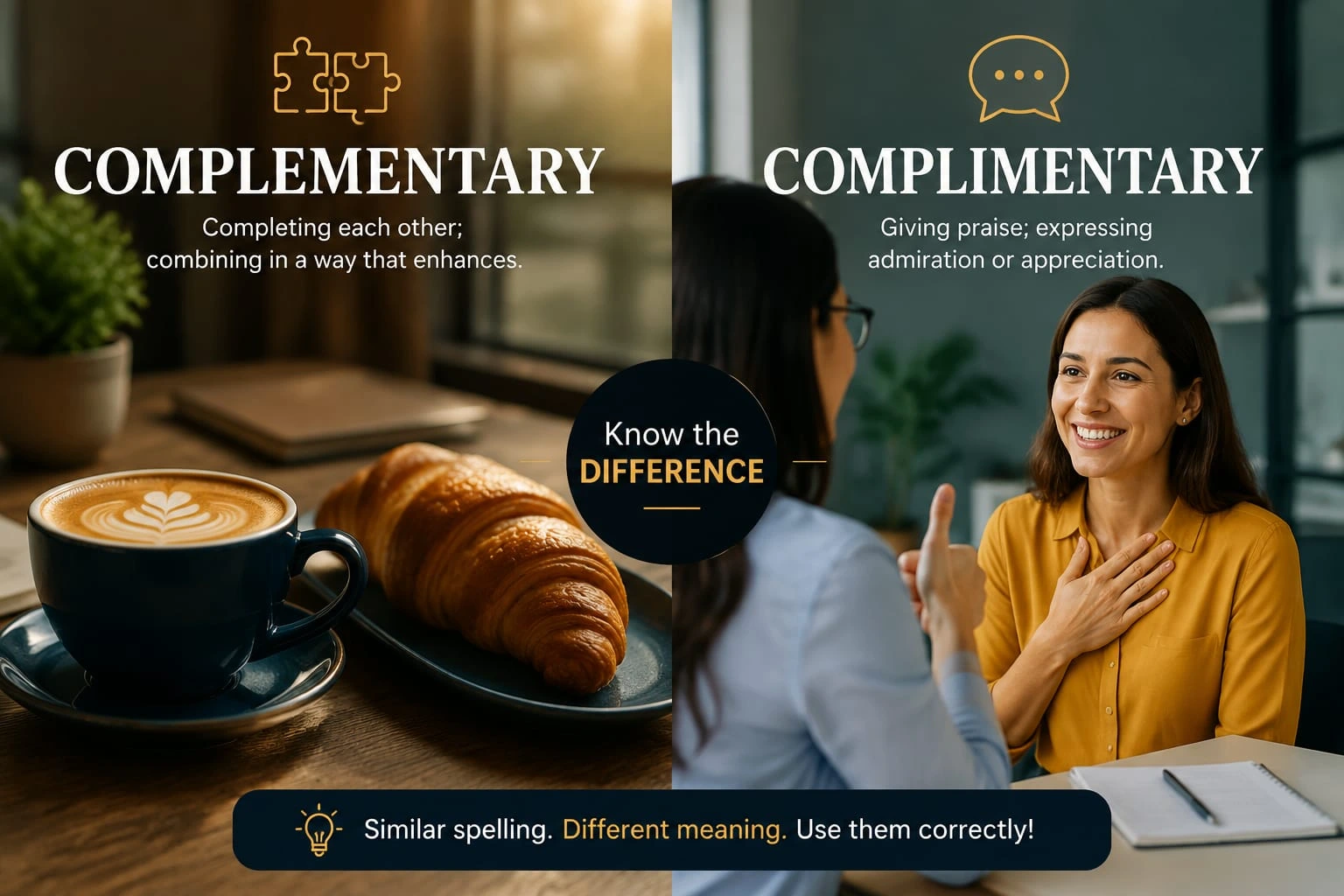
Complementary means something that completes or goes well with another thing. Complimentary means free of charge or expressing praise. ____________________________________________________________________________________________
Have you ever paused while writing an email and wondered whether you should write complementary or complimentary? You are not alone. These two English words look almost identical, sound very similar, and are often confused by native and non-native speakers alike.
The confusion usually happens because only one extra letter changes the meaning completely. Many people accidentally write complimentary breakfast when they mean something that goes well together, or they use complementary colors when talking about free hotel services. A simple spelling mistake can change your message and even make your writing look less professional.
This guide clears up the confusion once and for all. You’ll learn the difference between complementary and complimentary, where each word comes from, how British and American English use them, common mistakes to avoid, and real-life examples you can copy. By the end, you’ll know exactly which word fits every situation.
Complementary or Complimentary: Quick Answer
The difference is simple:
| Word | Meaning | Example |
| Complementary | Something that completes, improves, or matches another thing | Blue and orange are complementary colors. |
| Complimentary | Free of charge or expressing praise | Guests received a complimentary breakfast. |
Easy Trick to Remember
- Complementary = Complete
- Both contain “e”.
- If something completes another thing, use complementary.
- Complimentary = Compliment
- Both come from compliment.
- If something is free or full of praise, use complimentary.
Quick Examples
✅ The wine is complementary to the meal.
✅ We received complimentary tickets.
The Origin of Complementary or Complimentary
Although these words look alike today, they come from different Latin roots.
Origin of Complementary
The word complementary comes from the Latin word complementum, meaning something that fills up or completes.
Over time, English speakers began using it to describe things that:
- Complete each other
- Improve one another
- Work well together
Examples include:
- Complementary colors
- Complementary skills
- Complementary products
Origin of Complimentary
The word complimentary comes from compliment, which traces back to Italian and Spanish words related to polite expressions and praise.
Later, businesses started using complimentary to describe something given free as a gesture of goodwill.
Examples include:
- Complimentary drinks
- Complimentary breakfast
- Complimentary parking
Why the Confusion Exists
Both words:
- Sound almost the same.
- Share many letters.
- Have similar pronunciation.
However, their meanings are completely different.
One means matching or completing.
The other means free or expressing praise.
British English vs American English Spelling
Unlike many English words, there is no spelling difference between British and American English.
Both countries spell the words exactly the same.
The only challenge is choosing the correct word based on meaning.
Comparison Table
| Meaning | Correct Word | British English | American English |
| Goes well together | Complementary | ✅ Complementary | ✅ Complementary |
| Completes another thing | Complementary | ✅ Same | ✅ Same |
| Given free | Complimentary | ✅ Complimentary | ✅ Complimentary |
| Expressing praise | Complimentary | ✅ Complimentary | ✅ Complimentary |
Examples
British English:
- The hotel offers complimentary tea.
- The curtains are complementary to the furniture.
American English:
- Every guest received a complimentary drink.
- These software tools are complementary.
There is no regional spelling preference.
Which Spelling Should You Use?
The correct choice depends entirely on what you want to say.
Use Complementary if you mean:
- Matching
- Completing
- Improving another thing
- Working together
Examples:
- Complementary colors
- Complementary skills
- Complementary products
- Complementary services
Use Complimentary if you mean:
- Free of charge
- Showing admiration
- Expressing praise
Examples:
- Complimentary coffee
- Complimentary tickets
- Complimentary remarks
- Complimentary upgrade
Advice for Different Audiences
| Audience | Recommended Usage |
| United States | Use the meaning, not location. |
| United Kingdom | Same rule applies. |
| Australia | Same spelling. |
| Canada | Same spelling. |
| International English | Choose the word based on meaning only. |
There is no British vs American preference here.
Common Mistakes with Complementary or Complimentary
Many writers mix these words because they sound alike.
Here are the most common errors.
| Incorrect | Correct |
| Complimentary colors | Complementary colors |
| Complementary breakfast | Complimentary breakfast |
| Complimentary skills | Complementary skills |
| Complementary tickets | Complimentary tickets |
| Complimentary software tools | Complementary software tools |
Wrong❌
The hotel offers complementary breakfast.
Right✅
The hotel offers complimentary breakfast.
Wrong❌
Red and green are complimentary colors.
Right✅
Red and green are complementary colors.
Wrong❌
Their personalities are complimentary.
Right✅
Their personalities are complementary.
Wrong❌
We received complementary tickets.
Right✅
We received complimentary tickets.
Complementary or Complimentary in Everyday Examples
Here is how these words appear in daily writing.
Emails
✅ We are pleased to offer you a complimentary consultation.
✅ Your experience is complementary to our team’s expertise.
Business Writing
- Complimentary shipping
- Complimentary gift
- Complementary products
- Complementary services
News
“The restaurant now offers complimentary desserts on weekends.”
“The two companies provide complementary technologies.”
Social Media
“Our hotel includes a complimentary breakfast.”
“Our new colors are complementary, creating a balanced design.”
Academic Writing
“The findings are complementary rather than contradictory.”
“The reviewer was highly complimentary about the research.”
Complementary or Complimentary: Google Trends & Usage Data
Search data shows that many users search for complementary or complimentary because they are unsure which spelling matches their intended meaning.
Popular Search Queries
- complementary or complimentary
- complementary meaning
- complimentary meaning
- complimentary vs complementary
- complimentary breakfast
- complementary colors
- complimentary ticket
- complementary skills
Countries Where Confusion Is Common
- United States
- United Kingdom
- Canada
- Australia
- India
Usage by Context
| Context | Correct Word |
| Hotels | Complimentary |
| Restaurants | Complimentary |
| Customer service | Complimentary |
| Design | Complementary |
| Education | Complementary |
| Business partnerships | Complementary |
| Marketing gifts | Complimentary |
Although complimentary appears often in hospitality and customer service, complementary is more common in education, design, science, and business strategy.
Complementary vs Complimentary Comparison
| Feature | Complementary | Complimentary |
| Meaning | Completes another thing | Free or praising |
| Related Word | Complement | Compliment |
| Used in Design | ✅ Yes | ❌ No |
| Used in Hotels | ❌ Rare | ✅ Yes |
| Used in Business | ✅ Yes | ✅ Sometimes |
| Used for Praise | ❌ No | ✅ Yes |
| Used for Free Services | ❌ No | ✅ Yes |
Frequently Asked Questions
Q: Is it complementary or complimentary breakfast?
A: Complimentary breakfast is correct because the meal is provided free of charge.
Q: Is it complementary or complimentary colors?
A: Complementary colors is correct because the colors work well together and complete each other.
Q: Is complimentary the same as free?
A: Often, yes. In hotels, restaurants, and businesses, complimentary usually means free of charge.
Q: Does complementary mean matching?
A: Yes. It means things complete or enhance each other rather than being identical.
Q: Which word relates to compliments?
A: Complimentary relates to compliments, praise, and polite admiration.
Q: Which word is used in business?
A: Both are used, but in different ways.
- Complementary products work well together.
- Complimentary gifts are given for free.
Q: Is there a British or American spelling difference?
A: No. Both complementary and complimentary are spelled the same in British and American English.
Conclusion
The difference between complementary and complimentary becomes easy once you focus on the meaning rather than the spelling. Complementary describes things that complete, enhance, or work well with each other. You’ll often see it used for colors, skills, products, services, and ideas that naturally fit together. Complimentary, on the other hand, refers to something given free of charge or words that express praise and admiration. It is common in hotels, restaurants, customer service, and professional communication.
A simple memory trick can help you choose correctly every time. Think of complementary as something that completes, and complimentary as something related to a compliment or a free gift. Since both British and American English use the same spellings, your decision depends entirely on the context. By understanding the distinction and practicing with everyday examples, you can avoid one of the most common English writing mistakes and communicate with confidence.
Read More: Accept or Except: What’s The Difference?

As an English language enthusiast, I love diving into the tricky details of word differences and spelling variations. My mission is to explain confusing terms and make them accessible to everyone, helping readers to communicate with clarity and confidence.