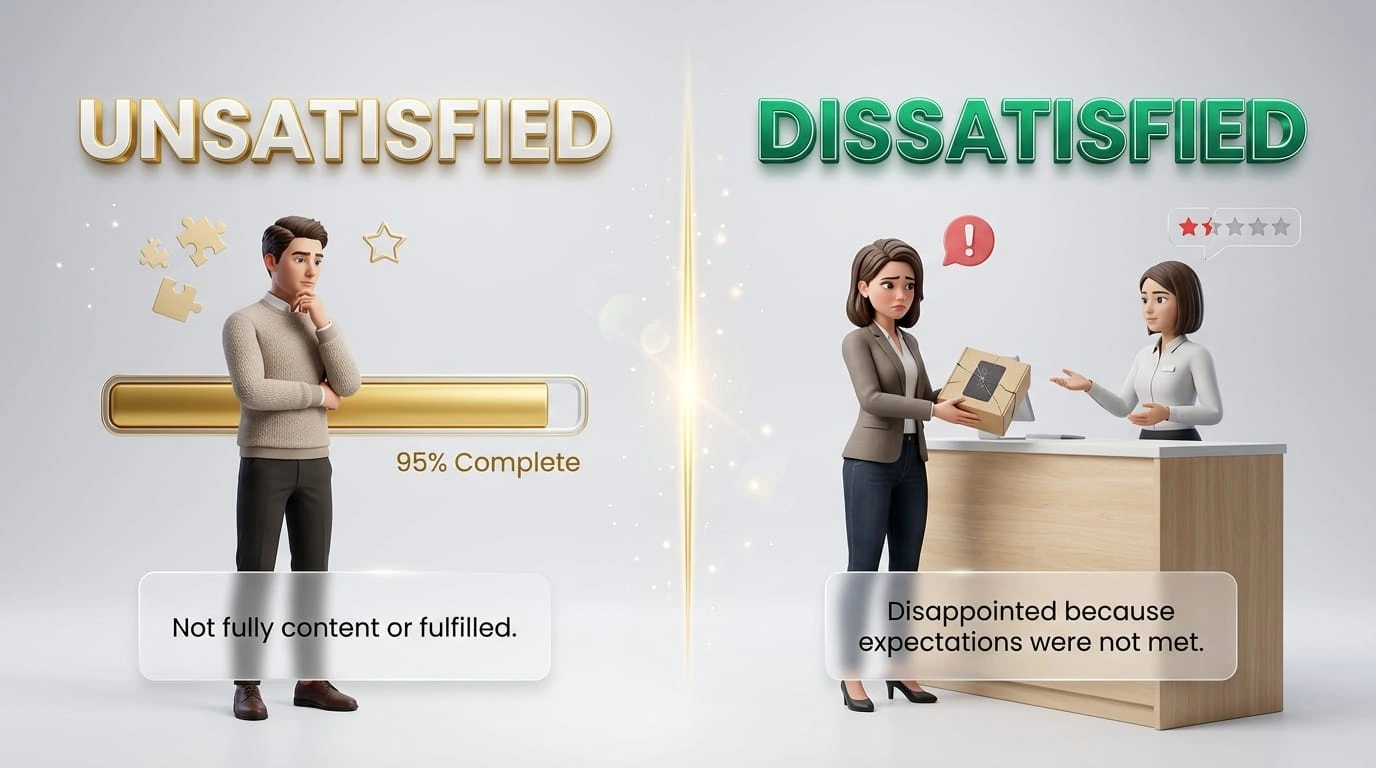
” Unsatisfied means not fully fulfilled or not enough, while dissatisfied means unhappy or disappointed with something. Although both words describe a lack of satisfaction, they are not always interchangeable.” ___________________________________________________________________________________________
A while ago, I was reviewing a customer’s feedback email that read, “I am unsatisfied with your service.” The sentence wasn’t technically wrong, but it didn’t sound quite right. In most customer service situations, native English speakers would naturally say, “I am dissatisfied with your service.” That small word choice changed the tone and made the message sound much more natural.
If you’ve ever wondered whether to use unsatisfied or dissatisfied, you’re not alone. These two words look similar and both suggest that something isn’t satisfactory. Because of that, many English learners and even native speakers use them interchangeably without realizing there is a subtle but important difference.
The good news is that the distinction is easy to understand once you know what each word really means. In this guide, you’ll learn when to use unsatisfied, when dissatisfied is the better choice, and how to avoid one of the most common vocabulary mistakes in English. By the end, you’ll be able to choose the right word with confidence in everyday conversations, professional writing, and academic work.
Unsatisfied or Dissatisfied: Quick Answer
Both unsatisfied and dissatisfied describe a lack of satisfaction, but they focus on different ideas.
- Unsatisfied means not fully fulfilled, completed, or achieved.
- Dissatisfied means unhappy, disappointed, or displeased with something.
Examples
✅ I still feel unsatisfied after eating lunch.
✅ The customer was dissatisfied with the quality of the product.
The Simple Rule
Think of it this way:
- Unsatisfied = Something is still missing.
- Dissatisfied = You don’t like what you received.
This simple distinction works in most situations.
The Origin of Unsatisfied or Dissatisfied
Understanding the history of these words makes their meanings much easier to remember.
Both words come from the verb satisfy, which entered English through Old French and ultimately comes from the Latin word satisfacere, meaning to do enough, fulfill, or meet a need.
As English evolved, two different prefixes created two related but distinct words.
Unsatisfied
The prefix un- usually means not or lacking.
So:
- satisfied = fulfilled
- unsatisfied = not fulfilled
The emphasis is on something that remains incomplete or unmet.
For example:
- An unsatisfied appetite
- An unsatisfied desire
- An unsatisfied requirement
In each case, something is still lacking.
Dissatisfied
The prefix dis- often expresses opposition, reversal, or a negative feeling.
So:
- satisfied = pleased
- dissatisfied = not pleased
The emphasis shifts from what is missing to how someone feels.
Examples include:
- A dissatisfied customer
- A dissatisfied employee
- Dissatisfied voters
- Dissatisfied clients
These people are unhappy because their expectations were not met.
Why Are They So Easy to Confuse?
The confusion happens because both words begin with a negative prefix and both relate to satisfaction.
However, their meanings developed in slightly different directions over time.
- Unsatisfied focuses on an unfulfilled need or desire.
- Dissatisfied focuses on disappointment or unhappiness.
Once you remember that difference, choosing the right word becomes much easier.
Unsatisfied or Dissatisfied Explained: Key Differences
Although these words are closely related, they are not perfect synonyms.
The biggest difference is what they describe.
| Term | Meaning | Best Used For | Typical Context |
| Unsatisfied | Not fulfilled or not enough | Needs, desires, curiosity, goals | Personal feelings, needs, achievements |
| Dissatisfied | Unhappy or disappointed | Opinions, experiences, services, products | Customer service, workplaces, reviews |
When to Use Unsatisfied
Choose unsatisfied when talking about something that remains incomplete or has not been fully met.
Common examples include:
- Hunger
- Curiosity
- Ambition
- Goals
- Needs
- Expectations (in some contexts)
Examples
- I left the restaurant feeling unsatisfied because the meal was too small.
- His curiosity remained unsatisfied after the lecture.
- She has an unsatisfied desire to travel the world.
- The team’s need for better equipment is still unsatisfied.
Notice that these examples focus on something that is lacking rather than a complaint.
When to Use Dissatisfied
Use dissatisfied when someone feels unhappy, disappointed, or critical about something they experienced.
This word often appears in customer service, business, education, and workplace communication.
Examples
- Many customers were dissatisfied with the delivery service.
- Employees are dissatisfied with the recent salary changes.
- The teacher was dissatisfied with the student’s effort.
- Residents are dissatisfied with the city’s transportation system.
In each example, the speaker expresses a negative opinion rather than an unmet need.
Can They Ever Be Interchangeable?
Sometimes, yes—but not always.
For example:
✅ I was unsatisfied with the amount of food.
✅ I was dissatisfied with the quality of the food.
The first sentence means there wasn’t enough food.
The second means the food wasn’t good enough.
That small difference changes the meaning.
A Simple Memory Trick
Here’s an easy way to remember:
- Unsatisfied = Unfulfilled
- Dissatisfied = Disappointed
Ask yourself one question:
Is something missing, or am I unhappy?
- If something is missing, choose unsatisfied.
- If you’re unhappy with what you got, choose dissatisfied.
This quick test works in most real-life writing situations and helps you avoid choosing the wrong word.
British English vs American English Spelling
Unlike many confusing English word pairs, unsatisfied and dissatisfied are not a British English vs American English spelling issue.
Both words are spelled exactly the same in:
- American English (US)
- British English (UK)
- Canadian English
- Australian English
- New Zealand English
The confusion comes from meaning, not spelling.
For example:
| English Variety | Preferred Spelling | Example |
| American English | Unsatisfied | She felt unsatisfied after the meeting. |
| American English | Dissatisfied | Customers were dissatisfied with the service. |
| British English | Unsatisfied | His curiosity remained unsatisfied. |
| British English | Dissatisfied | Many workers were dissatisfied with the decision. |
Key Takeaway
Whether you’re writing for readers in the United States, the United Kingdom, or anywhere else, the spellings stay the same. Your choice depends entirely on meaning and context.
Which Word Should You Use?
Choosing between unsatisfied and dissatisfied becomes easy once you think about what you want to express.
For American English Writers
Use unsatisfied when talking about needs, goals, or desires that remain unfulfilled.
Use dissatisfied when expressing disappointment with a product, service, or experience.
For British and Commonwealth Writers
The same rule applies.
British English makes no distinction in spelling, only in meaning.
For Global Audiences
If you’re writing for an international audience, choose the word that matches your message.
- Unsatisfied → Something is still lacking.
- Dissatisfied → Someone is unhappy or disappointed.
Quick Advice
If you’re writing:
- A customer review → Dissatisfied
- A complaint letter → Dissatisfied
- About hunger → Unsatisfied
- About curiosity → Unsatisfied
- About personal goals → Unsatisfied
- About poor service → Dissatisfied
Common Mistakes with Unsatisfied or Dissatisfied
Many writers know both words exist but aren’t sure which one fits a particular sentence.
Here are some common mistakes.
| Mistake | Correct | Reason |
| I am unsatisfied with your customer service. | I am dissatisfied with your customer service. | Customer complaints express disappointment. |
| The meal left me dissatisfied because I was still hungry. | The meal left me unsatisfied because I was still hungry. | Hunger is an unmet need. |
| Employees felt unsatisfied with management. | Employees felt dissatisfied with management. | They are unhappy, not lacking something. |
| My curiosity is dissatisfied. | My curiosity is unsatisfied. | Curiosity remains unfulfilled. |
| She felt unsatisfied with the poor quality. | She felt dissatisfied with the poor quality. | Quality affects opinions and satisfaction. |
Why These Mistakes Happen
Both words come from satisfy, so many people assume they mean exactly the same thing.
In reality:
- Unsatisfied describes an unmet need.
- Dissatisfied describes a negative opinion or feeling.
Keeping that difference in mind makes choosing the correct word much easier.
Unsatisfied or Dissatisfied in Everyday Examples
Seeing the words in real-life situations helps reinforce their meanings.
Professional Email
We are dissatisfied with the delayed delivery and request an update on our order.
News Headline
Residents remain dissatisfied with the city’s public transportation system.
Social Media Post
I finished dinner, but I’m still unsatisfied. Time for dessert!
Formal Report
Survey results showed that many employees were dissatisfied with workplace communication.
Everyday Conversation
Even after achieving his promotion, he felt unsatisfied because he wanted a better work-life balance.
These examples show that unsatisfied often relates to an unmet need, while dissatisfied usually expresses disappointment.
Unsatisfied or Dissatisfied: Google Trends & Usage Data
People around the world frequently search for unsatisfied or dissatisfied because the two words appear similar but are used differently.
Search Intent
The primary search intent is:
- Informational
Most users want to know which word is correct for a specific sentence or situation.
Countries Where This Topic Is Popular
Searches commonly come from:
- United States
- United Kingdom
- Canada
- Australia
- India
- Pakistan
- Philippines
Who Searches This Keyword?
Typical audiences include:
- Students
- English learners
- Teachers
- Bloggers
- Content writers
- Editors
- Business professionals
Usage Insight
In everyday English, dissatisfied appears more often in business, customer service, reviews, and workplace communication because people frequently describe their opinions about products and services.
Meanwhile, unsatisfied is more common when discussing personal needs, desires, ambitions, or curiosity.
Understanding this difference helps your writing sound more natural and accurate.
Comparison Table
| Word | Meaning | Typical Context | Best Used When |
| Unsatisfied | Not fulfilled or still lacking | Needs, hunger, curiosity, goals | Something remains incomplete |
| Dissatisfied | Unhappy or disappointed | Reviews, workplaces, customer service | Expressing a negative opinion |
FAQs
Q1: What is the difference between unsatisfied and dissatisfied?
Unsatisfied means something has not been fully fulfilled, while dissatisfied means someone feels unhappy or disappointed.
Q2: Can unsatisfied and dissatisfied be used interchangeably?
Sometimes, but not always. The correct choice depends on whether you’re talking about an unmet need (unsatisfied) or a negative opinion (dissatisfied).
Q3: Is unsatisfied grammatically correct?
Yes. Unsatisfied is a standard English word used when needs, desires, or goals remain unfulfilled.
Q4: Is dissatisfied stronger than unsatisfied?
Often, yes. Dissatisfied usually suggests a stronger feeling of disappointment or criticism than unsatisfied.
Q5: Which word should I use in a customer complaint?
Use dissatisfied. Customer complaints express disappointment with a product, service, or experience.
Q6: Can I say “I am unsatisfied with the service”?
It’s grammatically correct, but I am dissatisfied with the service sounds much more natural to native English speakers.
Q7: Are these words spelled differently in British and American English?
No. Both unsatisfied and dissatisfied have the same spelling in British and American English. The difference lies in their meaning, not their spelling.
Conclusion
Choosing between unsatisfied and dissatisfied is easier once you understand the idea behind each word. Although both describe a lack of satisfaction, they focus on different situations.
Use unsatisfied when talking about something that remains incomplete or unfulfilled, such as hunger, curiosity, ambitions, or personal goals. It tells readers that something is still missing.
Use dissatisfied when expressing disappointment or unhappiness with a product, service, decision, or experience. This is the word you’ll often see in customer reviews, workplace feedback, and formal complaints.
Remember this simple rule: unsatisfied means unfulfilled, while dissatisfied means disappointed. Keeping this distinction in mind will make your writing clearer, more accurate, and more natural.
Now that you understand the difference between unsatisfied and dissatisfied, you’ll be able to choose the right word with confidence. Bookmark this guide for future reference, and share it with anyone who has ever been unsure which word to use.
Unsatisfied or dissatisfied explained with meanings, differences, examples, usage tips, and expert advice to choose the correct word confidently every time.
Behaviour or Behavior: Difference Explained With Examples

As an English language enthusiast, I love diving into the tricky details of word differences and spelling variations. My mission is to explain confusing terms and make them accessible to everyone, helping readers to communicate with clarity and confidence.