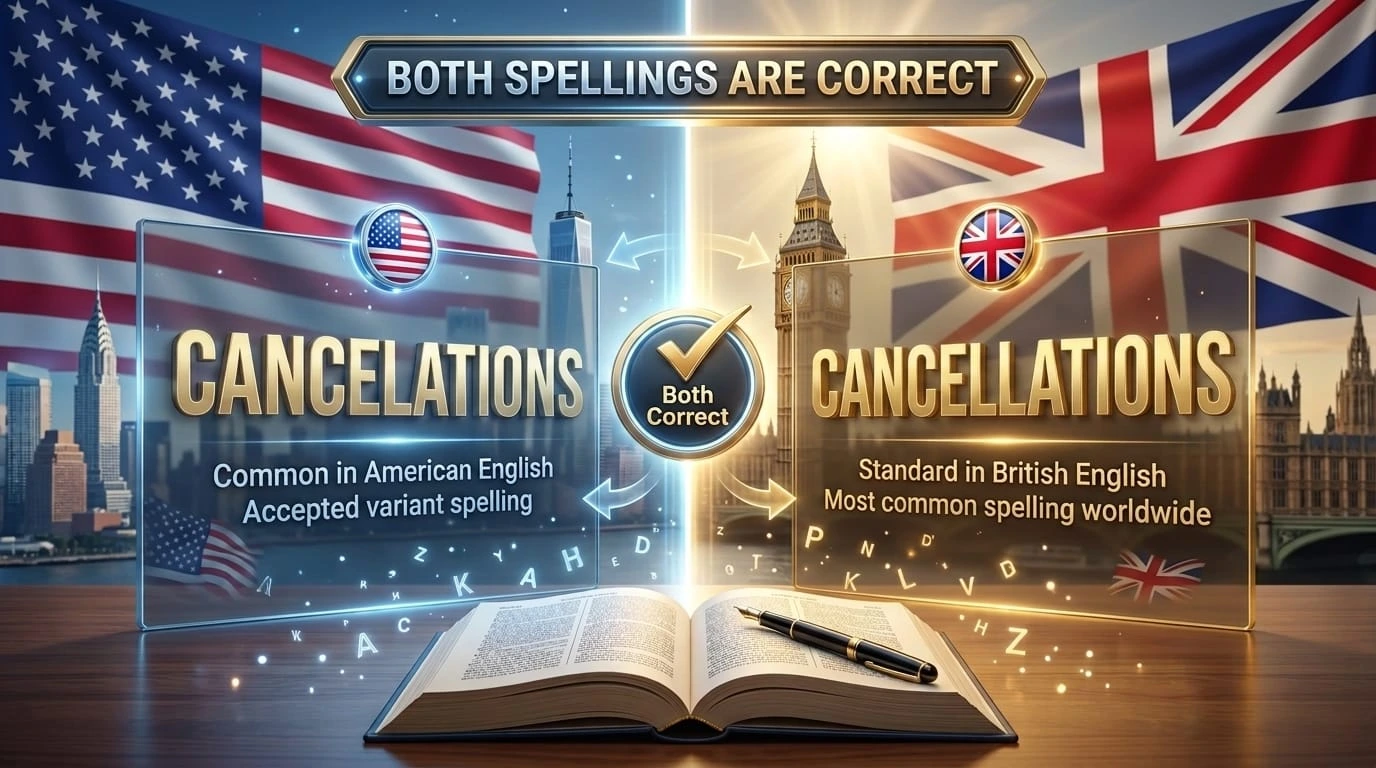
Both cancellations and cancelations are used, but cancellations (with two L's) is the standard spelling in both American and British English. Cancelations is a rare, informal variant.
I once sent a client email about “flight cancelations” and got a reply asking if I’d meant to write “cancellations.” That small red squiggle under my word haunted me for a week. Turns out, I wasn’t alone; this mix-up trips up writers, students, and even editors all the time.
Here’s why it happens. English spelling rules around doubled consonants are messy. Some words double the final letter before adding a suffix. Others don’t. And “cancel” sits right in that gray zone.
So which one is correct: cancellations or cancelations? This guide settles the debate for good. You’ll learn the right spelling, why the confusion exists, and how to use the word confidently in emails, reports, and everyday writing.
Cancellations or Cancelations: Quick Answer
Cancellations is the correct and widely accepted spelling. It’s used in dictionaries, style guides, and professional writing across the US, UK, Canada, and Australia.
For example: “The airline announced dozens of flight cancellations this weekend.” “Please review our cancellation policy before booking.”
Cancelations does appear occasionally, especially in casual American writing, but it’s not the standard form. Most spell-checkers and editors will flag it.
The Origin of the Cancellation Spelling Debate
The confusion comes from a classic English spelling puzzle: doubling consonants before a suffix.
The base word is cancel. In American English, many words ending in a single “L” don’t double it before adding “-ing” or “-ed” (think traveling, modeling, labeled). This pattern leads people to guess that “cancel” should follow the same rule, dropping the second “L.”
But cancellation breaks that pattern. It kept the double “L” from its Latin root, cancellare, meaning “to cross out” or “make like a lattice.” That root traveled through French into English centuries ago, and the double “L” stuck; even as other “-el” words simplified over time.
So the double-L spelling isn’t random. It’s historical, and it’s now firmly locked in as the accepted form.
Cancellations vs Cancelations: Key Differences
Here’s how the two spellings compare across major English varieties:
| Term | Meaning | When to Use | Region/Context |
| Cancellations | Standard plural noun for canceled events, bookings, or plans | Always formal and informal writing | US, UK, Canada, Australia |
| Cancelations | Non-standard, single-L variant | Rarely, mostly typos or informal shorthand | Occasional US casual writing |
Notice something interesting: even though American English usually drops extra letters (color vs colour, traveled vs travelled), cancellation stays the same on both sides of the Atlantic. That’s a rare case of full agreement.
Which Version Should You Use?
For students and academic writing → Use cancellations. Teachers and professors expect the standard spelling. For business and professional emails → Use cancellations. It signals attention to detail and polish. For casual texting or social media → Still use cancellations. There’s no real benefit to the shortened form, and it can look like a mistake. For global or international audiences → Use cancellations. It’s understood and accepted everywhere English is spoken.
Bottom line: there’s no context where cancelations is the better choice.
Common Mistakes with Cancellations
Mistake 1:
Writing “cancelation” as singular ❌ “I received a cancelation notice.” ✅ “I received a cancellation notice.”
Mistake 2:
Dropping the double L out of habit from other “-el” words ❌ “Multiple canceled flights led to canceling delays.” ✅ “Multiple canceled flights led to cancellation delays.” (Note: “canceled” with one L is actually correct in American English only “cancellation” keeps the double L.)
Mistake 3:
Assuming British and American spelling differ here ❌ Believing UK uses “cancellation” and US uses “cancelation.” ✅ Both regions use cancellation and cancellations.
Mistake 4:
Autocorrect confusion Some autocorrect tools “fix” cancellations to cancelations by mistake, especially on older software. Always double-check before sending important documents.
Mistake 5:
Confusing it with “canceled” or “cancelled” These verb forms genuinely do vary by region (canceled in the US, cancelled in the UK). But cancellation as a noun does not follow that split.
Cancellations in Real-World Examples
Professional email:
“Due to unforeseen circumstances, we regret to inform you of several appointment cancellations this week. Please contact our office to reschedule.”
News headline:
“Storm Causes Mass Flight Cancellations Across the Northeast”
Social media post:
“So many event cancellations this month 😩 hoping things pick back up soon.”
Formal document or report:
“Section 4.2 outlines the company’s cancellation policy, including refund eligibility and processing timelines for customer cancellations.”
In every case, the double-L spelling holds steady.
Cancellations: Data, Trends & Usage
Searches for spelling clarity on “cancellations” spike during certain seasons; especially around holiday travel, flight disruptions, and subscription renewal periods. People searching this term are usually trying to write something correctly, whether it’s a customer service message, a school assignment, or a business report.
This is a classic informational search intent: people want a quick, confident answer, not a long grammar lecture. That’s also why spelling questions like this trend heavily on mobile searches, often typed in a hurry right before hitting “send” on an email.
Interestingly, confusion around this word tends to rise wherever American English spelling habits (single-L conventions) bump up against words that don’t follow the pattern. Cancellation is one of the more common exceptions people encounter.
Cancellations vs Cancelations: Comparison Table
| Term/Variant | Meaning | Region/Context | Best Used When |
| Cancellations | Standard, correct spelling | Global (US, UK, Canada, Australia) | Always, in any writing context |
| Cancelations | Non-standard variant | Rare, informal US usage | Not recommended in any context |
Frequently Asked Questions
Q: What does “cancellations” mean?
A: It refers to the act of calling off or canceling something, such as a flight, event, subscription, or appointment. It’s the plural noun form of “cancellation.”
Q: How do you use “cancellations” correctly in a sentence
A: Use it to describe multiple canceled items or events, like “The store reported an increase in order cancellations.” It always takes the double-L spelling.
Q: Cancellations vs cancelations; what’s the real difference?
A: There isn’t a meaningful difference in meaning. Cancellations is the correct, dictionary-approved spelling. Cancelations is simply a common misspelling.
Q: Is “cancelations” ever acceptable in formal writing?
A: No. Formal writing, whether academic, business, or legal, should always use cancellations with the double L.
Q: Which version is correct: British or American English?
A: Both British and American English use cancellations. This is one of the rare words where spelling doesn’t split across regions.
Q: Where does the word “cancellations” come from?
A: It traces back to the Latin word cancellare, meaning “to cross out,” which passed into English through French. The double-L pattern has stayed consistent for centuries.
Q: Can “cancellations” be used in customer service or legal contexts?
A: Yes. It’s the standard term in refund policies, terms of service, booking systems, and customer communications worldwide.
Final Thoughts
Cancellations is the correct, standard spelling; always use two L’s. Cancelations is a non-standard variant that most style guides and spell-checkers will flag. Unlike words such as traveled/travelled, this term doesn’t split between American and British English. The double-L spelling comes from the word’s Latin roots and has stayed consistent for centuries.
Now you know exactly how to spell and use cancellations with confidence. Bookmark this guide so you never second-guess it again and share it with a friend or coworker who’s been typing it wrong. _______________________________________________________________________________________________
Mantle or Mantel: Meaning and Correct Usage✅

As an English language enthusiast, I love diving into the tricky details of word differences and spelling variations. My mission is to explain confusing terms and make them accessible to everyone, helping readers to communicate with clarity and confidence.