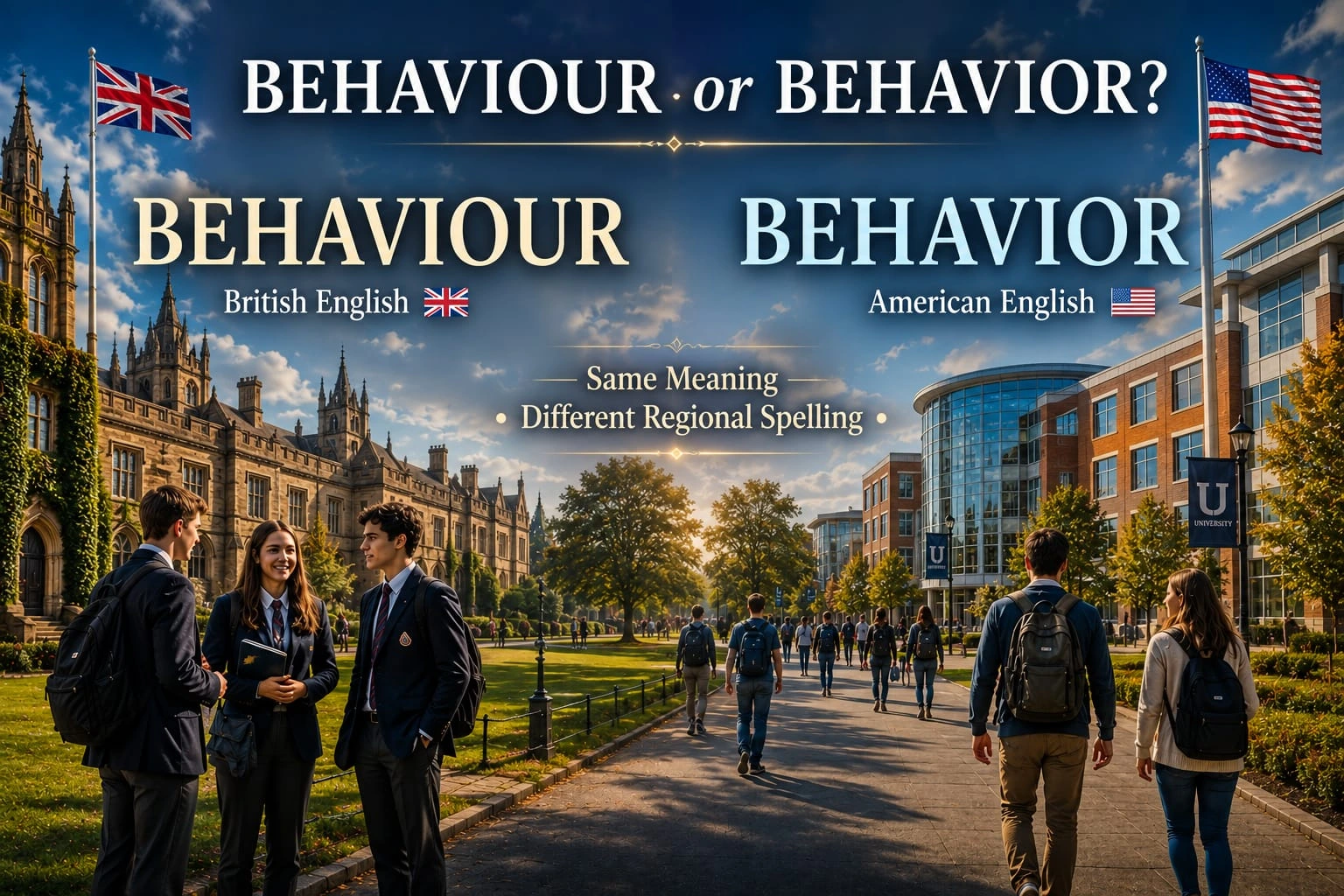
“Behaviour” or “behavior” means the way a person, animal, or thing acts or responds in a situation. Both spellings are correct. “Behavior” is standard in American English, while “behaviour” is standard in British and Commonwealth English.
I once reviewed a report from a colleague in London and changed every instance of “behaviour” to “behavior,” assuming I was fixing a typo. She later pointed out, kindly but firmly, that I’d actually introduced the error, not corrected one.
Turns out, both spellings are completely correct, and the right one depends entirely on your audience’s location. This is one of the most common US versus UK spelling differences, yet it still confuses writers, students, and even professionals every single day.
If you’ve ever paused before typing this word, unsure whether to include that extra u, this guide clears it up for good. You’ll learn exactly when to use “behavior,” when “behaviour” fits better, and why this spelling split exists in the first place.
Behaviour or Behavior: Quick Answer
Both spellings are correct. The difference comes down to region, not grammar.
- ✅ American English: “The teacher praised the student’s behavior.”
- ✅ British English: “The teacher praised the student’s behaviour.”
The rule to remember: American English drops the u in words ending in “-our,” while British English keeps it.
The Origin of Behaviour/Behavior
“Behaviour” comes from Middle English behaven, combined with the noun-forming pattern seen in words like “colour” and “favour.” Like many English words, it traces back through Old French to Latin roots, where spelling wasn’t yet standardized across regions.
The real split happened much later, in the early 1800s, when American lexicographer Noah Webster set out to simplify and standardize American spelling. He argued that dropping the u from words like “colour,” “favour,” and “behaviour” made English more phonetic and easier to learn. His dictionaries popularized “behavior,” “color,” and “favor” throughout the United States.
British English never adopted these changes, keeping the traditional “-our” spelling. This is why “behaviour” remains standard across the UK, Australia, Canada, India, and most other Commonwealth countries today.
British English vs American English Spelling
This spelling difference isn’t isolated to “behaviour.” It’s part of a much larger, predictable pattern.
| Context | American English | British English | Example |
| General spelling | Behavior | Behaviour | His behavior improved after the meeting. |
| Related word family | Behavioral | Behavioural | The study focused on behavioral patterns. |
| Similar word pairs | Color, favor, honor | Colour, favour, honour | Same -or/-our pattern applies throughout. |
| Academic and clinical writing | Behavior | Behaviour | Style depends on publication’s regional base. |
Once you learn this pattern, it applies to dozens of other words, making it much easier to predict spelling across an entire category, not just this one term.
Which Spelling Should You Use?
For American audiences
Use behavior, without the u. This is standard across all American writing, including academic and clinical contexts.
For British or Commonwealth audiences
Use behaviour, with the u. This applies throughout the UK, Australia, Canada, India, and most Commonwealth countries.
For global or mixed audiences
Either spelling works, but stay consistent throughout the same document or publication.
For academic or scientific writing
Check your target journal or institution’s style guide, since psychology and behavioral science publications often specify a preferred regional spelling.
Common Mistakes with Behaviour/Behavior
Mistake 1: Mixing spellings within the same document
✅ His behavior was consistent, and that behavior earned him a promotion.
❌ His behaviour was consistent, and that behavior earned him a promotion.
Why it happens: Writers switch unconsciously, especially when copy-pasting from different sources or working with multiple contributors.
Mistake 2: Forgetting the pattern applies to related words
✅ Behavioural therapy (UK) / Behavioral therapy (US)
❌ Behavioural therapy used inconsistently alongside behavior in the same American document.
Why it happens: Writers remember the base word’s spelling but forget to apply the same rule to derived forms like “behavioral.”
Mistake 3: Assuming one spelling is simply “wrong”
✅ Both “behavior” and “behaviour” are correct, depending on dialect.
❌ “Behaviour” is a typo for “behavior.”
Why it happens: People assume American English spelling rules apply universally, when they don’t.
Mistake 4: Ignoring house style guides in professional writing
✅ Check your organization’s style guide, then stay consistent.
❌ Randomly switching between “behavior” and “behaviour” in the same report.
Why it happens: Writers aren’t always aware their organization or publication has a preferred regional spelling.
Mistake 5: Overcorrecting a colleague’s writing
✅ Recognize regional spelling differences before editing someone else’s work.
❌ Changing every “behaviour” to “behavior” without checking the intended audience.
Why it happens: Writers assume their own regional spelling is the universal standard.
Behaviour/Behavior in Everyday Examples
Professional email:
“We appreciate your team’s professional behavior throughout the negotiation process.”
News headline (UK):
“Study Reveals Link Between Screen Time and Teenage Behaviour”
Social media post:
“Dogs really do mirror their owner’s behavior, it’s fascinating to watch. 🐕”
Formal document (US):
“Employees are expected to maintain professional behavior at all company events.”
Notice how the spelling shifts naturally depending on whether the source is American or British, without changing the underlying meaning.
Behaviour/Behavior: Google Trends & Usage Data
Search interest in “behaviour vs behavior” is steady and mostly informational, driven by writers, students, and professionals confirming which spelling fits their audience. American users overwhelmingly search “behavior,” while UK, Australian, Indian, and Canadian users search “behaviour” far more often.
This mirrors the exact same regional pattern seen in “color/colour” and “favor/favour”, confirming this isn’t a random inconsistency, but a consistent spelling system rooted in Noah Webster’s 19th-century American spelling reforms. Academic publishing and psychology research drive a notable share of searches, since behavioral science journals often specify a required regional spelling for submissions.
Behaviour vs Behavior: Comparison Table
| Term/Variant | Meaning | Region/Context | Best Used When |
| Behavior | The way a person or thing acts | American English | Writing for a US audience |
| Behaviour | The way a person or thing acts | British and Commonwealth English | Writing for UK, Australian, or Canadian audiences |
| Behavioral/Behavioural | Relating to behavior | Same regional split applies | Academic, clinical, or scientific writing |
Frequently Asked Questions
Q: What does “behaviour” or “behavior” mean?
A: Both words describe the way a person, animal, or system acts or responds in a given situation. The meaning is identical, only the spelling changes by region.
Q: How do you use “behavior” correctly in a sentence?
A: Use “behavior” the same way you’d use “behaviour,” for example, “Her behavior surprised everyone” works exactly like “Her behaviour surprised everyone.”
Q: Behaviour vs behavior, what’s the difference?
A: The difference is regional, not grammatical. American English drops the u, while British English keeps it. Both are equally correct.
Q: Is “behaviour” acceptable in formal writing?
A: Yes, especially in British, Australian, or Commonwealth contexts. American style guides typically prefer “behavior” instead.
Q: Which version is correct, behaviour or behavior?
A: Both are correct. Choose based on your audience’s region, and stay consistent throughout your writing.
Q: Where does the word “behaviour” come from?
A: It comes from Middle English behaven, following the same “-our” pattern as “colour” and “favour.” The American spelling split off in the early 1800s.
Q: Can “behavior” be used in British English?
A: It’s understood perfectly, but it’s less common. British readers will typically expect “behaviour” in formal or published writing.
Final Takeaway
Here’s the short version. Both “behavior” and “behaviour” are correct, the choice depends on your audience, not on right versus wrong.
Key points to remember:
- The rule: American English drops the u in “-our” endings; British English keeps it
- Part of a bigger pattern: This split matches “color/colour” and “favor/favour”
- Watch related words too: “Behavioral” and “behavioural” follow the same regional rule
- Consistency matters: Pick one style per document and stick with it
Once you know your audience, choosing between “behavior” and “behaviour” becomes automatic.
Affective or Effective: Difference Explained With Examples (2026)

As an English language enthusiast, I love diving into the tricky details of word differences and spelling variations. My mission is to explain confusing terms and make them accessible to everyone, helping readers to communicate with clarity and confidence.