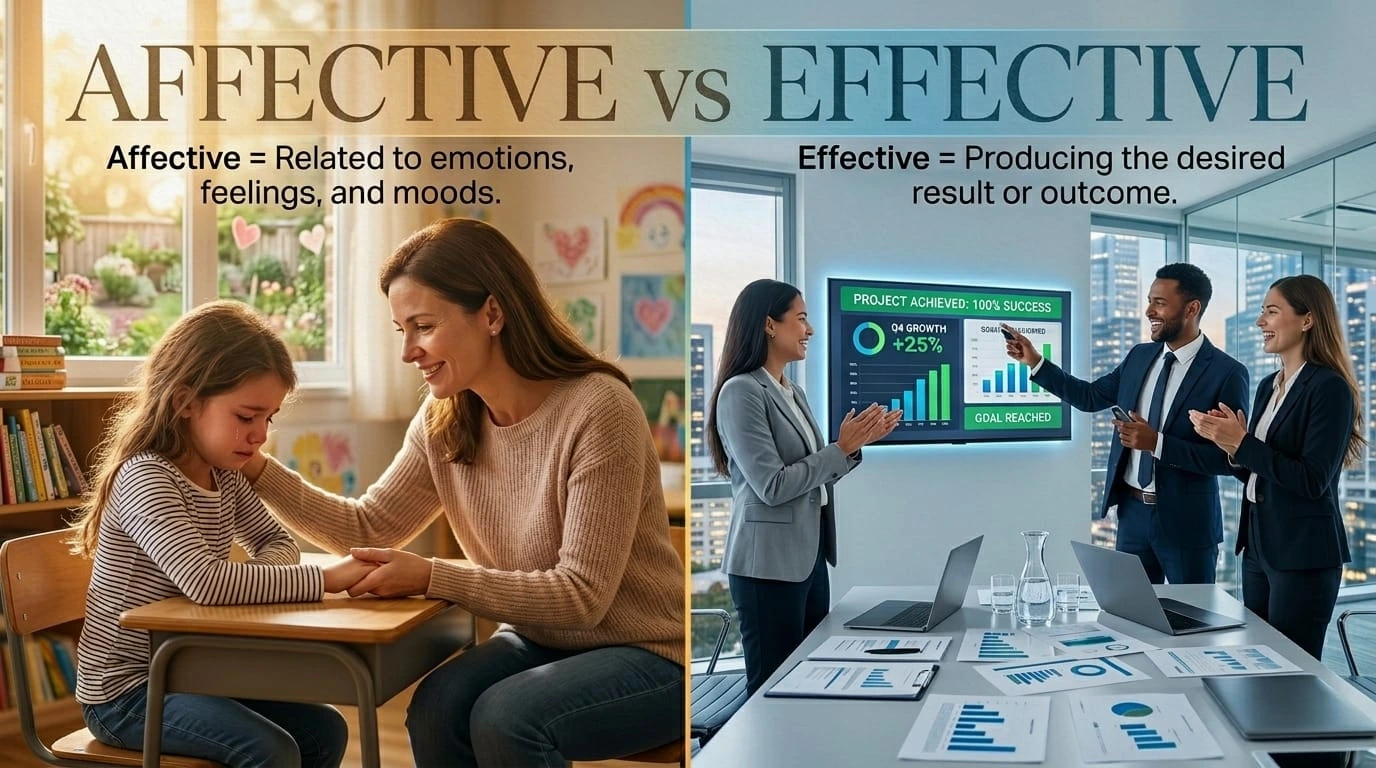
Effective means something works and gives good results, while affective relates to emotions or feelings.
Have you ever written “affective or effective” and stopped because both words looked correct? You are not alone. Many people search for affective vs effective, effective or affective, and meaning of affective and effective because these words sound similar but have very different meanings.
This confusion happens because only one letter changes between the two words. They also have similar pronunciation, which makes people use the wrong one in emails, school work, business writing, and everyday conversations.
Using the wrong word can change the meaning of your sentence. For example, saying a treatment is affective instead of effective can create confusion because one word relates to emotions while the other means something works well.
This guide explains the difference in a simple way. You will learn the meanings, origins, examples, common mistakes, usage rules, and practical advice so you can choose the correct word every time.
Affective or Effective: Quick Answer
Effective means something works well or produces the desired result.
Affective relates to emotions, feelings, or mood.
Examples:
✅ This medicine is effective for headaches.
✅ The therapy focuses on affective behavior.
Quick rule:
- Effective = produces results
- Affective = connected to emotions
The Origin of Affective or Effective
The word effective comes from the Latin word effectivus, meaning “producing results.”
The word affective comes from the Latin word affectus, meaning “emotion” or “feeling.”
The words developed separately but sound alike, which causes confusion.
People mix them up because:
- They have similar spelling.
- Their pronunciation sounds close.
- Only one letter changes.
Meaning of Affective and Effective
| Word | Meaning |
| Effective | Producing a desired result |
| Affective | Related to feelings or emotions |
British English vs American English Spelling
Unlike some English words, affective and effective have the same spelling in both British and American English.
Examples:
British English:
✅ The new policy was effective.
American English:
✅ The new policy was effective.
Comparison Table
| Feature | British English | American English |
| Effective | Effective | Effective |
| Affective | Affective | Affective |
| Spelling difference | None | None |
| Usage | Same | Same |
There is no regional spelling change.
Which Spelling Should You Use?
Choose based on meaning, not location.
For US audiences
Use effective when talking about results.
Example:
“The strategy was effective.”
Use affective when discussing emotions.
Example:
“The study examined affective responses.”
For UK and Commonwealth audiences
The same rule applies.
For global audiences
Choose according to context:
- Results → Effective
- Feelings → Affective
Common Mistakes with Affective or Effective
People often make these mistakes:
| Wrong | Correct |
| The medicine was affective. | The medicine was effective. |
| We need an affective solution. | We need an effective solution. |
| The study measured effective behavior. | The study measured affective behavior. |
| Effective response to emotions | Affective response to emotions |
Common reasons:
- Similar sounds
- Similar spelling
- Fast typing
Remember:
Effective = effect = results
Affective = affect = feelings
Affective or Effective in Everyday Examples
✅ This new process has been very effective.
News
✅ The government introduced an effective plan.
Social Media
✅ This workout routine is really effective.
Formal Writing
✅ Researchers studied affective responses among participants.
Education
✅ Teachers use effective learning methods.
Affective or Effective: Google Trends & Usage Data
Searches often include:
- affective vs effective
- effective or affective
- affective meaning
- effective meaning
- difference between affective and effective
Search behavior shows that effective is much more common because people use it in daily communication.
Countries where these searches frequently appear include:
- United States
- United Kingdom
- Canada
- Australia
- India
- Pakistan
Effective appears more in:
- Business writing
- Health content
- Education
- Marketing
Affective appears more in:
- Psychology
- Research studies
- Education theory
Keyword Variations Comparison Table
| Keyword Variation | Meaning |
| Effective | Produces results |
| Affective | Related to emotions |
| Affective vs Effective | Comparison search |
| Effective or Affective | Spelling question |
| Meaning of Effective | Definition search |
| Meaning of Affective | Definition search |
FAQs
Is affective or effective correct?
Both are correct, but they have different meanings.
What does effective mean?
Effective means something works successfully.
What does affective mean?
Affective relates to emotions or feelings.
Why do people confuse affective and effective?
They look and sound similar.
Is affective used often?
It is used less often and mostly appears in psychology and academic writing.
Is effective more common?
Yes. Effective is much more common in everyday language.
How can I remember the difference?
Remember:
Effective = effect = results
Affective = affect = feelings
Conclusion
The confusion between affective or effective is common because the words look and sound similar. Still, their meanings are very different. Effective describes something that works well and produces results. Affective relates to emotions, feelings, and emotional responses.
Most everyday writing uses effective because people often discuss solutions, plans, products, and results. Affective appears more in psychology, education, and research fields.
Understanding this difference will help you write more clearly and avoid common mistakes in emails, reports, articles, and conversations. A small spelling difference can create a large meaning difference, so choosing the right word matters.
Brooch or Broach: Difference Explained With Examples (2026)

As an English language enthusiast, I love diving into the tricky details of word differences and spelling variations. My mission is to explain confusing terms and make them accessible to everyone, helping readers to communicate with clarity and confidence.