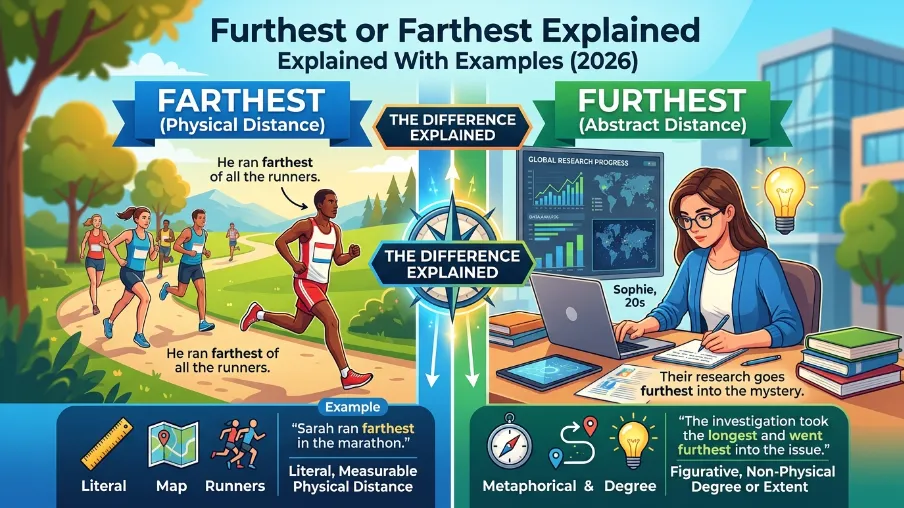
“Farthest” usually refers to physical distance, while “furthest” often refers to figurative or abstract distance.
You’re writing a sentence that says, “This is the furthest I’ve ever traveled.” Then suddenly you wonder should it actually be farthest instead of furthest?
This confusion is extremely common because both words are comparative forms of far, and both are often used interchangeably in everyday English. Many people hear native speakers use both versions and assume there is no difference at all.
People search for “furthest or farthest” because the words appear frequently in:
- school writing
- travel discussions
- professional communication
- books
- movies
- everyday conversations
The tricky part is that some grammar guides treat the words differently, while others say both are acceptable in many situations. That makes English learners and writers unsure about which word sounds more natural or correct.
The good news is that there is a simple pattern many writers follow:
- farthest usually relates to measurable physical distance
- furthest often relates to ideas, progress, or abstract meaning
In this guide, you’ll learn the meanings, origins, examples, grammar differences, common mistakes, comparison tables, and practical rules for correctly using furthest and farthest.
Furthest or Farthest – Quick Answer
👉 Farthest = Usually physical distance 📍
👉 Furthest = Often figurative or abstract distance 💭
Examples:
- That is the farthest city from here. ✅
- This discussion went furthest into the topic. ✅
Important Note:
👉 In modern English, many people use both interchangeably.
The Origin of Furthest or Farthest
Both words come from the adjective:
👉 far
Over time, English developed multiple comparative forms:
- farther
- further
- farthest
- furthest
Historically:
- farther/farthest connected more with physical distance
- further/furthest developed broader meanings
Today, modern English often overlaps these usages.
Furthest vs Farthest Meaning Explained
What Does “Farthest” Mean?
“Farthest” usually refers to:
- measurable distance
- physical locations
- geographic separation
Examples:
- Alaska is the farthest state from Florida.
- That car traveled the farthest.
- Which planet is farthest from the sun?
What Does “Furthest” Mean?
“Furthest” often refers to:
- degree
- progress
- ideas
- abstract extension
Examples:
- She went furthest in her research.
- Let’s take this discussion furthest tomorrow.
- His career advanced furthest among the group.
British English vs American English Usage
Both British and American English use:
- farthest
- furthest
However:
- British English sometimes prefers “furthest” more often
- American English frequently uses “farthest” for distance
Comparison Table
| Word | Common Use | Region |
|---|---|---|
| Farthest | Physical distance | Common in US |
| Furthest | Figurative distance | Common in UK and US |
✔ Both are accepted globally
Which Spelling Should You Use?
Use “Farthest” When Talking About:
- miles
- travel
- measurable distance
- physical locations
Use “Furthest” When Talking About:
- progress
- discussions
- ideas
- emotional or abstract meaning
Simple Rule:
👉 Real physical distance = farthest
👉 Abstract progress or meaning = furthest
Common Mistakes with Furthest or Farthest
Mistake 1
❌ Thinking one word is completely wrong
✔ Both are correct in modern English
Mistake 2
❌ Using them randomly in formal writing
✔ Consistency improves clarity
Mistake 3
❌ Ignoring context differences
✔ Distance vs abstract meaning helps guide usage
Mistake 4
❌ Assuming grammar rules are absolute
✔ Modern English allows overlap
Furthest or Farthest in Everyday Examples
Travel
- This is the farthest I’ve driven.
- Australia felt like the farthest destination.
Education
- She went furthest in her studies.
- His research explored the topic furthest.
Workplace
- Which department progressed furthest?
- The branch farthest from headquarters closed early.
Social Media
- “This is the farthest I’ve ever traveled 🌍”
- “We’ve come furthest together ❤️”
Furthest or Farthest – Google Trends & Usage Data
Search trends show:
- “Farthest” is more common in physical travel discussions
- “Furthest” appears more in British writing and abstract contexts
Key Insight:
👉 Modern English speakers often accept both words interchangeably.
Comparison Table: Furthest vs Farthest
| Feature | Furthest | Farthest |
|---|---|---|
| Abstract meaning | Common | Less common |
| Physical distance | Sometimes | Most common |
| British usage | Very common | Common |
| American usage | Common | Very common |
| Grammar acceptance | Correct | Correct |
Furthest vs Farthest in School Grammar
Many schools teach:
- farther/farthest = physical distance
- further/furthest = figurative distance
Example:
- The farthest mountain
- The furthest point in discussion
However, modern dictionaries often accept overlap.
Why These Words Confuse Writers
The confusion happens because:
- both come from “far”
- meanings overlap
- modern English is flexible
- native speakers mix them often
This creates uncertainty even for fluent English users.
Furthest vs Farthest in Literature
Writers sometimes choose words based on:
- rhythm
- tone
- style
- regional preference
That’s why both forms appear in:
- novels
- films
- journalism
- speeches
Simple Trick to Remember the Difference
Easy Memory Rule
👉 Farthest = physical miles 📍
👉 Furthest = figurative progress 💭
Quick Reminder
If you can measure the distance physically:
✔ farthest
If discussing ideas or progress:
✔ furthest
FAQs
1. What is the difference between furthest and farthest?
“Farthest” usually refers to physical distance, while “furthest” often relates to abstract distance or progress.
2. Is furthest correct English?
Yes. It is fully correct.
3. Which is more common, furthest or farthest?
“Farthest” is slightly more common for physical distance.
4. Can I use them interchangeably?
In many modern situations, yes.
5. Is farthest American English?
It is especially common in American English for measurable distance.
6. Which word sounds more formal?
Neither is inherently more formal.
7. What is the easiest way to remember the difference?
Farthest = physical distance, furthest = figurative meaning.
Conclusion
The confusion between furthest or farthest happens because both words come from the same root word and are often used similarly in modern English. However, there is a useful guideline that helps many writers choose correctly.
“Farthest” is commonly connected to physical or measurable distance, while “furthest” often relates to ideas, progress, or abstract situations. Still, modern English frequently allows both forms interchangeably, especially in casual conversation.
The easiest way to remember is simple:
👉 Farthest = real physical distance 📍
👉 Furthest = figurative or abstract distance 💭
Understanding this pattern can help improve clarity in writing, speaking, school assignments, professional communication, and everyday English usage.
Now you can confidently choose between furthest and farthest in different situations without confusion.

Hi, I’m Liam Rivers, author at Engglory.com.
I’m an English grammar expert who simplifies spelling confusion and tricky grammar rules to help readers write and speak with confidence.