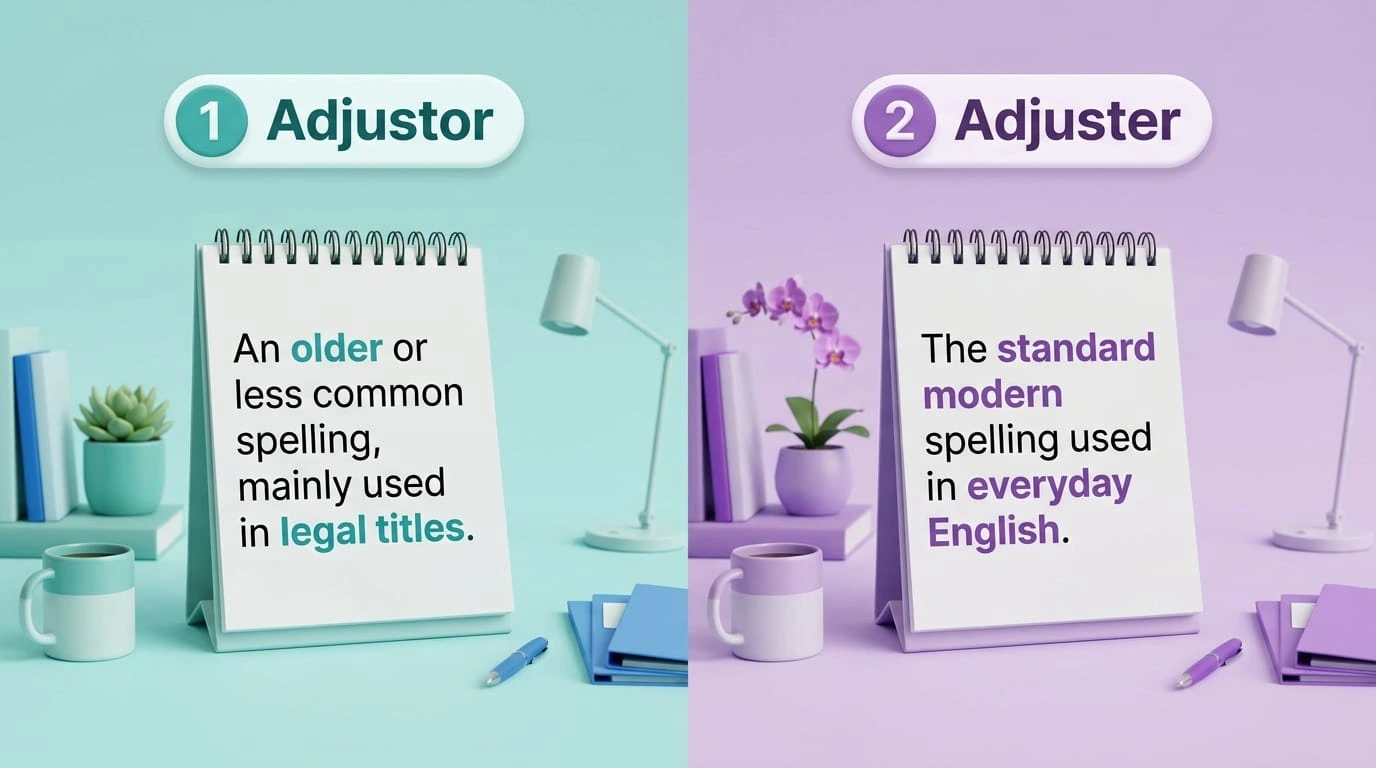
An adjuster or adjustor is a person or device that adjusts, evaluates, or makes something fit properly. Adjuster is the standard and preferred spelling in modern English, while adjustor is a less common variant mainly used in some technical or specialized contexts.
Have you ever wondered whether you should write adjustor or adjuster? If you’ve seen both spellings in insurance documents, job titles, or legal paperwork, you’re not alone. Many people search for “adjustor or adjuster” because both words appear to mean the same thing, yet one seems far more common than the other.
The confusion usually starts when reading insurance policies, job advertisements, or government documents. Some companies hire claims adjusters, while others mention claims adjustors. So, are both correct? Is one American English and the other British English? Or is one simply outdated?
The good news is that both spellings are recognized in English. However, adjuster is the standard and preferred spelling almost everywhere, especially in professional writing. Adjustor exists but is much less common and is mostly used in certain technical or legal contexts.
This guide explains the difference, where each spelling comes from, when to use each one, and which spelling is best for your audience.
Adjustor or Adjuster: Quick Answer
The short answer is simple:
- Adjuster is the standard and preferred spelling.
- Adjustor is an accepted variant but is much less common.
- In insurance, business, and everyday English, adjuster is almost always the correct choice.
Examples
✅ The insurance adjuster inspected the damaged house.
✅ The adjustor reviewed the equipment during testing. (Rare technical usage.)
Quick Comparison
| Word | Correct? | Common? | Best Use |
| Adjuster | ✅ Yes | Very Common | Insurance, business, everyday English |
| Adjustor | ✅ Yes | Rare | Technical or specialized contexts |
Quick Tip: If you’re unsure, choose adjuster.
The Origin of Adjustor or Adjuster
Both words come from the verb adjust, which means to change something slightly to make it correct or fit properly.
The verb adjust entered English from French, which ultimately traces back to the Latin word adjuxtare, meaning “to bring closer” or “make fit.”
As English developed, different noun endings became common.
- -er usually describes a person who performs an action.
- -or also creates agent nouns but appears less often in modern English.
That is why both forms developed:
- adjuster
- adjustor
Over time, English speakers strongly favored adjuster, especially in business and professional writing.
Today, dictionaries recognize both spellings, but adjuster has become the dominant form.
British English vs American English Spelling
Unlike many English spelling differences, adjustor and adjuster are not divided by British and American English.
Both American and British dictionaries generally prefer adjuster.
The spelling adjustor survives mostly because some organizations, industries, and technical documents have continued using it.
Comparison Table
| Feature | Adjuster | Adjustor |
| American English | ✅ Preferred | Rare |
| British English | ✅ Preferred | Rare |
| Canadian English | ✅ Preferred | Rare |
| Australian English | ✅ Preferred | Rare |
| Insurance Industry | ✅ Standard | Occasionally found |
| Everyday Writing | ✅ Yes | Rare |
Examples
American English
- The insurance adjuster approved the claim.
British English
- The loss adjuster visited the property.
Although Britain often uses the term loss adjuster, the spelling remains adjuster, not adjustor.
Pronunciation of Adjustor or Adjuster
adjuster (uh-JUS-ter)
Both adjuster and adjustor are pronounced the same: /əˈdʒʌstər/ (uh-JUS-ter). The only difference is their spelling, not their pronunciation. Whether you use adjuster or adjustor, English speakers pronounce both words identically.
Which Spelling Should You Use?
Choosing the right spelling depends on your audience, but for almost everyone, the answer is the same.
If Your Audience Is in the United States
Use adjuster.
This is the spelling used by:
- Insurance companies
- Government agencies
- Employers
- Newspapers
- Legal writing
If Your Audience Is in the UK or Commonwealth Countries
Use adjuster.
British English commonly uses the job title loss adjuster, making adjuster the expected spelling.
If You Write for an International Audience
Always choose adjuster.
It is:
- Easier to recognize
- More common worldwide
- Preferred by search engines
- More familiar to readers
Professional Recommendation
| Audience | Recommended Spelling |
| United States | Adjuster |
| United Kingdom | Adjuster |
| Canada | Adjuster |
| Australia | Adjuster |
| International | Adjuster |
Unless you’re quoting a document that specifically uses adjustor, stick with adjuster.
Common Mistakes with Adjustor or Adjuster
Although both spellings are accepted, many writers use them incorrectly or assume they have different meanings. Here are the most common mistakes.
| Mistake | Correct Version | Why? |
| The insurance adjustor handled my claim. | The insurance adjuster handled my claim. | Adjuster is the standard insurance term. |
| Thinking adjustor is British English. | Adjuster is preferred in both US and UK English. | There is no regional spelling difference. |
| Believing adjustor and adjuster have different meanings. | They mean the same thing. | The difference is mainly usage frequency. |
| Using adjustor in formal business writing. | Use adjuster instead. | It matches modern professional style. |
| Switching between spellings in one document. | Use one spelling consistently. | Consistency improves readability. |
Quick Tips
- ✅ Use adjuster for insurance, business, and legal writing.
- ✅ Keep the same spelling throughout your document.
- ✅ Only use adjustor if you’re following an organization’s official terminology or quoting a source.
Adjustor or Adjuster in Everyday Examples
Seeing the words in context makes the difference easier to remember.
In Emails
Correct
Our insurance adjuster will contact you within two business days.
In News Articles
The claims adjuster inspected homes damaged by the storm.
On Social Media
The insurance adjuster approved my claim today!
In Formal Business Writing
Every adjuster must complete annual professional training.
In Technical Documents
The machine’s brake adjustor should be inspected regularly.
Note: In some technical or mechanical fields, adjustor may appear as part of a product name or component description, but adjuster is still more common in general English.
Common Collocations
These are the most common phrases where the word is used in everyday and professional English. ✅
| Phrase | Preferred Spelling |
|---|---|
| Insurance adjuster | ✅ Adjuster |
| Claims adjuster | ✅ Adjuster |
| Loss adjuster | ✅ Adjuster |
| Public adjuster | ✅ Adjuster |
| Damage adjuster | ✅ Adjuster |
Adjustor or Adjuster: Google Trends & Usage Data
Search interest and published writing show a clear preference for adjuster.
General Usage
- Adjuster is searched far more often than adjustor.
- Most dictionaries list adjuster as the primary spelling.
- Insurance companies almost always use adjuster in job titles and official documents.
- News organizations and government agencies also prefer adjuster.
Popular by Country
| Country | Preferred Spelling |
| United States | Adjuster |
| United Kingdom | Adjuster (often “loss adjuster”) |
| Canada | Adjuster |
| Australia | Adjuster |
| New Zealand | Adjuster |
Industry Usage
| Industry | Common Spelling |
| Insurance | Adjuster |
| Legal | Adjuster |
| Business | Adjuster |
| News Media | Adjuster |
| Technical Manuals | Mostly Adjuster, occasionally Adjustor |
Bottom Line: If you’re writing for search engines or a general audience, adjuster is the safest and most recognizable choice.
Adjustor vs Adjuster Comparison Table
| Feature | Adjuster | Adjustor |
| Meaning | Person who evaluates or adjusts claims or equipment | Same meaning |
| Dictionary Status | Standard spelling | Accepted variant |
| Everyday Usage | Very common | Rare |
| Insurance Industry | Preferred | Uncommon |
| Business Writing | Preferred | Rare |
| Technical Documents | Common | Occasionally used |
| US English | Preferred | Rare |
| UK English | Preferred | Rare |
| SEO Recommendation | ✅ Best choice | Not recommended unless required |
Frequently Asked Questions
1. Is adjustor or adjuster correct?
Both spellings are correct, but adjuster is the standard and much more common form in modern English.
2. Which spelling do insurance companies use?
Almost all insurance companies use adjuster, such as claims adjuster or insurance adjuster.
3. Is adjustor British English?
No. British English also prefers adjuster, especially in the job title loss adjuster.
4. Do adjustor and adjuster mean different things?
No. They have the same meaning. The difference is mainly spelling preference and frequency of use.
5. Why does adjustor still exist?
It developed as an alternative noun form and remains in some technical, legal, and historical contexts, though it is uncommon today.
6. Which spelling is better for SEO?
Adjuster is the better choice because it is searched more often and is the spelling most readers expect.
7. Should I ever use adjustor?
Only if you’re quoting a document, following an organization’s official terminology, or writing about a technical component that uses that spelling.
Memory Trick ⭐
Remember: The ending -er is the standard choice for people who perform an action, such as teacher, driver, builder, and adjuster. If you’re unsure, choose adjuster.
Conclusion
Choosing between adjustor or adjuster is easier than it first appears. While both spellings are recognized by dictionaries and share the same meaning, adjuster has become the clear standard in modern English. It is the spelling used by insurance companies, employers, government agencies, news organizations, and most professional writers.
The spelling adjustor still appears from time to time, especially in technical documents or as part of official product names, but it is much less common. For most readers, seeing adjuster feels more familiar and natural.
If you’re writing an email, article, report, résumé, or business document, adjuster is almost always the best choice. It is widely understood, aligns with current style guides, and performs better in online searches. Unless you have a specific reason to use adjustor, stick with adjuster for clear, professional, and reader-friendly writing.
Complementary or Complimentary? Know the Difference

As an English language enthusiast, I love diving into the tricky details of word differences and spelling variations. My mission is to explain confusing terms and make them accessible to everyone, helping readers to communicate with clarity and confidence.


