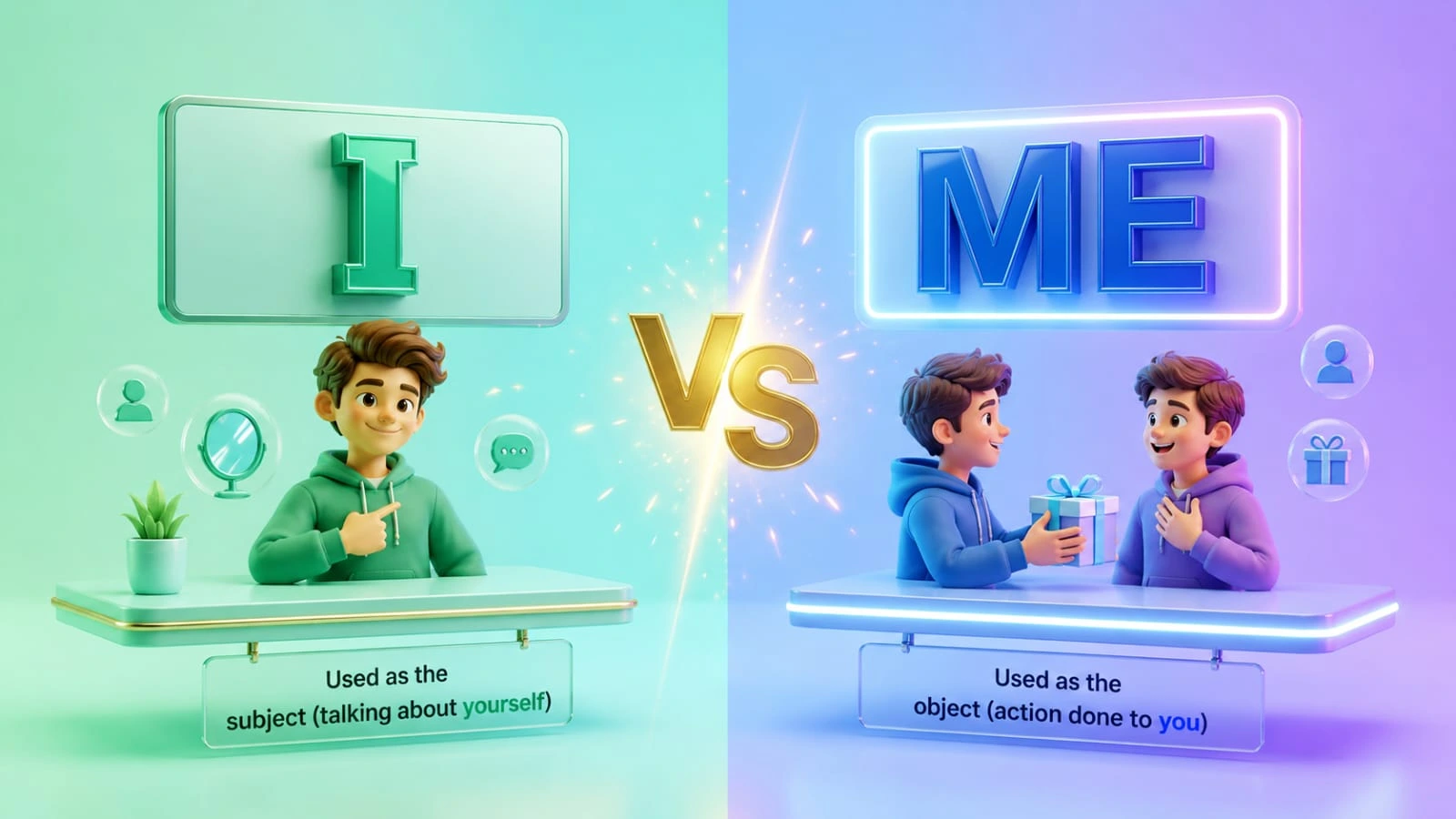
Use I when you are the subject doing the action, and use me when you are the object receiving the action. A simple trick is to remove the other person’s name if the sentence works with I, use I; if it works with me, use me.
“Should I say John and I or John and me?” If you’ve ever stopped in the middle of a sentence wondering which one is correct, you’re not alone. The “i or me” question is one of the most searched English grammar topics because both words refer to yourself, yet they are used in different situations.
Many native English speakers also make mistakes with I and me, especially in conversations, emails, social media posts, and business writing. You may have heard phrases like “Me and Sarah went to the store” or “The teacher praised Sarah and I.” One sounds casual but incorrect, while the other sounds formal but is also wrong.
The good news is that the rule is surprisingly simple. Once you understand the difference between a subject pronoun and an object pronoun, you’ll know exactly when to use I and when to use me.
This guide explains everything in simple English with examples, comparison tables, common mistakes, usage tips, and practical advice for both American and British English.
I or Me: Quick Answer
The difference is simple:
- Use I when you are the subject of the sentence (the person doing the action).
- Use me when you are the object of the sentence (the person receiving the action).
Examples
✅ I went to school.
✅ The teacher praised Sarah and me.
Easy Trick
Remove the other person’s name.
- Sarah and I went home.
- → I went home. ✅
- Sarah invited John and me.
- → She invited me. ✅
If the sentence still sounds correct, you’ve chosen the right word.
The Origin of I or Me
The words I and me both come from Old English, where pronouns changed form depending on their grammatical role.
- I comes from the Old English ic, meaning the speaker as the subject.
- Me comes from the Old English mec or me, referring to the speaker as the object.
Unlike spelling pairs such as color and colour, I and me are not spelling variations. They are different grammatical forms of the same personal pronoun.
English has kept this distinction for over a thousand years because it helps readers and listeners understand who performs an action and who receives it.
How Do You Pronounce “I” and “Me”?
| Word | IPA | Simple Pronunciation |
| I | /aɪ/ | “eye” |
| Me | /miː/ | “mee” |
Example: “Sarah and I are ready.” / “Please help me.”
Which Spelling Should You Use?
Since there is no spelling variation, your focus should be on grammar rather than location.
If your audience is American
Follow standard grammar:
- I as the subject
- me as the object
If your audience is British
Use exactly the same rule.
If your audience is international
The same grammar works everywhere English is spoken.
No matter where your readers live, I and me never change spelling.
Common Mistakes with I or Me
Many mistakes happen because people try to sound formal.
Mistake 1
❌ Me and Tom went shopping.
✅ Tom and I went shopping.
Mistake 2
❌ She gave the award to Sarah and I.
✅ She gave the award to Sarah and me.
Mistake 3
❌ Him and me are friends.
✅ He and I are friends.
Mistake 4
❌ Between you and I
✅ Between you and me
The preposition between always takes an object pronoun.
Mistake 5
❌ The manager thanked James and I.
✅ The manager thanked James and me.
I or Me in Everyday Examples
Understanding the rule becomes easier when you see it in real situations.
Emails
✅ Sarah and I will attend the meeting.
✅ Please contact me if you have questions.
Workplace
✅ My manager asked me to prepare the report.
✅ David and I completed the presentation.
Social Media
✅ My sister and I had an amazing trip!
✅ Everyone congratulated me on my graduation.
News
✅ The President and I discussed the proposal.
✅ Reporters interviewed me after the event.
Academic Writing
✅ My research partner and I conducted the experiment.
✅ The professor encouraged me to continue the study.
I or Me: Google Trends & Usage Data
Searches for “i or me” remain consistently popular because learners often need quick grammar help while writing.
Countries where the query is common
- United States
- United Kingdom
- Canada
- Australia
- India
- Pakistan
Why people search
- School homework
- English exams
- Business emails
- Job applications
- Social media captions
- Professional writing
- Grammar improvement
Unlike spelling debates, this search focuses on correct grammar usage rather than regional English differences.
I or Me Comparison Table
| Feature | I | Me |
| Part of speech | Subject pronoun | Object pronoun |
| Function | Does the action | Receives the action |
| Position | Before the verb | After the verb or preposition |
| Example | I called Sarah. | Sarah called me. |
| Formal writing | Yes | Yes |
| Spoken English | Yes | Yes |
Frequently Asked Questions
Q: Is “me and my friend” correct?
A: In formal grammar, no.
Correct:
My friend and I went shopping.
Q: Is “between you and I” ever correct?
A: No.
The correct expression is:
Between you and me.
Q: Why do people say “John and I” even when it’s wrong?
Many speakers believe I always sounds more formal. This leads to mistakes like:
❌ She called John and I.
The correct sentence is:
✅ She called John and me.
Q: Is there a spelling difference between British and American English?
A: No.
Both countries spell these words exactly the same.
Q: How can I remember the rule?
A: Remove the other person’s name.
Example:
Sarah and I went home.
↓
I went home.
It still works, so I is correct.
Q: Can I start a sentence with “Me”?
A: Usually, no.
Formal English prefers:
✅ I am happy.
Informal speech sometimes uses:
“Me too!”
Because it’s a shortened conversational expression.
Q: Is “It’s me” correct?
A: Yes.
Although some grammar books once preferred “It is I,” modern English almost always uses:
It’s me.
Conclusion
Choosing between I and me isn’t about sounding smarter it’s about understanding the role each word plays in a sentence. I is the subject, meaning it performs the action, while me is the object, meaning it receives the action. This simple distinction works in every variety of English, including British, American, Canadian, Australian, and other forms.
A quick way to check yourself is to remove the other person’s name from the sentence. If I sounds natural on its own, it’s the right choice. If me fits, then use me. This easy trick helps avoid many of the mistakes people make in conversations, emails, school assignments, and professional writing.
Remember that there is no British vs American spelling difference for these words. The only thing that matters is grammar. With a little practice, choosing between I and me becomes automatic, helping you write and speak with greater confidence, accuracy, and professionalism.
I or me explained simply with grammar rules, examples, common mistakes, comparison tables, FAQs, and easy usage tips for everyone everywhere.
Themselves or Themself: Which One Is Correct?✅

As an English language enthusiast, I love diving into the tricky details of word differences and spelling variations. My mission is to explain confusing terms and make them accessible to everyone, helping readers to communicate with clarity and confidence.


