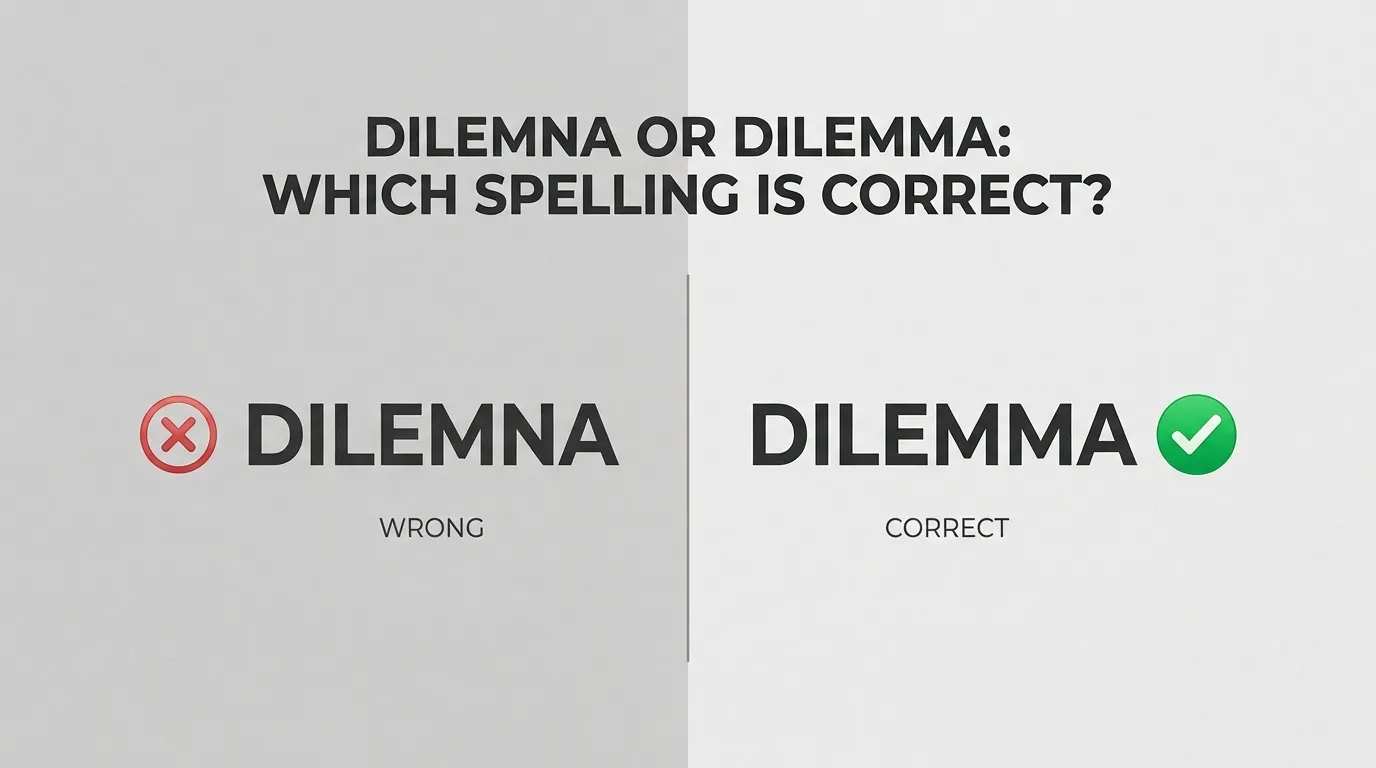
Dilemma is the correct spelling. Dilemna is a common misspelling. Dilemma refers to a difficult situation in which you must choose between two or more equally undesirable or challenging options.
A student once emailed a professor asking for advice about a career dilemna. The professor replied with helpful guidance but also gently corrected the spelling. The student wasn’t alonethousands of people accidentally write dilemna instead of dilemma every year.
This confusion is understandable. Although many people pronounce the word as if it contains an “n,” the correct spelling has two m’s and no n. Because the mistake is so widespread, it’s one of the most searched spelling questions online.
If you’ve ever wondered whether to write dilemna or dilemma, you’re in the right place. This guide explains the correct spelling, meaning, pronunciation, origin, examples, common mistakes, and simple memory tricks to help you remember it.
Dilemna or Dilemma: Quick Answer
| Word | Correct? | Meaning |
|---|---|---|
| Dilemma | ✅ Yes | A difficult choice between two or more options |
| Dilemna | ❌ No | Common misspelling of dilemma |
Examples
✅ She faced a difficult dilemma about accepting the job.
✅ We found ourselves in a moral dilemma.
❌ She faced a difficult dilemna.
What Does Dilemma Mean?
A dilemma is a situation where someone must choose between two or more difficult alternatives, often when neither choice is ideal.
It is commonly used in:
- everyday conversations
- business decisions
- politics
- ethics
- education
- personal relationships
Example 1
He faced the dilemma of choosing between two excellent universities.
Example 2
The company encountered a financial dilemma after sales declined.
Example 3
Parents often experience the dilemma of balancing work and family life.
Is Dilemna a Real Word?
No.
Dilemna is not accepted in standard English dictionaries. It is considered a spelling mistake.
Although it appears frequently online and in informal writing, professional editors and dictionaries recognize only dilemma.
Incorrect
❌ I’m in a serious dilemna.
Correct
✅ I’m in a serious dilemma.
Why Do People Spell It “Dilemna”?
The mistake has existed for centuries.
Several factors contribute to the confusion:
Pronunciation
Some speakers pronounce the word in a way that makes it sound like an “n” is present.
Memory Errors
People often remember the word incorrectly because English contains many words ending in -mna or similar letter combinations.
Typing Habits
Once someone learns the incorrect spelling, it often becomes a habit.
The Origin of Dilemma
The word dilemma comes from Greek.
It combines:
- di- meaning “two”
- lemma meaning “assumption” or “proposition”
Originally, it referred to an argument offering two possible alternatives.
Over time, its meaning expanded to describe any difficult choice between competing options.
Notice that the original word has two m’s—not an “n.”
Dilemna vs Dilemma: Comparison Table
| Feature | Dilemna | Dilemma |
|---|---|---|
| Correct spelling | ❌ | ✅ |
| Dictionary word | ❌ | ✅ |
| Standard English | ❌ | ✅ |
| Used in academic writing | ❌ | ✅ |
| Means difficult choice | ❌ | ✅ |
| Common misspelling | ✅ | ❌ |
When to Use “Dilemma”
Use dilemma whenever you’re talking about a difficult decision or challenging choice.
Personal Life
She faced the dilemma of moving abroad or staying near her family.
Business
The company encountered a pricing dilemma.
Education
Students often experience the dilemma of choosing a major.
Ethics
Doctors sometimes face ethical dilemmas.
Common Expressions with Dilemma
You’ll often see these phrases:
- moral dilemma
- ethical dilemma
- financial dilemma
- difficult dilemma
- personal dilemma
- face a dilemma
- solve a dilemma
Example 1
The judge faced an ethical dilemma.
Example 2
Buying or renting created a financial dilemma.
British vs American English
Unlike many spelling differences, there is no regional variation.
| Language Variety | Preferred Spelling |
|---|---|
| American English | Dilemma |
| British English | Dilemma |
| Canadian English | Dilemma |
| Australian English | Dilemma |
Everyone uses dilemma.
Common Mistakes
Mistake #1
❌ A career dilemna.
✅ A career dilemma.
Mistake #2
❌ Moral dilemna.
✅ Moral dilemma.
Mistake #3
❌ Thinking dilemna is an older spelling.
✅ It isn’t. Dilemma has always been the accepted standard spelling.
Mistake #4
❌ Adding an unnecessary “n.”
✅ Remember there is no “n” in dilemma.
Similar Common Misspellings
| Incorrect | Correct |
|---|---|
| Dilemna | Dilemma |
| Occured | Occurred |
| Openning | Opening |
| Rythm | Rhythm |
| Tought | Taught |
| Hayday | Heyday |
Memory Trick
Think of the word this way:
Di + lemma
Notice the double m in lemma.
There is no letter “n.”
Quick Rule
✔ Double m
✔ No n
Dilemma is always correct.
FAQs
Is it dilemna or dilemma?
Dilemma is the correct spelling.
Is dilemna a real word?
No. It is a common misspelling.
Why do people write dilemna?
Mostly because of pronunciation and memory errors.
What does dilemma mean?
It means a difficult situation requiring a choice between two or more challenging options.
Is dilemma used in both British and American English?
Yes. Both use the same spelling.
How do you remember the correct spelling?
Remember that dilemma has two m’s and no n.
Can a dilemma have more than two choices?
In modern English, yes. Although the word originally referred to two options, it is now commonly used for any difficult choice involving multiple alternatives.
Conclusion
When comparing dilemna or dilemma, only one spelling is correct.
Dilemma is the accepted spelling in British, American, Canadian, and Australian English. It describes a difficult decision where every option presents challenges or disadvantages.
Dilemna, although commonly seen online, is simply a spelling mistake and should be avoided in formal or professional writing.
The easiest way to remember the correct spelling is:
👉 Dilemma = Double “m,” No “n.”
Whether you’re writing an academic paper, a business report, or an everyday email, using dilemma correctly will make your writing more accurate and polished.

Hi, I’m Liam Rivers, author at Engglory.com.
I’m an English grammar expert who simplifies spelling confusion and tricky grammar rules to help readers write and speak with confidence.