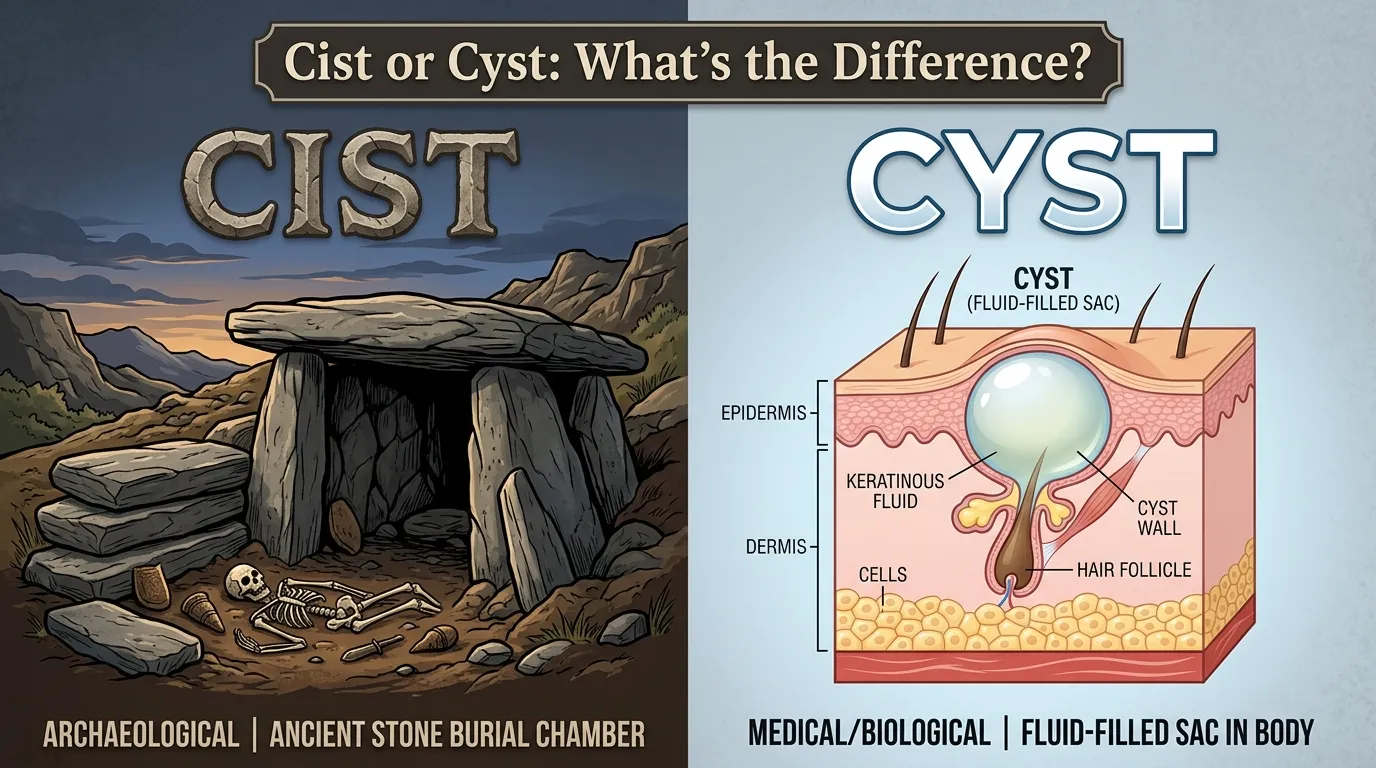
Cyst is the correct spelling for the common medical term describing a closed sac filled with fluid, air, or other material. Cist is a real word too, but it has a different meaning and is mainly used in archaeology and biology.
At first glance, cist and cyst look almost identical. They sound the same in most English accents, which makes them easy to confuse. However, these two words have very different meanings.
If you’re talking about a lump under the skin, a medical condition, or something diagnosed by a doctor, the correct word is cyst. On the other hand, cist is a specialized term used in fields like archaeology and biology, and most people rarely encounter it in everyday conversation.
People search for “cist or cyst” because they want to know:
- Which spelling is correct?
- Is cist a misspelling of cyst?
- What does cyst mean?
- When should you use cist?
- How can you remember the difference?
The answer depends entirely on the context. While cyst is the common medical word, cist is a separate word with its own specialized meaning.
Cist or Cyst: Quick Answer
| Word | Correct? | Meaning |
|---|---|---|
| Cyst | ✅ Yes | A sac in the body containing fluid, air, or other material |
| Cist | ✅ Yes | A stone burial chamber or a protective structure in biology |
Examples
✅ The doctor removed a cyst from her shoulder.
✅ Archaeologists discovered an ancient cist beneath the hill.
What Does Cyst Mean?
A cyst is a closed sac or pocket that can develop in different parts of the body.
It may contain:
- fluid
- pus
- air
- tissue
- other material
Most cysts are non-cancerous (benign), although some may require medical evaluation or treatment.
Example 1
The doctor examined the cyst on his wrist.
Example 2
She had a small ovarian cyst.
Example 3
The dentist found a dental cyst during the examination.
What Does Cist Mean?
A cist is a completely different word.
It usually refers to:
- a small stone burial chamber used in ancient times
- a protective resting stage in certain microscopic organisms (biology)
Because it’s a technical term, most people never need to use it outside specialized subjects.
Example 1
Archaeologists uncovered a Bronze Age cist.
Example 2
Some microorganisms form a protective cist during unfavorable conditions.
Cist vs Cyst: Meaning Comparison
| Feature | Cist | Cyst |
|---|---|---|
| Medical term | ❌ | ✅ |
| Archaeology | ✅ | ❌ |
| Biology (specialized) | ✅ | Sometimes (different meaning) |
| Common everyday word | ❌ | ✅ |
| Dictionary word | ✅ | ✅ |
Which Word Should You Use?
Choose the word based on what you’re talking about.
Use Cyst When Referring To:
- skin lumps
- medical conditions
- ovarian cysts
- breast cysts
- dental cysts
- kidney cysts
Examples
- The scan revealed a harmless cyst.
- Her doctor recommended monitoring the cyst.
Use Cist When Referring To:
- ancient burial chambers
- archaeological discoveries
- certain biological structures
Examples
- The excavation revealed a stone cist.
- The organism entered the cist stage.
Why People Confuse Cist and Cyst
Several factors contribute to the confusion.
Same Pronunciation
Both words are pronounced almost identically.
Similar Spelling
Only one letter differs.
Medical Typing Errors
Many people accidentally replace y with i while typing.
Limited Exposure
Most people know cyst but have never encountered cist, making them unsure which is correct.
British vs American English
There is no spelling difference between British and American English.
| Meaning | British English | American English |
|---|---|---|
| Medical condition | Cyst | Cyst |
| Burial chamber | Cist | Cist |
Common Mistakes
Mistake #1
❌ The doctor removed a cist.
✅ The doctor removed a cyst.
Mistake #2
❌ Archaeologists discovered an ancient cyst.
✅ Archaeologists discovered an ancient cist.
Mistake #3
❌ Assuming cist is always a spelling mistake.
✅ It is a real word with a specialized meaning.
Mistake #4
❌ Using cist in medical reports.
✅ Medical writing almost always uses cyst.
Everyday Examples
Healthcare
The ultrasound detected a small cyst.
Dermatology
The dermatologist removed a harmless cyst.
Archaeology
Researchers found a prehistoric cist during the excavation.
Biology
Certain organisms survive harsh conditions by forming a cist.
Common Types of Cysts
Some of the most common medical cysts include:
- ovarian cyst
- sebaceous cyst
- ganglion cyst
- kidney cyst
- breast cyst
- dental cyst
- Baker’s cyst
All of these use the spelling cyst.
Memory Trick
A simple way to remember the difference is:
Cyst = “Y” for “Your body.”
If it’s a medical condition or something inside the body, choose cyst.
Cist = “I” for “In history.”
Think of ancient burial chambers and archaeology.
FAQs
Is it cist or cyst?
Both are real words, but cyst is the correct medical term.
Is cist a real word?
Yes. It refers to an ancient stone burial chamber or a biological structure.
What is a cyst?
A cyst is a closed sac containing fluid, air, or other material inside the body.
Can I use cist instead of cyst?
No. They have different meanings.
Which spelling do doctors use?
Doctors use cyst.
Is there a British or American spelling difference?
No. Both varieties of English use the same spellings.
How do I remember the difference?
Think:
👉 Cyst = Medical
👉 Cist = Archaeology or specialized biology
Conclusion
Although cist and cyst sound alike, they are not interchangeable.
Cyst is the common medical term used to describe a sac that develops in the body and contains fluid, air, or other material. It’s the word you’ll encounter in healthcare, medical reports, and everyday conversations.
Cist, on the other hand, is a specialized word used mainly in archaeology for ancient stone burial chambers and in biology for certain protective structures.
The easiest way to remember the distinction is:
👉 Cyst = Health and medicine ✅
👉 Cist = History and specialized science ✅
Choosing the correct word based on the context will make your writing clearer, more accurate, and more professional.

Hi, I’m Liam Rivers, author at Engglory.com.
I’m an English grammar expert who simplifies spelling confusion and tricky grammar rules to help readers write and speak with confidence.