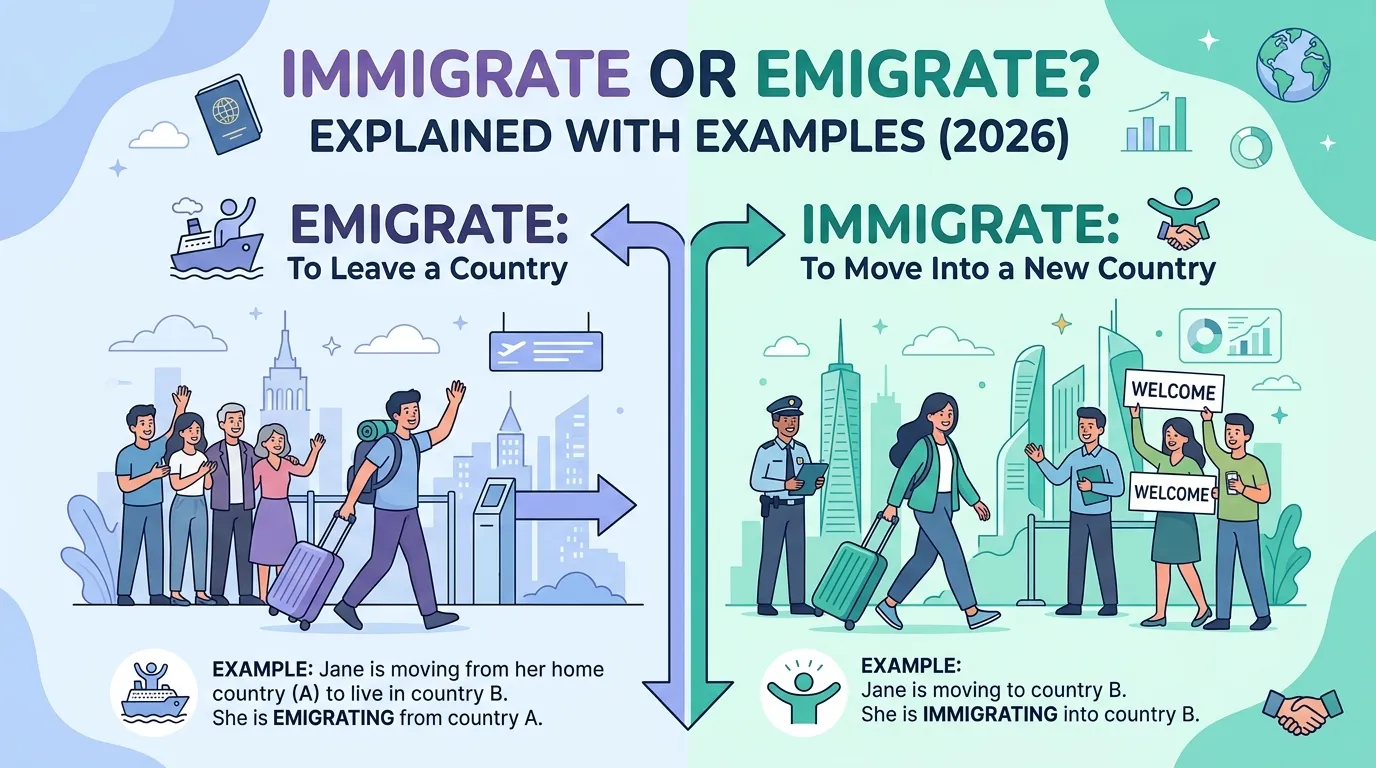
“Immigrate” means moving into a new country, while “emigrate” means leaving your home country to live elsewhere.
A friend says, “My family emigrated from Pakistan and immigrated to Canada.” At first, both words sound almost identical, and suddenly you wonder: what’s the actual difference between immigrate and emigrate?
This is one of the most confusing English word pairs because both relate to moving between countries. They are often used in the same conversation, and many people accidentally switch them while speaking or writing.
People search for “immigrate or emigrate” because the words frequently appear in:
- news reports
- visa discussions
- travel content
- history lessons
- government documents
- social media conversations
The confusion becomes easier once you understand one simple idea:
👉 emigrate focuses on leaving a country
👉 immigrate focuses on entering a new country
Both actions can happen during the same move, but the viewpoint changes depending on which country you are talking about.
In this guide, you’ll learn the meanings, origins, examples, grammar rules, common mistakes, comparison tables, and simple tricks for correctly using immigrate and emigrate.
Immigrate or Emigrate : Quick Answer
👉 Emigrate = Leave your country 🌍➡️
👉 Immigrate = Move into another country ➡️🌎
Examples:
- She emigrated from India. ✅
- She immigrated to Australia. ✅
Simple Rule:
👉 Leaving a country = Emigrate
👉 Entering a new country = Immigrate
The Origin of Immigrate or Emigrate
Both words come from Latin roots related to:
👉 moving from one place to another
Origin of “Emigrate”
The prefix:
👉 e- / ex- means “out”
So:
👉 emigrate = move out of a country
Origin of “Immigrate”
The prefix:
👉 im- means “into”
So:
👉 immigrate = move into a country
These prefixes make the difference much easier to remember.
Immigrate vs Emigrate : Meaning Explained
What Does “Emigrate” Mean?
“Emigrate” means:
👉 leaving your own country to live somewhere else
The focus stays on:
- departure
- leaving home country
Examples:
- They emigrated from Egypt.
- My grandparents emigrated in the 1980s.
- Many families emigrated during the war.
What Does “Immigrate” Mean?
“Immigrate” means:
👉 entering a new country to live there
The focus stays on:
- arrival
- entering another country
Examples:
- They immigrated to Canada.
- Thousands immigrate every year.
- She immigrated for better opportunities.
British English vs American English Usage
Both British and American English use:
- immigrate
- emigrate
Comparison Table
| Word | UK Usage | US Usage |
|---|---|---|
| Immigrate | Same | Same |
| Emigrate | Same | Same |
✔ Same spelling and meaning worldwide
Which Word Should You Use?
Use “Emigrate” When Talking About:
- leaving your country
- moving away from homeland
- departure from a nation
Use “Immigrate” When Talking About:
- entering a new country
- arriving to settle abroad
- moving into another nation
Simple Rule:
👉 From a country = Emigrate
👉 To a country = Immigrate
Common Mistakes with Immigrate or Emigrate
Mistake 1
❌ He immigrated from Pakistan.
✔ He emigrated from Pakistan.
Mistake 2
❌ She emigrated to America.
✔ She immigrated to America.
Mistake 3
❌ Thinking both words mean exactly the same thing
✔ The viewpoint changes the word choice
Mistake 4
❌ Forgetting “from” vs “to”
✔ Emigrate from / Immigrate to
Immigrate or Emigrate in Everyday Examples
News Reports
- Thousands emigrated during the crisis.
- Many people immigrated for work opportunities.
Family Stories
- My grandparents emigrated from Italy.
- They later immigrated to the United States.
Education
- Students sometimes immigrate after graduation.
- Some families emigrate for better education systems.
Social Media
- “Thinking about immigrating someday 🌍”
- “My family emigrated years ago.”
Immigrate or Emigrate : Google Trends & Usage Data
Search trends show:
- “Immigrate” is searched more frequently
- “Emigrate” often confuses learners because it is used less often
Key Insight:
👉 Most confusion happens because both actions occur during the same relocation process.
Comparison Table: Immigrate vs Emigrate
| Feature | Immigrate | Emigrate |
|---|---|---|
| Main focus | Entering country | Leaving country |
| Direction | Into | Out of |
| Common phrase | Immigrate to | Emigrate from |
| Used in migration topics | Yes | Yes |
| Meaning overlap | Related | Related |
Immigrate vs Emigrate in History
Historical discussions often use both words together.
Example:
- Millions emigrated from Europe.
- Many immigrated to America.
The same people can be described using both words depending on perspective.
Why These Words Confuse People
The confusion happens because:
- both involve moving countries
- pronunciation is similar
- the actions happen together
- the viewpoint changes the word
One move can involve:
- emigrating from one place
- immigrating to another
Immigrate vs Emigrate in Government Documents
Official immigration systems often use:
- immigrant
- immigration
- emigrant
- emigration
Correct terminology matters in:
- visa forms
- legal documents
- migration statistics
Simple Trick to Remember the Difference
Easy Memory Rule
👉 Emigrate = Exit 🚪
👉 Immigrate = Into 🏡
Quick Reminder
- emigrate from
- immigrate to
FAQs
1. What is the difference between immigrate and emigrate?
“Emigrate” means leaving a country, while “immigrate” means entering another country to live there.
2. Is it immigrate to or immigrate from?
The correct phrase is:
👉 immigrate to
3. Is it emigrate to or emigrate from?
The correct phrase is:
👉 emigrate from
4. Can one person both emigrate and immigrate?
Yes. The same move can be described from two perspectives.
5. Which word focuses on arrival?
“Immigrate” focuses on arrival into a new country.
6. Why do people confuse these words?
Because both involve moving between countries and sound similar.
7. What is the easiest way to remember the difference?
Emigrate = exit, immigrate = into.
Conclusion
The confusion between immigrate or emigrate happens because both words describe international movement and are often used together in the same situation. However, the difference becomes very simple once you focus on direction and perspective.
“Emigrate” refers to leaving your home country, while “immigrate” refers to entering a new country to live there.
The easiest way to remember is:
👉 Emigrate = exit a country 🚪
👉 Immigrate = move into a country 🏡
One person can technically do both during the same journey:
- emigrate from one country
- immigrate to another country
Understanding this difference helps improve clarity in writing, travel discussions, historical topics, news reports, and everyday English communication.

Hi, I’m Liam Rivers, author at Engglory.com.
I’m an English grammar expert who simplifies spelling confusion and tricky grammar rules to help readers write and speak with confidence.