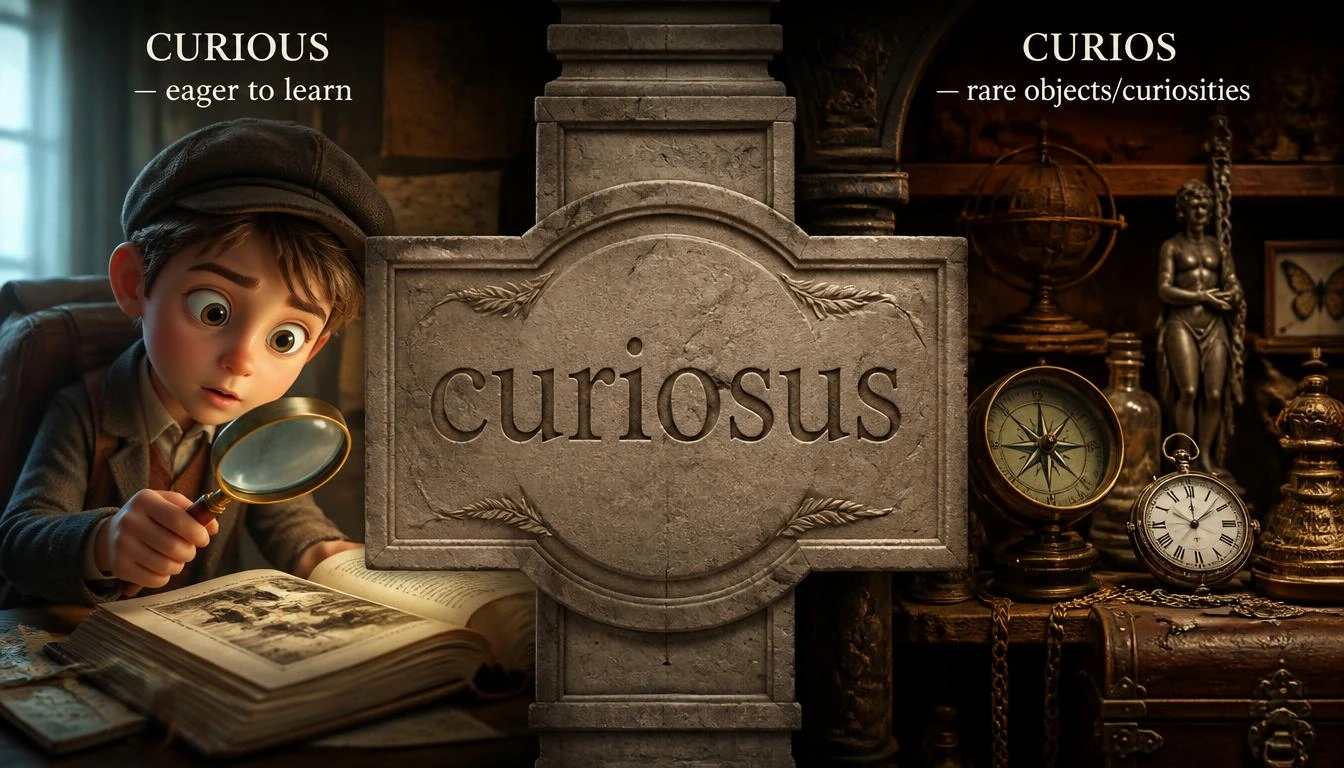
“Curious means wanting to know or learn something, while curios means rare or unusual collectible objects. Use curious for people and feelings, and curios for things and collections.” _____________________________________________________________________________________________
Have you searched for “curios or curious” because you were unsure which word is correct? You are not alone. Thousands of people get confused because these two words look similar and seem connected. At first glance, many assume they are simply different spellings of the same word, but that is not true. They have different meanings and are used in completely different situations.
This confusion often leads to grammar mistakes in emails, school assignments, articles, social media posts, and everyday writing. For example, many people write “I am curios” when they actually mean “I am curious.” A small spelling change can make your sentence incorrect and change its meaning.
In this guide, you will quickly learn the difference between curios and curious, understand their meanings, discover their origins, see real examples, and learn which word you should use with confidence. By the end, you will never mix them up again.
Curios or Curious: Quick Answer
The quick answer is simple:
Curious = wanting to know something or wanting to learn.
Examples:
- I am curious about space.
- She feels curious about the new student.
- The child was curious about the strange sound.
Curios = rare or unusual objects collected as interesting items.
Examples:
- The shop sells curios from around the world.
- He keeps old curios in a glass cabinet.
- The museum displayed many curios.
So if you are talking about a person’s feeling or interest, use curious.
If you mean unusual objects or collectibles, use curios.
The Origin of Curios or Curious
Both words come from the Latin word curiosus, which meant careful, eager, or interested.
Over time, the words changed and developed different meanings.
Curious became an adjective. It describes a person who wants to know or learn something.
Curios became a noun. It is actually a shorter form of “curiosities.” People used it for rare objects, antiques, and unusual collections.
The spelling difference exists because the words grew in different directions over many years. Even though they share the same root, they now have separate uses and meanings.
British English vs American English Spelling
There is no major British or American spelling difference between these words.
Both countries use:
- Curious
- Curios
The meaning stays the same in both regions.
| Word | British English | American English | Meaning |
|---|---|---|---|
| Curious | Curious | Curious | Wanting to know something |
| Curios | Curios | Curios | Unusual objects or collectibles |
Examples:
British example:
- She was curious about the weather report.
American example:
- He bought curios during his trip.
The spelling does not change across regions.
Which Spelling Should You Use?
The correct choice depends on what you want to say.
US audiences:
- Use curious for interest or questions.
- Use curios for collectible objects.
UK and Commonwealth audiences:
- Follow the same rule because the spelling does not change.
Global audiences:
- Use curious in most cases because people often mean interest or wanting information.
- Use curios only when talking about unusual objects.
If you are unsure, read your sentence again. Ask yourself:
“Am I describing a person’s interest, or am I talking about objects?”
Common Mistakes with Curios or Curious
People often mix these words because they look similar.
Wrong:
- I am curios about science.
Correct:
- I am curious about science.
Wrong:
- The shop sold many curious.
Correct:
- The shop sold many curios.
Wrong:
- She collected curious from different countries.
Correct:
- She collected curios from different countries.
Remember:
Curious = feeling
Curios = things
Curios or Curious in Everyday Examples
Emails
- I am curious about your new project.
- I am curious to learn more details.
News
- Reporters were curious about the company’s decision.
- The museum opened a display of rare curios.
Social Media
- I am curious to see the next episode.
- Check out these amazing curios from my trip.
Formal Writing
- Researchers were curious about the results.
- The exhibition included historical curios from Europe.
Curios or Curious: Google Trends & Usage Data
Search interest shows that curious is much more popular than curios.
People search curious because they want:
- Definitions
- Grammar help
- Learning content
- Personal development topics
People search curios mostly when looking for:
- Antique shops
- Collectibles
- Museum items
- Decorative objects
Countries with strong English search activity often show higher searches for curious, including:
- United States
- United Kingdom
- Canada
- Australia
- India
Curios appears more often in shopping and collection-related searches.
Keyword Comparison Table
| Variation | Word Type | Meaning | Example |
|---|---|---|---|
| Curious | Adjective | Wanting to know | I am curious about art |
| Curios | Noun | Rare objects | She bought curios |
| Curiosity | Noun | Desire to know | His curiosity grew |
| Curiously | Adverb | In a curious way | She looked curiously |
| Curiousness | Noun | State of being curious | Her curiousness surprised us |
FAQs
Is “curios” another spelling of “curious”?
No. They are different words with different meanings.
Is “I am curios” correct?
No. The correct sentence is:
“I am curious.”
What does “curios” mean?
Curios are rare, unusual, or collectible objects.
Is “curious” a noun?
No. Curious is an adjective.
Which word is used more often?
Curious is used much more often than curios.
Do British and American English spell these words differently?
No. The spelling stays the same in both forms of English.
How can I remember the difference?
Think of it this way:
Curious = people and feelings
Curios = objects and collections
Conclusion
Understanding the difference between “curios or curious” is easier once you know what each word does. Even though the words look alike and come from the same origin, they serve very different purposes. Curious describes a feeling or desire to learn something new. Curios refers to unusual or collectible objects. A single missing letter can change the meaning of a sentence.
Many people make mistakes because they type quickly or assume both words are spelling variations of the same term. They are not. The good news is that the spelling does not change between British and American English, so you only need to learn one rule. If you are talking about questions, learning, or interest, use curious. If you are talking about antiques or rare items, use curios.
A simple memory trick can help. Curious belongs to people and thoughts. Curios belongs to objects and collections. Keeping that rule in mind will help you write clearly and avoid common mistakes in everyday communication.
Specter or Spectre: Which Spelling Is Correct?

As an English language enthusiast, I love diving into the tricky details of word differences and spelling variations. My mission is to explain confusing terms and make them accessible to everyone, helping readers to communicate with clarity and confidence.