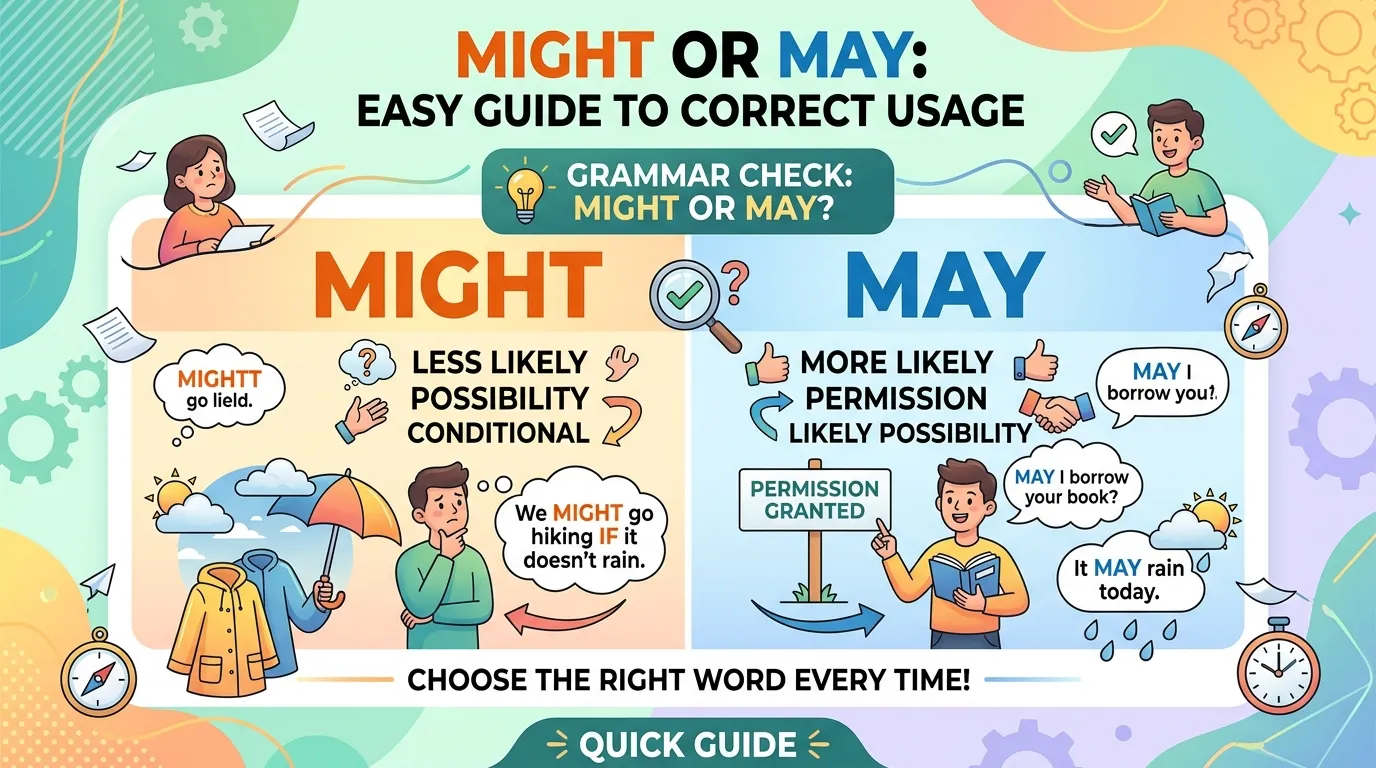
May and might are both modal verbs used to talk about possibility. May usually suggests a stronger possibility, while might often suggests a weaker or more uncertain possibility.
I remember helping a student prepare for an English exam. She wrote, “It may rain tomorrow,” and then asked if “It might rain tomorrow” was wrong. That simple question led to a long discussion because many English learners struggle with these two words.
The confusion makes sense. Both may and might can talk about things that are possible. In many situations, they can even replace each other without changing the meaning much. Yet there are times when one sounds more natural than the other.
If you’ve ever paused while writing or speaking and wondered whether to use may or might, you’re not alone. Students, professionals, and even native speakers sometimes hesitate.
The good news is that the difference is easier than it seems. Once you understand how each word expresses possibility, permission, and uncertainty, choosing the right one becomes much simpler.
Let’s break it down step by step.
Might or May – Quick Answer
Both words express possibility.
- May = something is possible and fairly likely.
- Might = something is possible but less certain.
Example 1
- It may rain later today.
- It might rain later today.
Both are correct, but might sounds a little less certain.
Example 2
- She may join us for dinner.
- She might join us for dinner.
Again, both work, but might suggests more doubt.
The Origin / Background of Might or May
Both words come from Old English and have been used for centuries.
Originally, may was often used to express permission and ability.
Over time, it also became a way to express possibility.
Might developed as the past form of may, but modern English uses it for more than just past situations.
Today, both words are commonly used to discuss uncertain events and future possibilities.
Because their meanings overlap, many people find them confusing.
Might or May Explained : Key Differences
The biggest difference is the level of certainty.
| Term | Meaning | When to Use | Context |
|---|---|---|---|
| May | Possible and somewhat likely | General possibility or permission | Formal and everyday English |
| Might | Possible but less certain | Greater uncertainty or hypothetical situations | Everyday and formal English |
Possibility
May often suggests a stronger chance.
- The package may arrive today.
Might often suggests a weaker chance.
- The package might arrive today.
Permission
Only may is commonly used to ask for permission.
- May I leave early today?
Using might here sounds unnatural.
Hypothetical Situations
Might is often preferred when discussing imagined situations.
- If I had more money, I might buy a new car.
Which Version Should You Use?
For Everyday Conversations
Both words usually work.
- I may go shopping later.
- I might go shopping later.
For Formal Requests
Use may.
- May I ask a question?
- May I enter the room?
For Uncertain Possibilities
Use might.
- We might cancel the trip if the weather gets worse.
For Professional Writing
Choose the word that best reflects the level of certainty.
- Higher possibility → may
- Lower possibility → might
For Global English Learners
Remember this simple rule:
- May = more likely
- Might = less likely
Common Mistakes with Might or May
| Mistake | Correction | Why It Happens |
|---|---|---|
| Might I leave the room? | May I leave the room? | Confusion about permission |
| Using may for very uncertain situations | Use might instead | Unclear level of certainty |
| Thinking may and might are always identical | They have slight differences | Overlapping meanings |
| Avoiding might completely | Use it for uncertainty | Lack of confidence |
| Using may in hypothetical situations | Might often sounds better | Grammar misunderstanding |
Common Error 1
❌ Might I borrow your pen?
✅ May I borrow your pen?
Common Error 2
❌ If I won the lottery, I may buy a yacht.
✅ If I won the lottery, I might buy a yacht.
Common Error 3
❌ May and might always mean exactly the same thing.
✅ They often overlap, but might usually suggests more uncertainty.
Might or May in Real-World Examples
Professional Email
“We may launch the new project next month.”
News Headline
“Interest Rates May Rise Later This Year”
Social Media Post
“I might stay home and watch movies tonight.”
Formal Report
“The findings may indicate a change in customer behavior.”
Hypothetical Statement
“If conditions improve, the company might expand overseas.”
Might or May : Data, Trends & Usage
Who Searches for This Topic?
- Students
- English learners
- Teachers
- Job seekers
- Academic writers
Common Search Questions
- Is may stronger than might?
- When should I use might?
- Can may and might be used interchangeably?
- Is might the past tense of may?
Search Intent
The search intent is mainly informational.
Users want to understand grammar rules and improve their English accuracy.
Why This Matters Today
Clear communication matters in school, business, and everyday life. Knowing when to use may and might helps your writing sound more natural and professional.
Standalone Comparison Table
| Term/Variant | Meaning | Region/Context | Best Used When |
|---|---|---|---|
| May | Possibility or permission | Formal and informal English | Something is reasonably possible |
| Might | Possibility with more uncertainty | Formal and informal English | Something is less certain |
| May | Permission | Schools, workplaces, formal requests | Asking politely |
| Might | Hypothetical possibility | Imagined situations | Discussing uncertain outcomes |
Frequently Asked Questions
Q: What do may and might mean?
A: Both words express possibility. They help describe things that could happen but are not certain.
Q: How do you use may correctly?
A: Use may for permission or when something seems reasonably possible.
Q: How do you use might correctly?
A: Use might when discussing a possibility that feels more uncertain or hypothetical.
Q: May vs might : what’s the difference?
A: May often suggests a stronger possibility, while might suggests greater uncertainty.
Q: Is may acceptable in formal writing?
A: Yes. It is very common in academic, business, and professional writing.
Q: Is might the past tense of may?
A: Historically, yes. However, modern English often uses might independently to express uncertainty.
Q: Can may and might be used interchangeably?
A: In many situations, yes. However, the level of certainty can differ slightly.
Conclusion
Understanding might and may can make your English clearer and more natural. While both words express possibility, may usually suggests a stronger chance that something will happen, while might often signals more doubt.
Keep these points in mind:
- May and might both express possibility.
- May is commonly used for permission.
- Might usually shows greater uncertainty.
- Might often fits hypothetical situations better.
- Both words are widely accepted in formal and informal English.
The next time you’re unsure which word to choose, think about how certain the situation feels. If the possibility seems stronger, use may. If it feels less certain, use might.
Now you know exactly how to use might and may. Bookmark this guide so you never second-guess these common English words again.

Hi, I’m Evelyn Hartley. I love writing short stories that explore everyday life and the little emotions we all feel. I try to keep my words simple but meaningful, so readers can really connect with them.