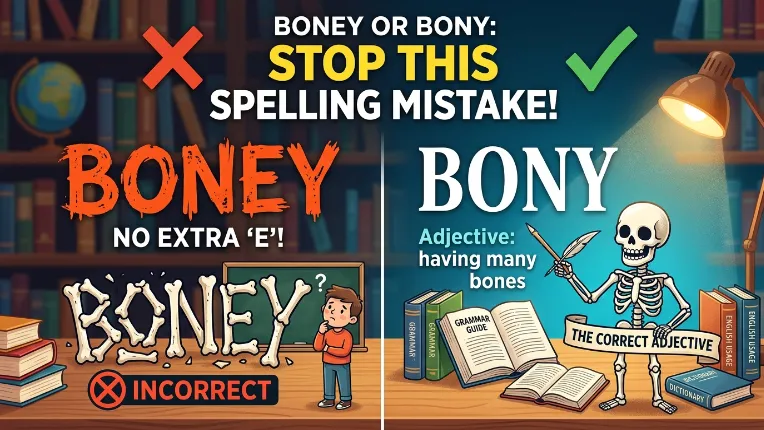
Bony is the correct spelling. “Boney” is a less common variant and often considered incorrect in formal writing.
A student writes, “The dog looked very boney after illness.” The sentence feels right at first glance. But something is off. That extra “e” creates confusion and weakens the impression. This is a common mistake many people make when writing English.
The confusion between boney and bony happens because English spelling rules are not always simple. Some words keep silent letters, while others drop them. People often assume both forms are acceptable. In casual writing, you may see both. But in formal English, only one is widely correct.
This article clears the confusion once and for all. You will learn the correct spelling, why the mistake happens, and how to use the word with confidence. Whether you are a student, teacher, or content writer, this guide will help you avoid a common error and improve your writing.
Boney or Bony – Quick Answer
The correct spelling is bony.
- ✅ Correct: The cat looked thin and bony.
- ❌ Incorrect: The cat looked thin and boney.
Meaning:
“Bony” describes someone or something with visible bones or very little fat.
- Example: His hands were cold and bony.
- Example: The horse looked weak and bony.
👉 Boney is sometimes used informally, but it is not standard in modern English.
The Origin of Boney or Bony
The word bony comes from the word bone. It follows a simple English rule:
👉 When adding “-y” to a word ending in “e,” the “e” is usually dropped.
- Bone + y → Bony
- Ice + y → Icy
- Stone + y → Stony
This rule explains why “bony” is correct. The spelling “boney” keeps the “e,” which breaks this pattern.
Why does “boney” exist?
“Boney” appears in older texts and informal writing. Some people still use it because it looks more natural to them. But over time, modern English has standardized bony as the correct form.
So, while “boney” is not completely unknown, it is not preferred in formal or academic writing.
British English vs American English Spelling
Unlike many confusing words, bony does not change between British and American English. Both follow the same spelling.
Comparison Table
| Feature | British English | American English | Correct Form |
|---|---|---|---|
| Standard spelling | Bony | Bony | ✅ Bony |
| Variant spelling | Boney (rare) | Boney (rare) | ❌ Avoid |
| Usage in writing | Formal & common | Formal & common | ✅ Bony |
| Acceptability | Preferred | Preferred | ✅ Bony |
👉 Unlike words like “colour/color,” this word does not change by region.
Which Spelling Should You Use?
The answer is simple: always use bony.
For Different Audiences:
- United States: Use bony in all writing
- United Kingdom: Use bony only
- Commonwealth countries: Use bony
- Global audience: Stick with bony for clarity
Professional Advice:
- In exams → Use bony
- In emails → Use bony
- In articles → Use bony
- In social media → You may see “boney,” but avoid it
👉 Using the correct spelling builds trust and shows strong language skills.
Common Mistakes with Boney or Bony
Many learners repeat the same errors. Here are the most common ones:
1. Adding an unnecessary “e”
- ❌ Boney
- ✅ Bony
👉 Remember: Drop the “e” before adding “-y.”
2. Thinking both spellings are equal
Some believe both are correct. This is not true in modern standard English.
- ❌ Both are acceptable
- ✅ Only bony is correct
3. Copying informal writing
Social media often uses incorrect spelling.
- ❌ “That dog looks so boney”
- ✅ “That dog looks so bony”
4. Confusing with similar patterns
Not all words follow the same rule, which causes confusion.
- Bone → Bony ✅
- Love → Lovely (keeps “e”)
👉 English has exceptions, but “bony” follows the drop-“e” rule.
Boney or Bony in Everyday Examples
Understanding real-life usage helps you remember better.
1. In Emails
- ✅ “The patient appeared weak and bony after illness.”
- ❌ “The patient appeared weak and boney after illness.”
2. In News Writing
- ✅ “Rescuers found a bony dog near the roadside.”
Professional writing always uses bony.
3. On Social Media
- ❌ “Why is that cat so boney?”
- ✅ “Why is that cat so bony?”
👉 Informal platforms often contain mistakes.
4. In Formal Writing
- ✅ “The sculpture showed a thin, bony figure.”
5. In Daily Conversation
Even when speaking, correct spelling matters in writing:
- “He looked very bony after the long illness.”
Boney or Bony – Google Trends & Usage Data
Search data shows a clear pattern.
Global Usage:
- “Bony” is searched and used far more often
- “Boney” appears less and is declining
Country Trends:
- USA: Strong preference for bony
- UK: Almost exclusive use of bony
- Australia & Canada: Follow bony
Why is “bony” more popular?
- It follows grammar rules
- It is taught in schools
- It is used in dictionaries
👉 “Boney” survives mainly due to habit, not correctness.
Comparison Table: Boney vs Bony
| Aspect | Bony (Correct) | Boney (Incorrect) |
|---|---|---|
| Spelling accuracy | ✅ Correct | ❌ Incorrect |
| Formal writing | ✅ Accepted | ❌ Avoid |
| Grammar rule | Follows rule | Breaks rule |
| Usage frequency | Very high | Very low |
| Dictionary status | Standard word | Rare/variant |
| Professional use | Yes | No |
FAQs
1. Is “boney” ever correct?
“Boney” is rarely used and considered non-standard. In modern English, bony is the correct choice.
2. Why do people write “boney”?
People keep the “e” because the base word is “bone.” But grammar rules require dropping it.
3. Is “bony” used in medical terms?
Yes. Doctors use “bony” to describe body structure, such as “bony joints” or “bony frame.”
4. Does pronunciation change?
No. Both “bony” and “boney” are pronounced the same. The difference is only in spelling.
5. Can I use “boney” in creative writing?
You can, but it is not recommended. It may look like a mistake to readers.
6. Is “bony” formal or informal?
“Bony” works in both formal and informal writing. It is the standard form.
7. How can I remember the correct spelling?
Use this trick:
👉 “Drop the E before adding Y” → Bone → Bony
Conclusion
The confusion between boney and bony is simple but important. While both forms may appear in writing, only bony is correct in modern English. It follows a clear grammar rule drop the silent “e” before adding “-y.” This makes it the standard spelling used in schools, professional writing, and global communication.
Using the wrong spelling may not seem like a big mistake, but it can affect clarity and credibility. Whether you are writing an email, article, or exam answer, choosing the correct form shows attention to detail. Over time, small improvements like this build strong language skills.
Always remember: when in doubt, follow the rule and keep it simple. Stick with bony, and you will never go wrong. Clear writing creates strong impact, and correct spelling is the first step toward that goal.

Hi, I’m Evelyn Hartley. I love writing short stories that explore everyday life and the little emotions we all feel. I try to keep my words simple but meaningful, so readers can really connect with them.