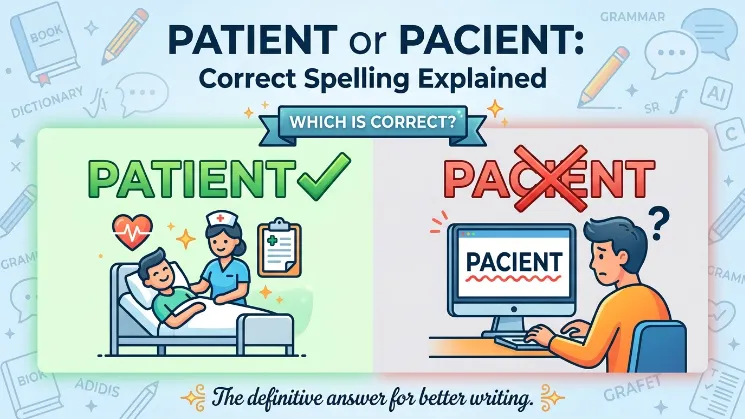
“Patient” is the only correct English spelling; “pacient” is a common misspelling influenced by other languages.
A young medical intern was writing notes during a busy hospital shift. He quickly typed, “The pacient needs rest.” His senior doctor paused and said, “Check the spelling.” Confused, he searched his phone and found both “patient” and “pacient” used in different places. That moment made him realize how easily English spelling can mislead even careful writers.
This confusion is very common among students, healthcare workers, and English learners. The keyword “patient vs pacient” is often searched by people who want to make sure they are using the correct medical and grammatical term. The issue usually comes from similar spellings in languages like Spanish, French, and Portuguese, where “paciente” looks almost identical.
In English, however, spelling matters a lot—especially in medical or formal writing. A small error can affect professionalism and clarity. This guide will clearly explain the correct spelling, why the confusion exists, and how to avoid this mistake in real-life writing.
Patient vs Pacient – Quick Answer
- Patient → ✅ Correct English spelling
- Pacient → ❌ Incorrect in English
Meaning of “Patient”:
- A person receiving medical care
- A calm, tolerant individual
Examples:
- The patient is recovering in the ward.
- Please be patient while waiting for results.
👉 “Pacient” is not used in standard English.
Origin of Patient
The word patient comes from the Latin “patiens,” meaning to suffer or endure. It entered Old French as “pacient,” and later evolved into Middle English as patient.
Over time, English standardized the spelling by replacing “ci” with “ti,” simplifying the word into its modern form.
However, many other languages kept versions closer to the original Latin spelling:
- Spanish: paciente
- French: patient
- Portuguese: paciente
This is why learners often confuse the spelling when switching to English.
Why “Pacient” Is Wrong in English
The spelling “pacient” does not exist in English dictionaries.
Reasons it appears:
- Influence from other languages
- Typing habits of multilingual speakers
- Mispronunciation-based spelling
Key rule:
👉 In English, always use patient.
Patient vs Pacient – Language Comparison
Comparison Table
| Language | Correct Form | Usage |
|---|---|---|
| English | Patient | Medical + personality |
| Spanish | Paciente | Same meaning |
| French | Patient | Same meaning |
| Portuguese | Paciente | Same meaning |
| Incorrect English | Pacient | ❌ Not valid |
Patient in Everyday Use
The word patient is widely used in two main contexts:
1. Medical Context
- The patient was admitted for surgery.
- Doctors are monitoring the patient closely.
2. Personality Context
- Be patient during difficult times.
- She is very patient with children.
In Emails:
- Kindly update the condition of the patient.
In News:
- The patient showed signs of improvement after treatment.
On Social Media:
- “Stay calm and patient, everything takes time.”
Common Mistakes with Patient vs Pacient
Mistake 1:
❌ The pacient is stable
✔️ The patient is stable
Mistake 2:
❌ Be pacient with me
✔️ Be patient with me
Mistake 3:
❌ The doctor checked the pacient
✔️ The doctor checked the patient
Mistake 4:
❌ Using “pacient” in formal writing
✔️ Always use patient
Why Learners Get Confused
Three main reasons:
- False Friends Across Languages
Similar spelling in Spanish and French causes confusion. - Sound Similarity
Both words are pronounced almost the same. - Typing Habit Errors
People type quickly and assume the spelling is correct.
Patient in Real-Life Situations
Hospitals:
- Correct: The patient is stable
- Incorrect: The pacient is stable
Education:
- Correct: Be patient while learning
- Incorrect: Be pacient while learning
Professional Writing:
- Correct: Patient records are confidential
- Incorrect: Pacient records are confidential
Google Trends & Usage Insight
Search data shows:
- “Patient” is extremely common worldwide
- “Pacient” appears mostly as a spelling error or from non-English speakers
Key Insight:
👉 English content, medical documents, and education systems all use patient.
Comparison Table: Patient vs Pacient
| Feature | Patient (Correct) | Pacient (Incorrect) |
|---|---|---|
| Language | English | Other languages |
| Meaning | Medical/personality | Same meaning but wrong spelling |
| Dictionary Use | Yes | No |
| Usage | Global English | Not accepted |
| Example | The patient is safe | ❌ Invalid |
FAQs
1. Is it patient or pacient?
The correct English spelling is patient.
2. Is “pacient” ever correct?
No, it is not used in English.
3. What does patient mean?
It means a person receiving medical care or someone who is calm and tolerant.
4. Why do people write pacient?
Because of influence from other languages like Spanish and French.
5. Can I use pacient in exams?
No, always use patient in English exams.
6. Is patient a noun or adjective?
It can be both:
- Noun: hospital patient
- Adjective: be patient
7. How can I remember the correct spelling?
Think: English always uses “patient” with “t” at the end.
Conclusion
The difference between patient vs pacient is simple but important. In English, only patient is correct. It is used for both medical situations and personality traits like calmness and tolerance. The spelling “pacient” comes from other languages and is not accepted in English writing.
This confusion happens mainly because many languages share similar word roots, but English has standardized its own spelling system. For professional, academic, or medical writing, using the correct form is essential to maintain clarity and credibility.
Once you remember the simple rule English uses patient with “t” you will never make this mistake again. Whether you are writing emails, essays, or hospital notes, correct spelling helps you look more accurate and professional.

Hi, I’m Liam Rivers, author at Engglory.com.
I’m an English grammar expert who simplifies spelling confusion and tricky grammar rules to help readers write and speak with confidence.