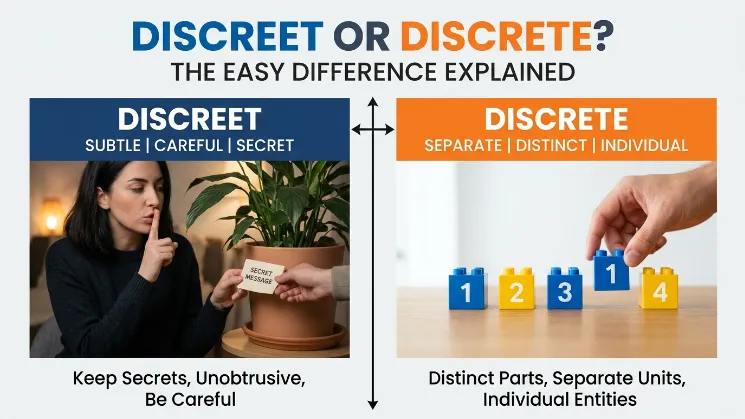
“Discreet” means careful and private, while “discrete” means separate and distinct.
A manager once sent an email saying, “Please handle this matter in a discrete way.” The message was serious, but the word choice was wrong. He meant discreet, not discrete. One small spelling mistake changed the meaning completely.
This confusion is very common. Many people search for “discreet or discrete” because both words look almost the same. They differ by just one letter, but their meanings are very different.
These words often appear in emails, professional writing, exams, and business communication. Using the wrong one can make your sentence unclear or even embarrassing.
The tricky part is that both words are correct. The real challenge is knowing when to use each one.
In this guide, you will clearly understand the difference between discreet and discrete, how to remember them, and how to use them correctly in daily writing.
Discreet or Discrete – Quick Answer
- Discreet = careful, private, and not drawing attention
- Discrete = separate, individual, or distinct
Examples:
- Be discreet when discussing personal matters.
- The data is divided into discrete sections.
👉 Simple rule:
Discreet = secret behavior
Discrete = separate things
The Origin of Discreet or Discrete
Both words come from the same Latin root “discretus,” meaning “separated.” Over time, their meanings changed.
- Discreet developed the idea of being careful and thoughtful, especially in sensitive situations
- Discrete kept the original meaning of something being separate or divided
This is why the words look similar but have different meanings today.
British English vs American English Spelling
There is no difference between British and American English for these words.
Comparison Table
| Word | British English | American English |
|---|---|---|
| Discreet | Discreet | Discreet |
| Discrete | Discrete | Discrete |
Both forms are used the same way worldwide.
Which Spelling Should You Use?
The correct choice depends on meaning.
Use “Discreet” when:
- Talking about privacy or secrecy
- Describing careful behavior
Examples:
- She was discreet about the issue
- Please be discreet in public
Use “Discrete” when:
- Talking about separate or distinct items
- Referring to data, numbers, or categories
Examples:
- The system has discrete parts
- Data is stored in discrete units
Pro Tip:
👉 Discreet = secret (both have “ee”)
👉 Discrete = separate
Common Mistakes with Discreet or Discrete
Mistake 1:
❌ Please be discrete about this matter
✔️ Please be discreet about this matter
Mistake 2:
❌ The data is discreet
✔️ The data is discrete
Mistake 3:
❌ He handled it in a discrete way (meaning private)
✔️ He handled it in a discreet way
Mistake 4:
❌ Using them interchangeably
✔️ Each word has a specific meaning
Discreet or Discrete in Everyday Examples
In Emails:
- Please keep this information discreet
- The report is divided into discrete sections
In Business:
- A discreet approach is needed
- The system works in discrete steps
In Social Media:
- Handle sensitive topics discreetly
- Posts are grouped into discrete categories
In Academic Writing:
- Data is analyzed in discrete units
- The researcher remained discreet
Discreet or Discrete – Google Trends & Usage Data
Search trends show:
- Discreet is more common in daily communication
- Discrete is more common in technical and academic fields
- Many users search both due to spelling similarity
Usage Insight:
- Discreet → social, personal, professional tone
- Discrete → technical, scientific, structured contexts
Comparison Table: Discreet vs Discrete
| Feature | Discreet | Discrete |
|---|---|---|
| Meaning | Private, careful | Separate, distinct |
| Usage | Social, personal | Technical, academic |
| Context | Behavior | Objects or data |
| Example | Discreet conversation | Discrete values |
| Memory Tip | “ee” = keep secret | No “ee” = separate |
FAQs
1. Is it discreet or discrete?
Both are correct, but they have different meanings.
2. What does discreet mean?
It means careful, private, and not attracting attention.
3. What does discrete mean?
It means separate or distinct.
4. Why are they confusing?
They look very similar but have different meanings.
5. Which is used in data or math?
Discrete is used in technical contexts.
6. Which is used for behavior?
Discreet is used for behavior and privacy.
7. How can I remember the difference?
Discreet = secret, Discrete = separate.
Conclusion
The difference between discreet or discrete is small in spelling but big in meaning. Discreet is about being careful, private, and respectful of sensitive situations. It is commonly used in social and professional communication. Discrete, on the other hand, refers to things that are separate, distinct, or individually divided. It is often used in technical, academic, and scientific contexts.
The confusion happens because both words look almost identical. However, a simple memory trick can make things easier. The word discreet has double “e,” just like the word “secret.” This can help you remember that it is related to privacy. Discrete does not have double “e,” which connects it to the idea of separation.
Using the correct word improves clarity and professionalism in your writing. Whether you are writing an email, report, or exam answer, choosing the right word shows attention to detail.
With this understanding, you can now confidently use discreet and discrete without any confusion.

Hi, I’m Liam Rivers, author at Engglory.com.
I’m an English grammar expert who simplifies spelling confusion and tricky grammar rules to help readers write and speak with confidence.