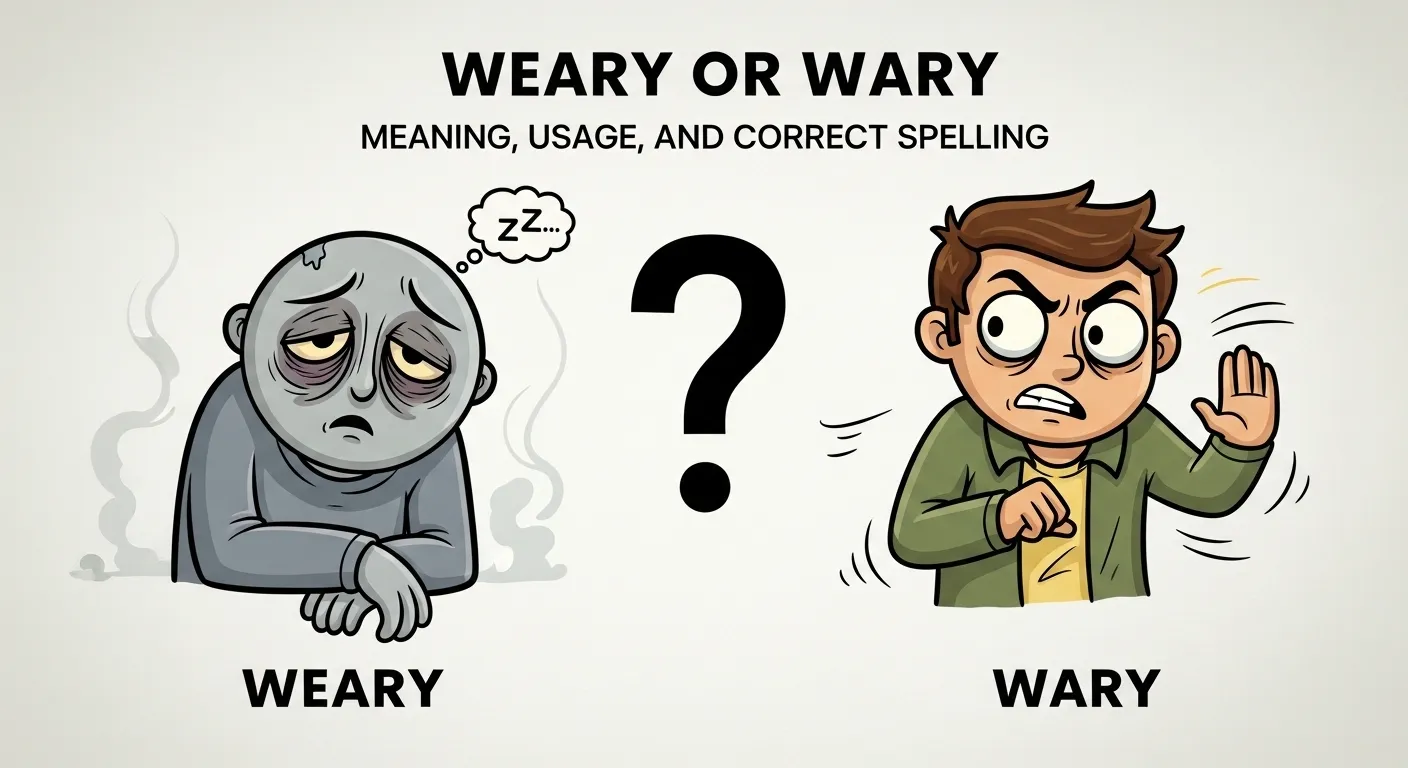
“Weary” means tired, and “wary” means cautious don’t confuse them.
Have you ever typed “weary or wary” into Google because you weren’t sure which to use? You’re not alone. These two words sound similar but have very different meanings, and using the wrong one can completely change your sentence.
Weary describes physical or mental tiredness, as in “After the long trip, she felt weary.”
Wary refers to being cautious or alert, as in “Be wary of unfamiliar websites.”
People search for this keyword because confusing these words is common in emails, essays, social media, and professional writing. The goal is to clarify which word fits the context so you can write confidently.
This article will give you a quick answer, explain the origin, show spelling rules, highlight common mistakes, provide practical examples, and give advice based on your audience. By the end, you’ll always know whether to use weary or wary in your writing.
Weary or Wary – Quick Answer
| Word | Meaning | Example |
| Weary | Tired or exhausted | “He felt weary after the marathon.” |
| Wary | Cautious or alert | “She was wary of the noisy street.” |
Tip: Feeling tired? Use weary. Being cautious? Use wary.
The Origin of Weary or Wary
- Weary comes from Old English werig, meaning tired or exhausted.
- Wary comes from Old English war, meaning careful or alert.
- Both words evolved separately, which is why they sound alike but mean different things.
British English vs American English Spelling
| Word | British English | American English | Example |
| Weary | weary | weary | “The weary traveler rested.” |
| Wary | wary | wary | “Be wary of suspicious links.” |
Observation: Both words are spelled the same in UK and US English; the confusion is only about meaning.
Which Spelling Should You Use?
- Weary → Use for tiredness or exhaustion.
- Wary → Use for caution or alertness.
Audience-based advice:
- US, UK, and Commonwealth writers: Same rules apply.
- Global audience: Focus on meaning, as the spelling is consistent worldwide.
Common Mistakes with Weary or Wary
| Mistake | Correct Version | Why It’s Wrong |
| “I am very wary after walking.” | “I am very weary after walking.” | Wary = cautious, not tired |
| “Be weary of scams online.” | “Be wary of scams online.” | Weary = tired, not cautious |
| “He looked wary from work.” | “He looked weary from work.” | Confuses tiredness with caution |
Weary or Wary in Everyday Examples
Emails:
- “I’m feeling weary after the long meeting.”
- “Please be wary when clicking links.”
News Articles:
- “Residents are weary of repeated blackouts.”
- “Citizens are wary of rising crime rates.”
Social Media:
- “I’m so weary of Mondays!”
- “Stay wary of online scams.”
Formal Writing:
- “The committee grew weary of constant delays.”
- “Investors remain wary of market fluctuations.”
Weary or Wary – Google Trends & Usage Data
- Weary searches are linked to fatigue and exhaustion.
- Wary searches are linked to caution, safety, and alertness.
- Top countries: United States, UK, India, Canada, Australia.
- Context: Writing guidance, proofreading, and English learning are the main reasons people search.
Comparison Table: Weary vs Wary
| Feature | Weary | Wary |
| Meaning | Tired, exhausted | Cautious, alert |
| Pronunciation | /ˈwɪəri/ | /ˈweəri/ |
| Usage | Fatigue or exhaustion | Caution in situations |
| Common Mistake | Using wary instead of weary | Using weary instead of wary |
FAQs
1. Is “weary” used in American or British English?
Both; meaning is the same worldwide.
2. Can “wary” describe being tired?
No, “wary” only means cautious or alert.
3. Are “weary” and “wary” pronounced the same?
They sound similar, but “weary” is slightly longer.
4. Can “weary” be figurative?
Yes, e.g., “She was weary of hearing the same excuse.”
5. How can I remember the difference?
Think: weary = tired, wary = cautious.
6. Can “wary” describe a person?
Yes, e.g., “He is wary of strangers.”
7. Are there common phrases with these words?
- “Weary traveler” → tired traveler
- “Wary investor” → cautious investor
Conclusion
Confusing weary and wary is common, but understanding the difference makes your writing precise and professional. Weary is always about tiredness, while wary is about caution. Both words are spelled the same in British and American English, so the focus should be on correct usage.
Using these words correctly improves clarity in emails, social media posts, essays, and formal writing. Remember: if you feel exhausted, use weary; if you are alert or cautious, use wary.
By practicing these distinctions and observing context, you will avoid mistakes and communicate more effectively. This small effort makes a big difference in how your writing is perceived. Keep this guide handy to confidently use weary or wary anytime, anywhere.
Dual or Duel: Meaning, Usage, and Correct Choice

Hi, I’m Liam Rivers, author at Engglory.com.
I’m an English grammar expert who simplifies spelling confusion and tricky grammar rules to help readers write and speak with confidence.