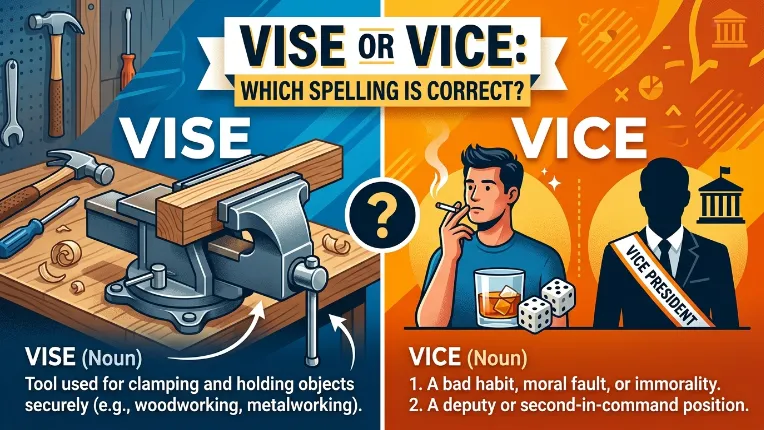
“Vice” is the correct word in most cases, while “vise” is used in American English for a gripping tool.
Ali was writing an email to his boss. He wanted to say, “I need to hold this pipe in a vise.” But he paused. Was it vise or vice? He quickly searched online, only to find both spellings used in different places. Confusing, right?
This is exactly why people search for “vise or vice.” Both words look almost identical, but they mean completely different things depending on context and region. One refers to a tool used to hold objects tightly, while the other is linked to immoral behavior or positions like vice president.
Spelling confusion like this is common in English, especially when British and American English differ. A small mistake can change the meaning of your sentence completely. This guide clears that confusion once and for all. You’ll learn the correct spelling, when to use each word, and how to avoid common mistakes in daily writing.
Vise or Vice – Quick Answer
The difference is simple:
- Vice = immoral habit OR a position (like vice president)
- Vise = a tool used to grip or hold objects tightly (mainly American English)
Examples:
- He struggled to escape his gambling vice. ✅
- The mechanic tightened the pipe in a vise. ✅
In British English, even the tool is spelled vice, not vise.
The Origin of Vise or Vice
The word vice comes from the Latin word “vitium,” meaning fault or defect. Over time, it entered Old French as “vice,” keeping the meaning of moral weakness or wrongdoing.
Later, the mechanical tool (used for gripping objects) was also called a vice because it “holds tightly,” like a moral vice traps a person.
In American English, to avoid confusion, the spelling “vise” was introduced specifically for the tool. This made it easier to separate meanings:
- Vice → moral or official meaning
- Vise → mechanical tool
So, the difference exists mainly because American English prefers clarity in spelling.
British English vs American English Spelling
Spelling rules vary between British and American English, and this is a perfect example.
Key Difference:
- British English uses vice for both meanings
- American English uses vise for the tool and vice for other meanings
Comparison Table
| Meaning | British English | American English |
| Moral weakness | Vice | Vice |
| Position (e.g., VP) | Vice | Vice |
| Mechanical gripping tool | Vice | Vise |
Examples:
- UK: He fixed the wood in a vice
- US: He fixed the wood in a vise
Which Spelling Should You Use?
Choosing the right spelling depends on your audience.
If your audience is American:
Use:
- Vise → for tools
- Vice → for morals or positions
If your audience is British or Commonwealth:
Use:
- Vice → for everything
If your audience is global:
- Prefer vice unless you are clearly referring to the tool in an American context
- If writing technical content, use vise for clarity
Pro Tip:
If you’re unsure, ask:
👉 Am I talking about a tool?
- Yes → vise (US)
- No → vice
Common Mistakes with Vise or Vice
Many people mix these words because they sound the same.
Mistake 1:
❌ He placed the metal in a vice (US context)
✔️ He placed the metal in a vise
Mistake 2:
❌ Smoking is a bad vise
✔️ Smoking is a bad vice
Mistake 3:
❌ She became the vise president
✔️ She became the vice president
Mistake 4:
❌ The mechanic used a vice tool (US spelling error)
✔️ The mechanic used a vise
Quick Tip:
- Vice = behavior or rank
- Vise = tool (US only)
Vise or Vice in Everyday Examples
Understanding real-life usage makes things easier.
In Emails:
- Please secure the object in a vise before cutting. (US)
- He needs to overcome this bad vice.
In News:
- The Vice President addressed the nation today.
- Addiction is often described as a dangerous vice.
On Social Media:
- “Trying to quit my worst vice this year 😅”
- “Anyone know where I can buy a bench vise?”
In Formal Writing:
- Corruption is considered a serious moral vice.
- The engineer used a vise to stabilize the material.
Vise or Vice – Google Trends & Usage Data
Search trends show clear patterns:
- “Vice” is searched globally and much more frequently
- “Vise” is mostly searched in the United States
- Countries like the UK, Canada, and Australia prefer vice for all meanings
Usage Insight:
- Vice dominates in general writing, media, and education
- Vise appears mainly in technical, mechanical, or DIY contexts
Conclusion from Trends:
If you’re writing for a global audience, vice is the safer and more common choice unless referring to a tool in American English.
Comparison Table: Vise vs Vice
| Feature | Vise | Vice |
| Meaning | Tool for gripping objects | Moral weakness / position |
| Usage Region | American English | Global |
| Common Context | Mechanical work | Behavior, politics, titles |
| Example | Bench vise | Vice president, bad vice |
| Frequency | Less common | Very common |
FAQs
1. Is it vise or vice?
Both are correct, but vice is more common. Vise is used for a tool in American English.
2. What is the meaning of vice?
It means a bad habit, immoral behavior, or a secondary position (like vice president).
3. What is a vise tool?
A vise is a mechanical device used to hold objects tightly during work.
4. Do British people use “vise”?
No, British English uses vice for both meanings.
5. Can vice mean a tool?
Yes, in British English, vice also refers to the gripping tool.
6. Why are vise and vice confusing?
They sound the same and have similar spellings but different meanings and regional usage.
7. Which spelling should I use in exams?
Use vice, unless your exam specifically follows American English and refers to a tool.
Conclusion
The confusion between vise or vice is common, but once you understand the difference, it becomes easy to use them correctly. The key is context. If you’re talking about a bad habit or a position, the correct word is always vice. If you’re referring to a tool used for gripping, then vise is correct in American English, while British English still prefers vice.
This small spelling difference can have a big impact on clarity, especially in professional writing. Using the wrong word might confuse your reader or change the meaning of your sentence entirely. That’s why it’s important to match your spelling with your audience.
For global communication, vice is generally the safer option. But if you’re writing technical content for an American audience, using vise shows precision and correctness.
Mastering these small details improves your writing and builds trust with your readers. Now, you’ll never hesitate again when choosing between vise or vice.

Hi, I’m Evelyn Hartley. I love writing short stories that explore everyday life and the little emotions we all feel. I try to keep my words simple but meaningful, so readers can really connect with them.