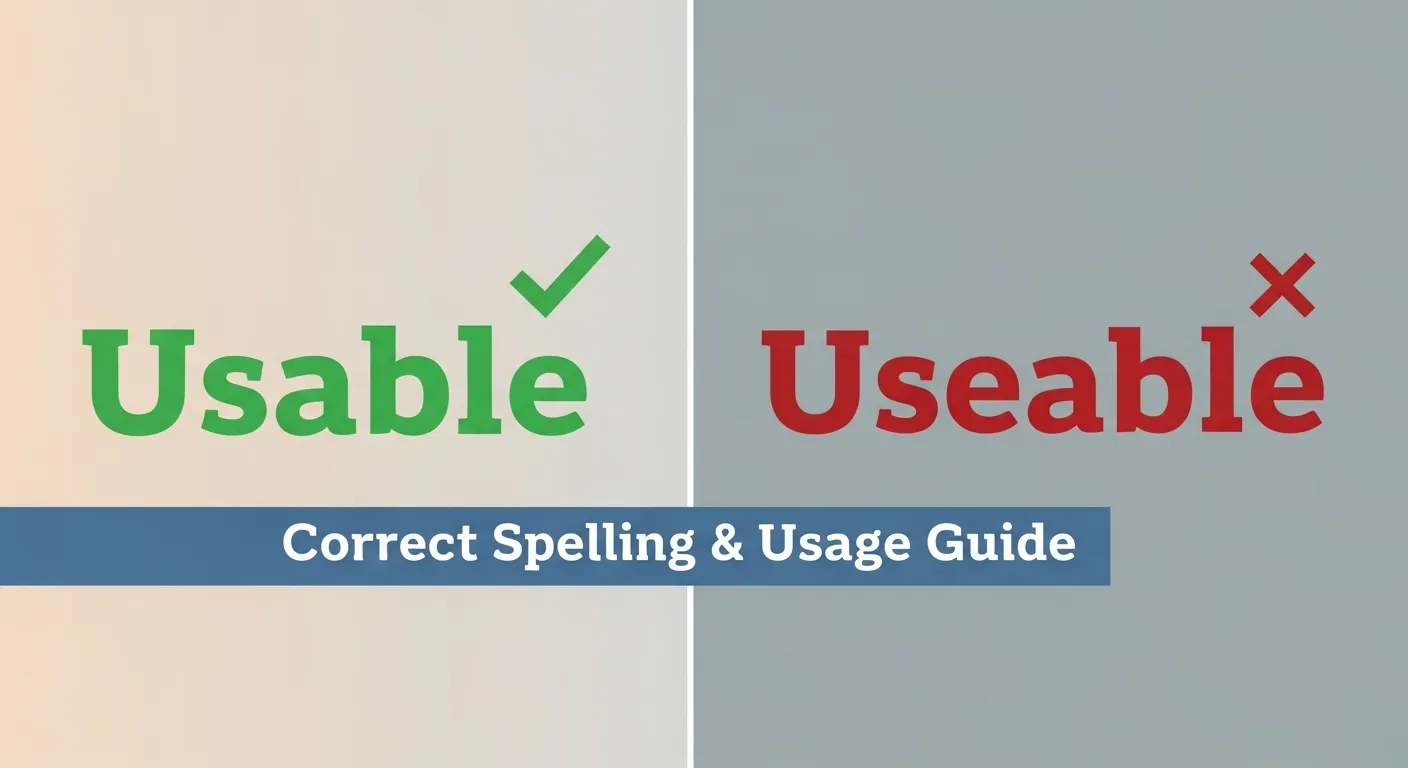
“Usable” is the standard spelling, while “useable” is less common but acceptable.
Many writers and English learners get confused between “usable” and “useable”. Both words sound the same and mean the same thing, but one spelling is far more common in modern English. Using the less common form can make your writing look slightly unusual.
Usable describes something that can be used effectively. For example, “The software is now fully usable on all devices.”
Useable is an alternative spelling with the same meaning but is rarely seen in contemporary writing.
People search for “usable or useable” to clarify proper usage in essays, emails, websites, and professional documents. Knowing the preferred form ensures your writing looks polished and aligns with standard English conventions.
In this article, we’ll provide a quick answer, explain the origin, show British vs American usage, highlight mistakes, provide practical examples, and offer audience-based advice. By the end, you’ll confidently know when to write usable or useable in any context.
Usable or Useable – Quick Answer
| Word | Meaning | Example |
| Usable | Able to be used effectively | “The app is usable on mobile devices.” |
| Useable | Alternative spelling | “The tool is useable, but ‘usable’ is preferred.” |
Tip: Always use usable unless you have a reason to choose the less common variant useable.
The Origin of Usable or Useable
- Usable comes from the verb use + suffix -able, meaning “able to be used.”
- The variant useable appeared due to spelling patterns influenced by English pronunciation and morphology.
- Both words are correct, but dictionaries and style guides prefer usable.
British English vs American English Spelling
| Word | British English | American English | Example |
| Usable | usable | usable | “The form is usable online.” |
| Useable | useable | useable | “The form is useable, but less common.” |
✅ Observation: Both spellings are recognized in UK and US English; usable is overwhelmingly preferred in modern writing.
Which Spelling Should You Use?
- Usable → Standard, preferred in all types of writing: formal, academic, business, and online.
- Useable → Acceptable alternative but rare and less recommended.
Audience tip:
- US, UK, Commonwealth, and global writers: Use usable to follow standard conventions.
Common Mistakes with Usable or Useable
| Mistake | Correct Version | Why It’s Wrong |
| “The website is useable.” | “The website is usable.” | Less common spelling |
| “Make sure the tool is useable.” | “Make sure the tool is usable.” | Use the preferred form |
| “Useable resources are limited.” | “Usable resources are limited.” | Useable is correct but uncommon |
Usable or Useable in Everyday Examples
Emails:
- “The new template is fully usable for our team.”
- “Please check if the feature is usable before release.”
News Articles:
- “The emergency kit must be usable in all weather conditions.”
- “The shelters are usable even during winter storms.”
Social Media:
- “This filter is so usable for quick edits!”
- “The tool is usable, works perfectly for beginners.”
Formal Writing:
- “The software interface is intuitive and usable for all employees.”
- “Researchers tested whether the new equipment was usable in field conditions.”
Usable or Useable – Google Trends & Usage Data
- Usable dominates search results and usage in both US and UK English.
- Useable appears occasionally but is far less common.
- Top countries: United States, UK, Canada, Australia, India.
- Context: Writing guidance, tech documentation, software usability, and educational content.
Comparison Table: Usable vs Useable
| Feature | Usable | Useable |
| Meaning | Able to be used | Same meaning |
| Pronunciation | /ˈjuːzəbl/ | /ˈjuːzəbl/ |
| Usage | Standard, widely used | Alternative, rare |
| Common Mistake | Writing “useable” unnecessarily | Using “useable” instead of standard “usable” |
FAQs
1. Is “usable” American or British English?
Both; it is the standard spelling worldwide.
2. Can “useable” be used in formal writing?
Yes, but it is uncommon and not preferred.
3. Are “usable” and “useable” pronounced differently?
No, they are pronounced the same.
4. Which spelling is recommended in professional writing?
Usable is recommended for clarity and consistency.
5. Can “usable” describe abstract things?
Yes, e.g., “The concept is usable in different scenarios.”
6. Are there common phrases with “usable”?
- “Usable resources” → resources that can be utilized
- “Usable space” → space that can be effectively used
7. How can I remember the difference?
Think: usable = standard, useable = alternative spelling.
Conclusion
Confusing usable and useable is common, but knowing the preferred form ensures polished and professional writing. Usable is the standard spelling used worldwide in emails, essays, software documentation, news articles, and social media. Useable is correct but rarely used and can make your writing look unconventional.
When describing anything that can be effectively used tools, software, space, or resources always default to usable. Using the standard form improves clarity, consistency, and credibility across all forms of communication.
By keeping this guide in mind, you’ll never hesitate when writing usable or useable, and your writing will always align with modern English standards. Remember: usable is the safest choice for professional and everyday writing.
👉Protesters or Protestors: Correct Spelling & Usage

Hi, I’m Liam Rivers, author at Engglory.com.
I’m an English grammar expert who simplifies spelling confusion and tricky grammar rules to help readers write and speak with confidence.