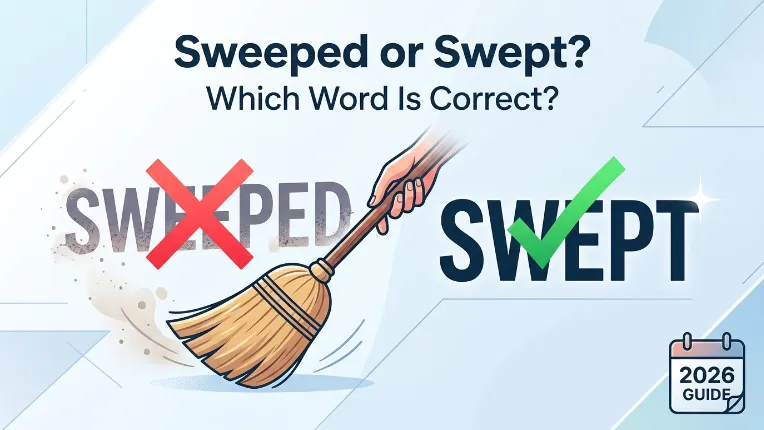
Sweeped or swept? The correct past tense of “sweep” is swept, not sweeped.
Every morning, Ali opens his small shop and begins his day the same way by cleaning the floor. One day, while writing a message to his helper, he typed, “I already sweeped the floor.” He paused. Something didn’t look right. Was it sweeped or swept?
This small doubt is more common than you might think. Many English learners and even native speakers search for “sweeped or swept” because the rule for past tense verbs can be confusing. Normally, we add –ed to form the past tense of verbs like clean → cleaned or walk → walked. So it feels natural to think sweep → sweeped should be correct.
But English has many irregular verbs, and sweep is one of them. The correct past tense and past participle form is swept. Still, people continue to search this question online because the spelling pattern looks unusual and easy to misunderstand.
In this guide, you will learn the quick answer, the history of the word, spelling rules in British and American English, common mistakes, and real-life examples of correct usage.
Sweeped or Swept – Quick Answer
The correct past tense of sweep is swept.
❌ Incorrect: I sweeped the floor yesterday.
✅ Correct: I swept the floor yesterday.
Examples:
- She swept the kitchen before guests arrived.
- The wind swept the leaves across the street.
- The team swept the series in three games.
The word sweeped is not standard English. It appears because people apply the regular –ed rule, but sweep is an irregular verb.
Here is the correct verb form:
| Verb Form | Correct Word |
| Base form | Sweep |
| Past tense | Swept |
| Past participle | Swept |
| Incorrect form | Sweeped |
So whenever you talk about the past action of sweeping, always use swept.
The Origin of Sweeped or Swept
The verb sweep has a long history in English. It comes from the Old English word “swāpan”, which meant to brush away, clean, or move something aside.
Over time, the language changed, but the verb kept its irregular past tense form. Instead of adding –ed, the word changed internally to create swept.
This pattern happens with several English verbs:
| Base Verb | Past Tense |
| Keep | Kept |
| Sleep | Slept |
| Weep | Wept |
| Sweep | Swept |
These verbs follow a similar pattern where “eep” becomes “ept.”
Because modern English learners often expect regular verbs, they sometimes create sweeped by mistake. However, dictionaries and grammar rules only recognize swept as correct.
Understanding the history helps explain why the spelling seems unusual today.
British English vs American English Spelling
Unlike many English words, sweeped vs swept is not a British vs American spelling issue. Both British and American English use swept as the correct past tense.
Some words differ between these two forms of English, such as colour vs color or travelling vs traveling. But sweep remains the same in both systems.
Here is a comparison table:
| English Type | Correct Past Tense | Example Sentence |
| American English | Swept | She swept the garage yesterday. |
| British English | Swept | He swept the garden path. |
| Australian English | Swept | The caretaker swept the hallway. |
| Incorrect form | Sweeped | ❌ Not correct in any form |
So no matter where you are writing—from the United States to the United Kingdom or anywhere else—the correct form remains swept.
Which Spelling Should You Use?
The answer is simple: always use “swept.”
Still, it helps to consider your audience when writing.
If your audience is American
Use swept, just as in all standard American dictionaries.
Example:
The janitor swept the school hallway.
If your audience is British or Commonwealth
The same rule applies. British English also uses swept.
Example:
She swept the patio before the guests arrived.
If your audience is global
Choose swept because it is the universally accepted form in English.
Using sweeped can make writing appear incorrect or unprofessional, especially in academic papers, news articles, or business communication.
Common Mistakes with Sweeped or Swept
Many people make simple grammar mistakes with this word. Here are the most common ones.
1. Using “sweeped”
❌ He sweeped the room quickly.
✅ He swept the room quickly.
2. Confusing past tense and present
❌ She sweep the floor yesterday.
✅ She swept the floor yesterday.
3. Using the wrong participle
❌ The floor has sweeped already.
✅ The floor has swept already.
4. Thinking it follows regular verb rules
Many learners assume every verb adds –ed, but English has many irregular verbs that must be memorized.
5. Spelling mistakes
People sometimes write:
- sweapt
- sweept
- sweeped
Only swept is correct.
Sweeped or Swept in Everyday Examples
The word swept appears in many everyday situations.
In emails
I swept the office before the meeting started.
In news writing
Strong winds swept through the coastal city last night.
In social media posts
Just swept my room and finally feel productive today.
In storytelling
The storm swept across the valley, leaving trees bent and streets covered with leaves.
In formal writing
The cleaning staff swept the entire building before the conference.
These examples show that swept works in both casual and professional communication.
Sweeped or Swept – Google Trends & Usage Data
Search data shows that thousands of people look up “sweeped or swept” each year. Most searches come from:
- United States
- India
- Pakistan
- Philippines
- United Kingdom
This happens mainly because English learners expect the regular –ed pattern.
Online writing tools and grammar checkers also highlight sweeped as an error and suggest swept.
In published writing, the difference is clear:
| Word | Usage Frequency |
| Swept | Extremely common |
| Sweeped | Rare and considered incorrect |
In books, news articles, and academic writing, swept appears almost exclusively.
Sweeped vs Swept Comparison Table
| Feature | Sweeped | Swept |
| Grammar status | Incorrect | Correct |
| Verb type | Assumed regular | Irregular verb |
| Past tense of sweep | ❌ No | ✔ Yes |
| Used in dictionaries | No | Yes |
| Used in formal writing | No | Yes |
This table clearly shows that swept is the only accepted form.
FAQs
Is sweeped ever correct?
No. Sweeped is not standard English. The correct past tense of sweep is swept.
Why do people say sweeped?
People often follow the regular verb rule of adding –ed, which leads to the incorrect form sweeped.
Is swept the past tense or past participle?
It is both.
Example:
She swept the floor. (past tense)
She has swept the floor. (past participle)
Is swept used in American English?
Yes. American English uses swept, just like British English.
What type of verb is sweep?
Sweep is an irregular verb because its past tense changes from sweep to swept instead of adding –ed.
Can swept be used figuratively?
Yes. It can describe movement or emotion.
Example:
Excitement swept through the crowd.
Are there other verbs like sweep?
Yes. Examples include:
- keep → kept
- sleep → slept
- weep → wept
Conclusion
The confusion between sweeped or swept comes from one of the most common challenges in English: irregular verbs. Many learners expect verbs to follow the simple –ed rule, so writing sweeped feels logical. However, English often breaks its own patterns.
The correct past tense of sweep is swept, and this rule applies across all major forms of English, including American, British, and Commonwealth usage. Whether you are writing an email, posting on social media, or preparing a professional report, swept is the only correct choice.
Understanding why this happens also makes learning easier. Words like keep, sleep, and weep follow the same pattern, changing from –eep to –ept in the past tense. Once you recognize this pattern, remembering swept becomes much simpler.
If you ever hesitate between sweeped or swept, remember this quick rule: English grammar accepts swept, while sweeped is considered incorrect.
Using the correct form improves clarity, professionalism, and confidence in your writing.

Hi, I’m Evelyn Hartley. I love writing short stories that explore everyday life and the little emotions we all feel. I try to keep my words simple but meaningful, so readers can really connect with them.