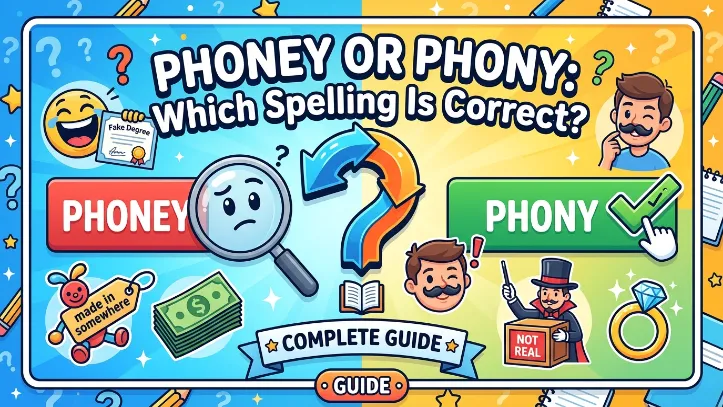
Both “phoney” and “phony” are correct spellings meaning fake or not genuine, but “phony” is preferred in American English.
A shop owner once warned a customer, “Be careful, that watch looks phony.” The customer paused for a moment, wondering if the spelling should actually be phoney. This small doubt is common because both spellings appear in English writing.
Words like phoney and phony often confuse writers since they look slightly different but carry the same meaning. Many people search for “phoney or phony” to confirm which spelling is correct and whether one form is better for professional writing.
The truth is that both spellings exist in English. However, “phony” is the more common spelling in American English, while “phoney” appears more often in British English or older texts. In modern writing, especially online content, phony is widely preferred.
Understanding the difference helps writers choose the correct spelling for their audience and avoid confusion in emails, articles, blogs, and professional communication.
In this article, we will explain the meaning, origin, spelling differences, common mistakes, examples, and usage trends of phoney and phony.
Phoney or Phony – Quick Answer
Both words mean fake, dishonest, or not genuine, but their spelling preference differs by region.
| Word | Region Preference | Meaning |
| Phony | American English | Fake or fraudulent |
| Phoney | British English / older style | Fake or fraudulent |
Example Sentences
Phony:
- The website looked phony and unsafe.
Phoney:
- His excuse sounded phoney.
Both sentences have the same meaning.
The Origin of Phony
The word phony appeared in English during the late 1800s in the United States. It was originally used to describe fake jewelry or counterfeit items.
Some language historians believe it may come from the British slang word “fawney,” which referred to a trick used by criminals selling fake gold rings.
Over time, the spelling simplified to phony, and the meaning expanded to include anything fake or dishonest.
Examples:
- Phony money
- Phony identity
- Phony story
Today, the word is commonly used in both formal and informal contexts.
British English vs American English Spelling
The main difference between phoney and phony lies in regional spelling preference.
Comparison Table
| Word | US English | UK English | Usage |
| Phony | ✔ Common | ✔ Accepted | Most widely used |
| Phoney | Rare | ✔ More common historically | Less common today |
In modern global writing—especially online—phony is far more common.
Which Spelling Should You Use?
Choosing between phoney and phony depends on your audience.
Use “Phony” When
- Writing for an American audience
- Creating online content or blogs
- Writing business communication
Example:
- The caller used a phony name.
Use “Phoney” When
- Writing in British English style
- Following traditional or historical spelling
Example:
- The advertisement seemed phoney.
However, even in British writing, phony is becoming more common today.
Common Mistakes with Phoney and Phony
Mistake 1: Thinking One Spelling Is Wrong
Many people assume phoney is incorrect. In reality, it is simply a less common variant.
Mistake 2: Mixing Spellings in the Same Article
Example:
Incorrect:
- The story was phony, and his excuse sounded phoney.
Correct:
- Choose one spelling and stay consistent.
Mistake 3: Confusing Phony With “Phone”
Because the words look similar, some writers accidentally write phone instead of phony.
Incorrect:
- That website looks phone.
Correct:
- That website looks phony.
Phony or Phoney in Everyday Examples
In News
- Police arrested a man using a phony identity.
In Online Security
- Avoid clicking links from phony websites.
In Business
- The company was accused of selling phony products.
In Conversation
- His apology sounded phony.
In Entertainment
- The movie shows a detective chasing phony documents.
These examples show how commonly the word appears in everyday English.
Google Trends & Usage Data
Search and language data show that phony is significantly more popular than phoney.
Usage trends reveal:
- Phony dominates in American websites and news articles.
- Phoney appears less often and mostly in older British texts.
- Global online writing strongly favors phony.
SEO data also shows that people often search phrases like:
- phony meaning
- phony person
- phony website
This confirms that phony is the preferred modern spelling.
Comparison Table: Phony vs Phoney
| Feature | Phony | Phoney |
| Meaning | Fake or dishonest | Fake or dishonest |
| American English | Preferred | Rare |
| British English | Accepted | More traditional |
| Modern usage | Very common | Less common |
| SEO popularity | High | Low |
This comparison helps writers choose the best spelling for their audience.
FAQs
1. Is “phoney” a correct spelling?
Yes, but it is less common than phony.
2. Which spelling is more popular today?
Phony is more widely used worldwide.
3. Do phony and phoney have different meanings?
No, both mean fake or not genuine.
4. Which spelling should I use in blogs?
It is better to use phony because it is more common online.
5. Is phony informal?
It is slightly informal but widely accepted in modern writing.
6. Can phony describe a person?
Yes, it can describe someone who is dishonest or insincere.
Example:
- He seemed like a phony friend.
7. Is phony used in professional writing?
Yes, especially when describing fraud or fake activities.
Conclusion
The words phoney and phony share the same meaning: something fake, dishonest, or not genuine. Both spellings exist in English, but their popularity differs depending on region and modern usage.
Phony is the preferred spelling in American English and is now the most widely used form globally. It appears frequently in news reports, security warnings, online content, and everyday conversations.
Phoney, while still technically correct, is less common and often seen in older British texts or traditional spelling styles.
For most writers especially those creating blogs, articles, or online content the best choice is phony. Using the more common spelling ensures clarity and consistency for readers around the world.
Whenever you encounter these two forms, remember that both mean the same thing, but phony is the modern standard used by most writers today.
Caliber or Calibre: Which Spelling Is Correct?

Hi, I’m Liam Rivers, author at Engglory.com.
I’m an English grammar expert who simplifies spelling confusion and tricky grammar rules to help readers write and speak with confidence.