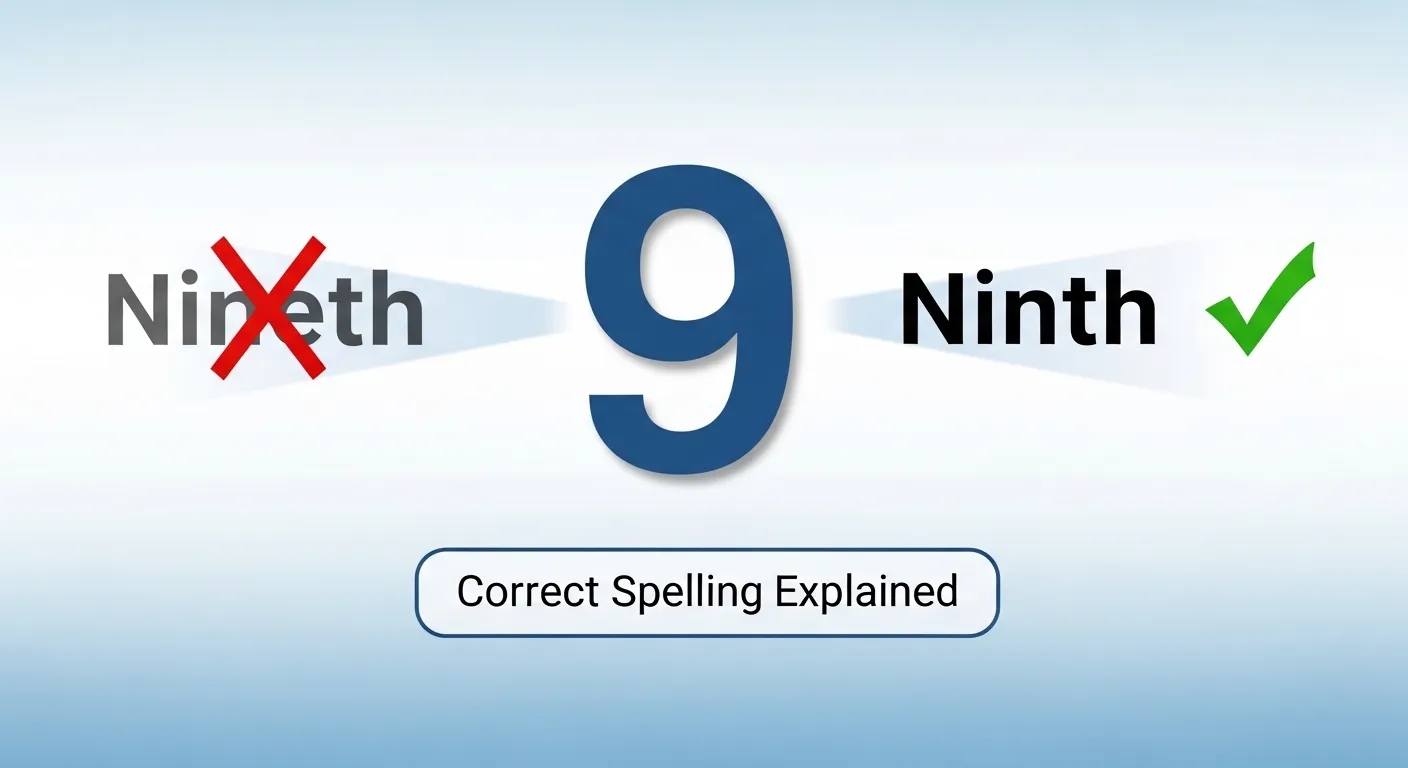
Ninth is the correct spelling. Nineth is incorrect and should not be used in standard English.
Have you ever paused while writing and wondered, Is it nineth or ninth? You are not alone. Many English learners and even native speakers get confused when turning numbers into ordinal words. Since we write five → fifth, some people assume nine → nineth should follow the same pattern. But English spelling does not always follow simple rules.
This confusion appears often in school assignments, emails, forms, and even social media posts. People search for this keyword because they want a quick answer and clear guidance before using the word in formal writing.
The truth is simple: the correct spelling is ninth, not nineth. The word drops the final e from nine and adds -th.
In this guide, you will learn the correct spelling, its origin, usage rules, common mistakes, and real examples. By the end, you will feel confident using ninth in any situation.
Nineth or Ninth – Quick Answer
The correct spelling is ninth.
- ❌ Nineth – Incorrect
- ✅ Ninth – Correct
Examples:
- She finished in ninth place.
- Today is the ninth of March.
- He lives on the ninth floor.
Why not “nineth”?
English drops the silent e in nine before adding -th, forming ninth.
The Origin of Ninth
The word ninth comes from Old English nigoða, which later became ninthe and then ninth. Over time, English simplified the spelling and pronunciation.
English often changes word forms instead of following strict patterns. For example:
| Number | Ordinal |
| Five | Fifth |
| Nine | Ninth |
| Twelve | Twelfth |
The spelling looks irregular, but it follows historical sound changes. The final e in nine was removed to make pronunciation smoother: ninth (not nine-th).
This is why nineth never became a standard spelling.
British English vs American English Spelling
Good news: there is no difference between British and American English for this word.
Both forms use:
- Ninth – Correct
- Nineth – Incorrect
| Version | Correct Form |
| American English | Ninth |
| British English | Ninth |
| Australian/Canadian English | Ninth |
| Incorrect variant | Nineth |
Unlike words such as color/colour or center/centre, this spelling is the same worldwide.
Which Spelling Should You Use?
Always use ninth, no matter your audience.
- US audience: Use ninth
- UK audience: Use ninth
- Global or business writing: Use ninth
- Academic or formal writing: Use ninth
There is no regional variation. Using nineth may make your writing look incorrect or unprofessional.
Common Mistakes with Nineth or Ninth
Many people make small errors when writing ordinal numbers. Here are the most common ones:
| Mistake | Correction |
| Nineth grade | Ninth grade |
| Nineth floor | Ninth floor |
| Nineth position | Ninth position |
| 9th written as nineth | Ninth |
Why the mistake happens
- People follow the pattern: nine + th
- They do not know the silent e is dropped
- They rely on pronunciation instead of spelling rules
Tip:
If the base word ends with silent e, check the correct ordinal form instead of guessing.
Nineth or Ninth in Everyday Examples
Emails
- Please report to the ninth floor for your interview.
- The meeting is scheduled for the ninth of April.
News Writing
- The athlete secured ninth place in the final.
- The company opened its ninth branch this year.
Social Media
- Just moved into my ninth apartment!
- Today marks our ninth anniversary.
Academic or Formal Writing
- Students in the ninth grade must complete the project.
- The data was collected on the ninth day of the study.
Using nineth in these contexts would be seen as a spelling error.
Nineth or Ninth – Google Trends & Usage Data
Search data shows that “ninth” is the dominant spelling worldwide. The incorrect form “nineth” appears mostly in search queries where users are checking the correct spelling.
Popularity by region:
- United States – High usage of ninth
- United Kingdom – High usage of ninth
- India & Pakistan – Frequent searches for nineth or ninth
- Global learners – Often search to confirm spelling
Context of searches
- School homework
- Grade levels (ninth grade)
- Addresses and floors
- Date writing
- English learning
This shows that people are not using nineth intentionally they are searching to avoid mistakes.
Comparison Table: Nineth vs Ninth
| Word | Correct? | Usage |
| Ninth | ✅ Correct | Standard English worldwide |
| Nineth | ❌ Incorrect | Common spelling mistake |
FAQs
1. Is nineth ever correct?
No. Nineth is always incorrect in standard English.
2. Why is it spelled ninth and not nineth?
English drops the silent e from nine before adding -th.
3. How do you write 9th in words?
Write it as ninth.
4. Is ninth used in both US and UK English?
Yes. The spelling is the same in all English varieties.
5. What is the meaning of ninth?
It means number nine in order or position.
6. How do you use ninth in a sentence?
She finished ninth in the competition.
7. What grade is ninth grade?
It is the first year of high school in many education systems.
Conclusion
The confusion between nineth and ninth is common, but the solution is simple. The correct spelling is always ninth, and it is used the same way across American, British, and global English. The mistake happens because people try to follow a simple pattern from the word nine, but English spelling often changes based on historical usage.
Remember this rule: drop the silent e from nine and add -th to form ninth. Whether you are writing an email, school paper, business document, or social media post, using the correct spelling helps your writing look clear and professional.
If you ever feel unsure, think of common phrases like ninth grade, ninth floor, or ninth place. These examples reinforce the correct form and make it easier to remember.
Mastering small spelling details like this improves your confidence and accuracy. Once you learn the correct form, you will never hesitate between nineth or ninth again.
Kindergarden or Kindergarten: Which Spelling Is Correct?

Hi, I’m Evelyn Hartley. I love writing short stories that explore everyday life and the little emotions we all feel. I try to keep my words simple but meaningful, so readers can really connect with them.