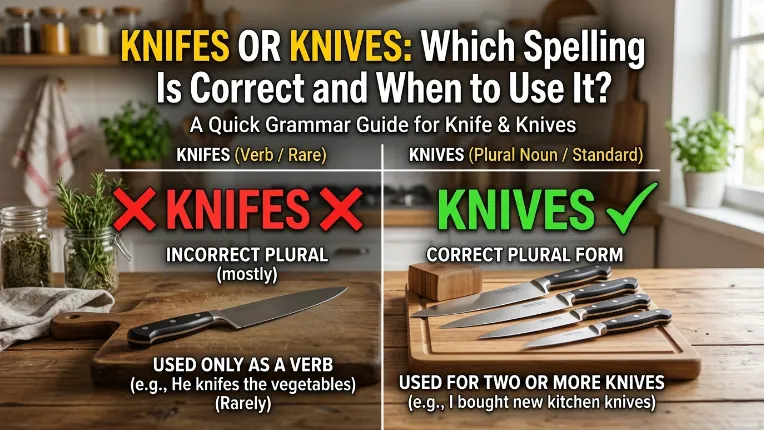
“Knives” is the correct plural of “knife,” while “knifes” is rarely used and usually considered incorrect in modern English.
A cooking instructor once asked a group of students to place their knives on the table before starting a lesson. One student hesitated while writing notes and wondered whether the plural should be knifes or knives. This small spelling question is surprisingly common in English.
Many learners search for “knifes or knives” because English plural rules can sometimes feel confusing. In most cases, we simply add “s” to make a word plural. However, some words follow different patterns. The word knife is one of those exceptions.
The correct plural form is knives, where the “f” changes to “v” before adding “es.” This rule also applies to several similar English nouns. Understanding why this change happens helps writers avoid spelling mistakes and use the correct form in everyday communication.
In this article, we will explain the meaning, origin, spelling rules, common mistakes, examples, and usage trends for knifes and knives, so you can confidently choose the correct word.
Knifes or Knives – Quick Answer
| Word | Correct? | Meaning |
| Knives | ✔ Correct | Plural of knife |
| Knifes | ✖ Usually incorrect | Rare verb form |
Example Sentences
Correct:
- The chef placed several knives on the kitchen counter.
Incorrect:
- The chef placed several knifes on the kitchen counter.
The plural noun form is knives.
The Origin of Knife and Its Plural Form
The word knife comes from the Old English word “cnīf,” which originally referred to a cutting tool. In early English spelling, many nouns ending in “f” changed to “ves” when forming the plural.
This pattern developed because of pronunciation changes in medieval English. Over time, the rule became standard for certain nouns.
Examples of similar plural patterns include:
| Singular | Plural |
| Knife | Knives |
| Leaf | Leaves |
| Life | Lives |
| Wolf | Wolves |
| Shelf | Shelves |
Because of this rule, knives became the accepted plural form of knife.
British English vs American English Spelling
Unlike many other words, the plural of knife is the same in both British and American English.
Comparison Table
| Word | US English | UK English | Status |
| Knife | ✔ | ✔ | Singular |
| Knives | ✔ | ✔ | Correct plural |
| Knifes | Rare | Rare | Usually incorrect |
Both language varieties follow the same grammar rule.
Which Spelling Should You Use?
Use “Knives” When Talking About More Than One Knife
Examples:
- The restaurant ordered new knives for the kitchen.
- Please keep the knives in the drawer.
- The chef sharpened his knives before cooking.
This is the correct plural form used in everyday English.
When Is “Knifes” Used?
The word knifes can appear as a verb meaning to stab or cut someone with a knife. However, this usage is rare and mostly appears in news reports or crime descriptions.
Example:
- The attacker knifes the victim in the story.
Because this meaning is uncommon, most people encounter knives far more often.
Common Mistakes with Knifes and Knives
Mistake 1: Adding “S” to Form the Plural
Incorrect:
- I bought two knifes.
Correct:
- I bought two knives.
Mistake 2: Forgetting the “F to V” Rule
Many learners forget that some nouns ending in f change to ves in the plural.
Examples:
Incorrect:
- leafs
- wolfs
Correct:
- leaves
- wolves
Mistake 3: Mixing Plural and Verb Forms
Incorrect:
- The kitchen has many knifes.
Correct:
- The kitchen has many knives.
Knives in Everyday Examples
In Cooking
- The chef uses different knives for vegetables and meat.
In Restaurants
- The waiter placed forks and knives on the table.
In Outdoor Activities
- Campers carry sharp knives for survival tasks.
In Shopping
- The store sells high-quality kitchen knives.
In Safety Instructions
- Keep knives away from children.
These examples show how commonly the word appears in daily language.
Google Trends & Usage Data
Search data shows that many people type “knifes” when they are unsure about the correct plural spelling. However, dictionaries and grammar guides confirm that knives is the standard plural form.
Usage patterns indicate:
- Knives appears frequently in cooking blogs, restaurant guides, and kitchen product descriptions.
- Knifes is rarely used except as a verb in specific contexts.
Search engines often auto-correct knifes to knives, highlighting the correct spelling.
Comparison Table: Knifes vs Knives
| Feature | Knives | Knifes |
| Part of speech | Plural noun | Verb form |
| Meaning | More than one knife | To stab with a knife |
| Usage frequency | Very common | Rare |
| Grammar correctness (plural) | ✔ Correct | ✖ Incorrect |
| Dictionary acceptance | ✔ Yes | Limited |
This table clearly shows why knives is the correct plural.
FAQs
1. What is the plural of knife?
The correct plural is knives.
2. Is “knifes” ever correct?
It can be used as a verb, but it is rarely used in everyday English.
3. Why does knife become knives in the plural?
Because some English nouns ending in f change to ves when pluralized.
4. Is the rule the same in British and American English?
Yes, both use knives as the plural.
5. Are there other words like knife?
Yes. Examples include leaf/leaves, wolf/wolves, and life/lives.
6. Can I write “two knifes”?
No, the correct form is two knives.
7. Why do people search for “knifes or knives”?
Because English plural spelling rules can be confusing.
Conclusion
The difference between knifes and knives mainly comes down to English plural spelling rules. The correct plural of knife is knives, where the “f” changes to “v” before adding “es.” This pattern also appears in several other English nouns.
Although knifes can technically exist as a verb meaning “to stab with a knife,” it is rarely used in everyday language. For most writing situations especially when referring to kitchen tools or objects the correct form is knives.
Understanding this rule helps writers avoid common spelling mistakes and improves clarity in both casual and professional writing. Whenever you talk about more than one knife, remember the simple rule: knife becomes knives.
Phoney or Phony: Which Spelling Is Correct? Complete Guide

Hi, I’m Evelyn Hartley. I love writing short stories that explore everyday life and the little emotions we all feel. I try to keep my words simple but meaningful, so readers can really connect with them.