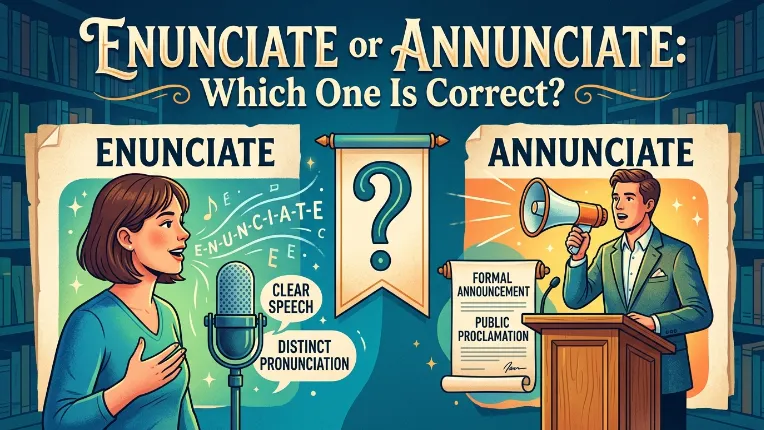
“Enunciate” means to speak clearly, while “annunciate” means to announce something formally.
You’re in a meeting, trying to sound confident. You say, “Please annunciate your words clearly.” Suddenly, someone pauses and you wonder, did I just say that right? This small moment creates a big doubt. Words like enunciate and annunciate sound similar, but they don’t mean the same thing. Many people mix them up every day, especially in speech, writing, and even professional settings.
People search for “enunciate or annunciate” because both words feel interchangeable. They share similar sounds and formal tones, which makes the confusion natural. But using the wrong word can change your meaning completely. If you’re teaching, speaking publicly, or writing professionally, this difference matters.
This article clears that confusion once and for all. You’ll learn what each word means, where they come from, how they’re used, and which one fits your situation. By the end, you’ll never hesitate again when choosing between these two tricky words.
Enunciate or Annunciate – Quick Answer
Enunciate means to speak words clearly and pronounce them properly.
Annunciate means to announce or declare something officially.
Examples:
- Please enunciate your words so everyone understands you.
- The host will annunciate the winner tonight.
👉 Simple rule:
Use enunciate for speaking clearly.
Use annunciate for making announcements.
The Origin of Enunciate or Annunciate
Both words come from Latin, which is why they look and sound similar.
- Enunciate comes from “enuntiare”, meaning to declare or express clearly. Over time, it focused more on clear speech and pronunciation.
- Annunciate comes from “annuntiare”, meaning to announce or proclaim. It kept its meaning related to giving news or declarations.
The confusion exists because both words started with similar roots linked to speaking or declaring. But English shaped them differently over time.
Think of it like this:
- Enunciate → clarity in speech
- Annunciate → delivery of information
British English vs American English Spelling
Unlike many English words, enunciate and annunciate do not change spelling between British and American English. The confusion is not about region—it’s about meaning.
However, usage frequency differs slightly.
| Feature | Enunciate | Annunciate |
| Meaning | Speak clearly | Announce formally |
| Common in US | Very common | Rare |
| Common in UK | Very common | Rare |
| Everyday Use | Yes | Mostly formal or religious |
| Spelling Difference | None | None |
👉 Key point: This is not a spelling issue like color vs colour. It’s a meaning issue.
Which Spelling Should You Use?
The better question is: Which word should you use?
Use Enunciate when:
- You talk about speaking clearly
- You give speech advice
- You teach pronunciation
👉 Example: Actors must enunciate every word.
Use Annunciate when:
- You mean to announce something formally
- You are writing in a formal or religious context
👉 Example: The priest will annunciate the message.
Audience-Based Advice:
- US audience: Use enunciate most of the time
- UK/Commonwealth: Same rule applies
- Global audience: Stick with enunciate unless you truly mean “announce”
👉 Safe choice: In 90% of cases, you need enunciate, not annunciate.
Common Mistakes with Enunciate or Annunciate
Many people misuse these words. Here are common mistakes:
❌ Wrong:
Please annunciate clearly during the presentation.
✔ Correct:
Please enunciate clearly during the presentation.
❌ Wrong:
He enunciated the results of the election.
✔ Correct:
He annunciated the results of the election.
❌ Mistake:
Using both words as synonyms
✔ Fix:
They are not interchangeable
❌ Mistake:
Thinking annunciate is a “fancier” version
✔ Fix:
It has a different meaning, not a higher level
👉 Quick tip:
If the sentence is about clarity, choose enunciate.
Enunciate or Annunciate in Everyday Examples
Let’s see how these words appear in real life.
Emails:
- Please enunciate your points clearly in the meeting.
- We will annunciate the policy update tomorrow.
News:
- The speaker failed to enunciate properly during the debate.
- The government will annunciate new laws next week.
Social Media:
- Why don’t people enunciate in voice notes?
- The company finally annunciated the launch date!
Formal Writing:
- Students must enunciate each word clearly.
- The official will annunciate the decision.
👉 Notice:
“Enunciate” is used more often in daily language.
Enunciate or Annunciate – Google Trends & Usage Data
Search data shows a clear pattern:
- Enunciate is searched far more often worldwide
- Annunciate has low search volume and is used in limited contexts
Popularity by Region:
- United States: “Enunciate” dominates
- United Kingdom: Same trend
- India & Pakistan: “Enunciate” widely used in education
- Religious contexts (global): “Annunciate” appears more
Context Usage:
| Context | Enunciate | Annunciate |
| Education | High | Low |
| Public Speaking | High | Very Low |
| News & Media | Medium | Low |
| Religious Texts | Low | Medium |
👉 Insight:
If you’re writing for SEO or general readers, enunciate is the stronger keyword.
Comparison Table: Enunciate vs Annunciate
| Feature | Enunciate | Annunciate |
| Meaning | Speak clearly | Announce formally |
| Usage Frequency | Very high | Low |
| Context | Speech, teaching | Formal, religious |
| Common Mistake | Rarely misused correctly | Often confused |
| Example | Enunciate your words | Annunciate the news |
FAQs
1. Is annunciate a real word?
Yes, but it is rare and used mainly in formal or religious contexts.
2. Can I use annunciate instead of enunciate?
No. They have different meanings and are not interchangeable.
3. Why do people confuse enunciate and annunciate?
Because they sound similar and both relate to speaking.
4. Which word is more common?
Enunciate is far more common in everyday language.
5. Is annunciate outdated?
Not outdated, but rarely used in modern casual speech.
6. What is the easiest way to remember the difference?
- Enunciate = clear speech
- Annunciate = announcement
7. Do both words have the same spelling in US and UK?
Yes, there is no spelling difference between regions.
Conclusion
The difference between enunciate and annunciate is simple but important. One focuses on how you speak, and the other focuses on what you announce. In daily life, most situations require enunciate because clear communication matters everywhere at school, work, and public speaking.
On the other hand, annunciate is more formal and appears in specific contexts, like official announcements or religious language. That’s why it feels unfamiliar to many people. The key is not just knowing both words, but knowing when to use each one correctly.
If you remember one thing, let it be this: when clarity is the goal, always choose enunciate. When you are declaring something formally, then annunciate fits.
Using the right word builds confidence and improves communication. Now, the next time you speak or write, you’ll choose the correct word without hesitation.

Hi, I’m Liam Rivers, author at Engglory.com.
I’m an English grammar expert who simplifies spelling confusion and tricky grammar rules to help readers write and speak with confidence.