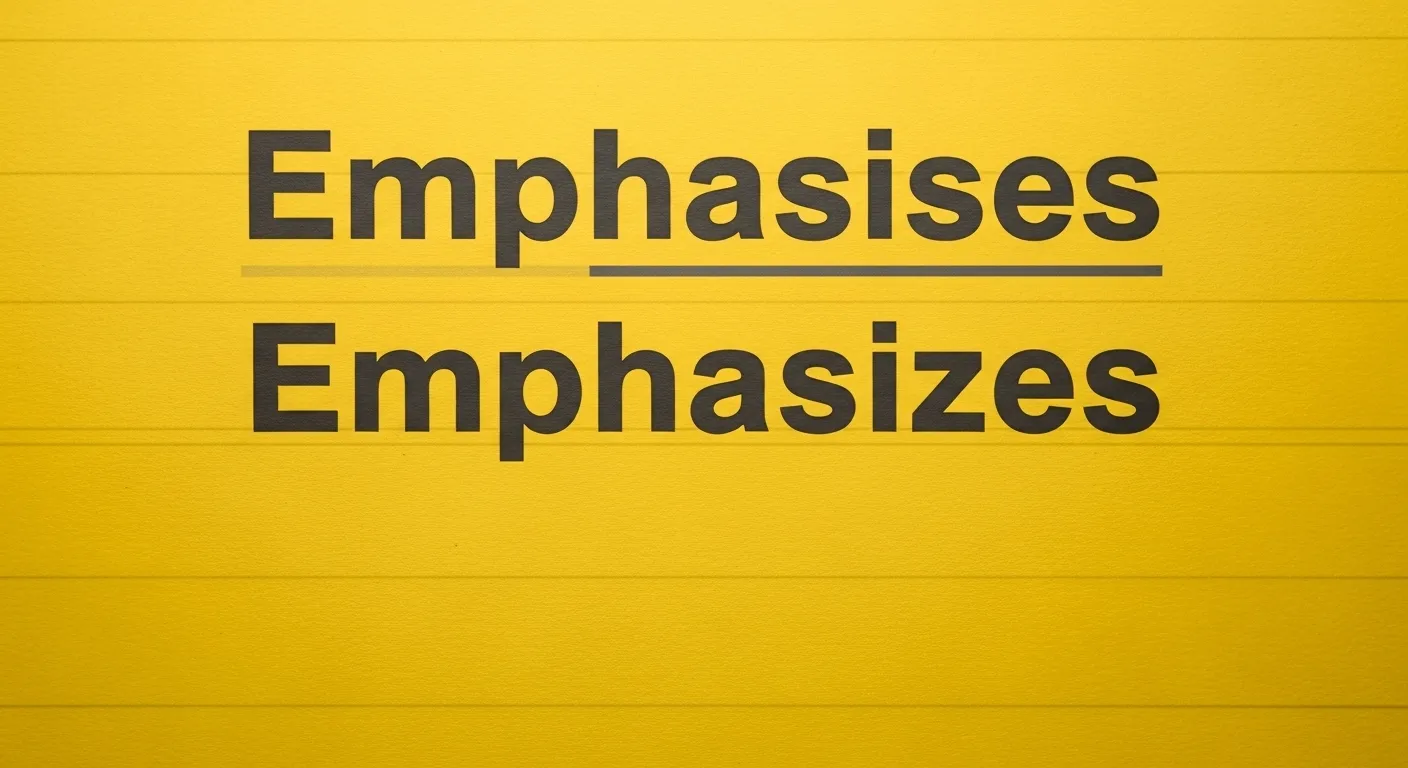
Both “emphasises” and “emphasizes” are correct. “Emphasises” is British English. “Emphasizes” is American English.
Have you ever paused while writing and wondered: Is it “emphasises” or “emphasizes”? You are not alone. This spelling confusion is common. Students, bloggers, teachers, and business writers search this keyword daily. They want a clear answer. They want to avoid mistakes. They want to sound professional.
The confusion happens because English has two main spelling systems: British and American. Many words change when they cross the Atlantic. Some use -ise in the UK. Others use -ize in the US. This small letter change can make writers unsure.
If you are writing an email, an article, or academic work, choosing the right spelling matters. It shows care. It shows clarity. It shows audience awareness.
In this guide, you will get a quick answer, full history, spelling rules, comparison tables, common mistakes, and real examples. By the end, you will know exactly which spelling to use and when.
Emphasises or Emphasizes – Quick Answer
Both spellings are correct.
- Emphasises → British English
- Emphasizes → American English
Examples:
- The teacher emphasises the importance of reading. (UK)
- The teacher emphasizes the importance of reading. (US)
The meaning is the same. The pronunciation is the same. Only the spelling changes.
The Origin of Emphasises or Emphasizes
The word comes from the Greek word “emphainein,” which means “to show” or “to make clear.” It entered English through Latin and French.
The verb “emphasize” appeared in English in the 17th century. At that time, spelling was not fixed. Writers used different forms.
The ending -ize has Greek roots. Many linguists say -ize is actually the older form in English. However, British English later preferred -ise in many verbs.
That is why today:
- American English keeps -ize
- British English often uses -ise
Both forms are historically valid.
British English vs American English Spelling
The main difference is simple:
| Feature | British English | American English |
| Common Form | Emphasises | Emphasizes |
| Verb Ending | -ise | -ize |
| Usage Region | UK, Australia, NZ | USA |
| Meaning | Same | Same |
More Examples of Similar Words
| British | American |
| Organises | Organizes |
| Realises | Realizes |
| Recognises | Recognizes |
| Criticises | Criticizes |
In American English, -ize is standard.
In British English, -ise is more common in modern usage.
However, some UK publishers (like Oxford University Press) still prefer -ize. So even in Britain, both may appear.
Which Spelling Should You Use? Emphasizes or Emphasises
The answer depends on your audience.
Use “Emphasizes” If:
- You write for an American audience.
- Your company follows US English.
- Your website targets US readers.
- You use American spelling in general (color, organize, center).
Use “Emphasises” If:
- You write for UK readers.
- You follow British spelling (colour, organise, centre).
- Your school or institution requires British English.
- Your audience is in Australia, New Zealand, or South Africa.
Writing for a Global Audience?
Pick one style. Stay consistent.
Do not mix:
❌ The article emphasizes clarity and also emphasises detail.
✔ The article emphasizes clarity and detail. (US)
✔ The article emphasises clarity and detail. (UK)
Consistency builds trust.
Common Mistakes with Emphasises or Emphasizes
Here are frequent errors:
1. Mixing Spellings
Wrong: The report emphasises growth and emphasizes profit.
Correct: Choose one style only.
2. Adding Extra Letters
Wrong: Emphasizess
Wrong: Emphasiseses
Correct: Emphasizes / Emphasises
3. Confusing with “Emphasis”
“Emphasis” is a noun.
“Emphasize/Emphasise” is a verb.
Example:
- She puts emphasis on quality. (noun)
- She emphasizes quality. (verb)
4. Using the Wrong Style in Academic Work
Always check your style guide (APA, MLA, Oxford, etc.).
Emphasises or Emphasizes in Everyday Examples
In Emails
- This email emphasizes the deadline. (US)
- This email emphasises the deadline. (UK)
In News Writing
- The minister emphasizes economic reform.
- The minister emphasises public safety.
On Social Media
- She emphasizes mental health awareness.
- He emphasises daily exercise.
In Academic Writing
- The study emphasizes long-term results.
- The study emphasises long-term results.
The tone does not change. Only the regional spelling does.
Emphasises or Emphasizes – Google Trends & Usage Data
Search data shows clear patterns:
- “Emphasizes” is highly popular in the United States.
- “Emphasises” is searched more in the UK and Australia.
- Global websites often use the American form for wider reach.
American English dominates online content. That is why “emphasizes” appears more in global search results.
However, UK-based schools, newspapers, and government sites prefer “emphasises.”
Your choice should match your target region.
Comparison Table: Emphasises vs Emphasizes
| Aspect | Emphasises | Emphasizes |
| Language Type | British English | American English |
| Ending | -ise | -ize |
| Meaning | To give importance | To give importance |
| Pronunciation | Same | Same |
| Correct? | Yes | Yes |
| Best for | UK/Commonwealth | USA/Global SEO |
FAQs
1. Is “emphasises” wrong?
No. It is correct in British English.
2. Is “emphasizes” more correct?
No. It is correct in American English. Both are valid.
3. Which spelling is older?
The -ize ending has older Greek roots.
4. Can I use -ize in British English?
Yes. Some British publishers accept it.
5. Which spelling is better for SEO?
If targeting the US, use “emphasizes.”
If targeting the UK, use “emphasises.”
6. Do they sound different?
No. Pronunciation is the same.
7. Is “emphasise” also correct?
Yes. It is the British base form of the verb.
Conclusion
The confusion between “emphasises” and “emphasizes” is simple once you understand regional spelling rules. Both words mean the same thing. Both are correct. The only difference is location.
If you write for an American audience, use emphasizes. If you write for a British or Commonwealth audience, use emphasises. The key is consistency. Do not mix spellings in the same document.
English has evolved across countries. Small spelling changes like -ise and -ize reflect that history. They do not change meaning or quality. They simply show regional preference.
Before publishing, ask yourself: Who is my reader? What style guide am I following? Once you answer that, your choice becomes easy.
Now you can write with confidence. No more second guessing. No more spelling stress. Just clear and correct English.
Read More
Scarred or Scared: What’s the Difference?

Hi, I’m Evelyn Hartley. I love writing short stories that explore everyday life and the little emotions we all feel. I try to keep my words simple but meaningful, so readers can really connect with them.