“Dual” means twofold, while “duel” means a fight never confuse them.
Have you ever paused while writing and wondered: “Should it be ‘dual’ or ‘duel’?” This confusion is common because the words sound similar but have completely different meanings. Using the wrong one can change the meaning of your sentence entirely.
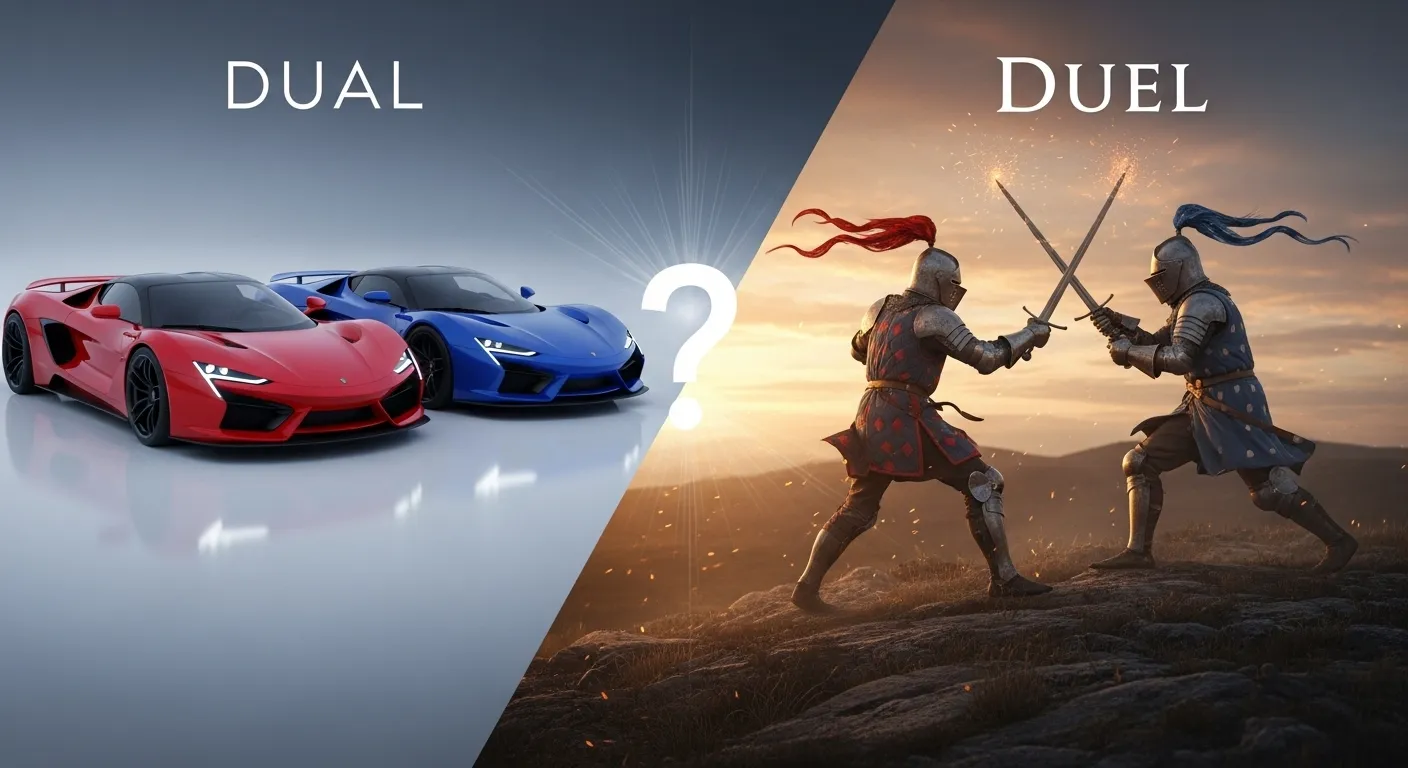
Dual refers to something that has two parts or functions. For example, “The car has a dual exhaust system.”
Duel refers to a formal fight or competition, often between two people. For example, “The knights prepared for a duel at dawn.”
People search for “dual or duel” to avoid mistakes in emails, essays, social media, and professional writing. Understanding the difference helps convey the correct meaning and improves clarity.
In this article, we’ll provide a quick answer, explain the origin, show usage in British vs American English, highlight common mistakes, provide practical examples, and give advice for correct usage in any context. By the end, you’ll confidently know when to use dual and when to use duel.
Dual or Duel – Quick Answer
| Word | Meaning | Example |
| Dual | Twofold, having two parts | “The phone has a dual SIM slot.” |
| Duel | A fight or contest between two | “The rivals agreed to a duel at sunrise.” |
Tip: Two of something? Use dual. A fight or contest? Use duel.
The Origin of Dual or Duel
- Dual comes from Latin dualis, meaning “consisting of two.” It entered English in the 15th century.
- Duel comes from Latin duellum, meaning “war between two.” It entered English in the late Middle Ages.
- Both words sound alike because of similar pronunciation, but their meanings and origins are completely different.
British English vs American English Spelling
| Word | British English | American English | Example |
| Dual | dual | dual | “The system has dual functions.” |
| Duel | duel | duel | “They fought a duel in the old tradition.” |
✅ Observation: Both words are spelled the same in UK and US English; confusion arises only from meaning.
Which Spelling Should You Use?
- Dual → Use for anything with two parts, functions, or aspects.
- Duel → Use for a fight, contest, or rivalry.
Audience tip:
- US, UK, and Commonwealth writers: Same rules apply.
- Global audience: Focus on meaning; the spelling is universal.
Common Mistakes with Dual or Duel
| Mistake | Correct Version | Why It’s Wrong |
| “They have a duel purpose.” | “They have a dual purpose.” | Duel = fight, not twofold |
| “The rivals had a dual at dawn.” | “The rivals had a duel at dawn.” | Dual = twofold, not fight |
| “Dual combat was unfair.” | “Duel combat was unfair.” | Dual ≠ fight |
Dual or Duel in Everyday Examples
Emails:
- “Our office has a dual monitor setup.”
- “The two departments agreed to a friendly duel in the hackathon.”
News Articles:
- “The politician’s dual roles sparked debate.”
- “The historical novel described a sword duel in the castle.”
Social Media:
- “Trying a dual workout routine today!”
- “The boxing match was a thrilling duel.”
Formal Writing:
- “The car’s dual braking system ensures safety.”
- “The duel between the two companies lasted for months.”
Dual or Duel – Google Trends & Usage Data
- Dual searches are linked to technology, devices, and functions.
- Duel searches are linked to competitions, games, and historical contexts.
- Top countries: United States, UK, India, Canada, Australia.
- Context: Mostly writing guidance, educational use, and proofreading.
Comparison Table: Dual vs Duel
| Feature | Dual | Duel |
| Meaning | Twofold, double | Fight or contest between two |
| Pronunciation | /ˈdjuːəl/ | /ˈdjuːəl/ |
| Usage | Two parts/functions | Competition or combat |
| Common Mistake | Using duel instead of dual | Using dual instead of duel |
FAQs
1. Is “dual” British or American English?
Both; meaning is the same worldwide.
2. Can “duel” refer to arguments?
Yes, figuratively, e.g., “a duel of wits.”
3. Are “dual” and “duel” pronounced the same?
Yes, they are pronounced very similarly.
4. Can “dual” describe people?
Yes, e.g., “She has dual citizenship.”
5. How can I remember the difference?
Think: dual = twofold, duel = fight.
6. Are there common phrases with these words?
- “Dual purpose” → twofold function
- “Sword duel” → traditional fight
7. Can “duel” be used in sports?
Yes, e.g., “The tennis players had a duel at the finals.”
Conclusion
Confusing dual and duel is common, but knowing the difference ensures accurate and professional writing. Dual always refers to something with two parts or functions, while duel refers to a fight, contest, or rivalry.
Both words are spelled the same in British and American English, so the main challenge is understanding meaning. Correct usage prevents miscommunication in emails, social media, essays, and formal writing.
Remember: If you mean “two of something,” use dual; if you mean a fight or competition, use duel. Practicing these distinctions will make your writing precise, confident, and professional. By keeping this guide handy, you’ll never confuse dual or duel again.
Protesters or Protestors: Correct Spelling & Usage

Hi, I’m Evelyn Hartley. I love writing short stories that explore everyday life and the little emotions we all feel. I try to keep my words simple but meaningful, so readers can really connect with them.