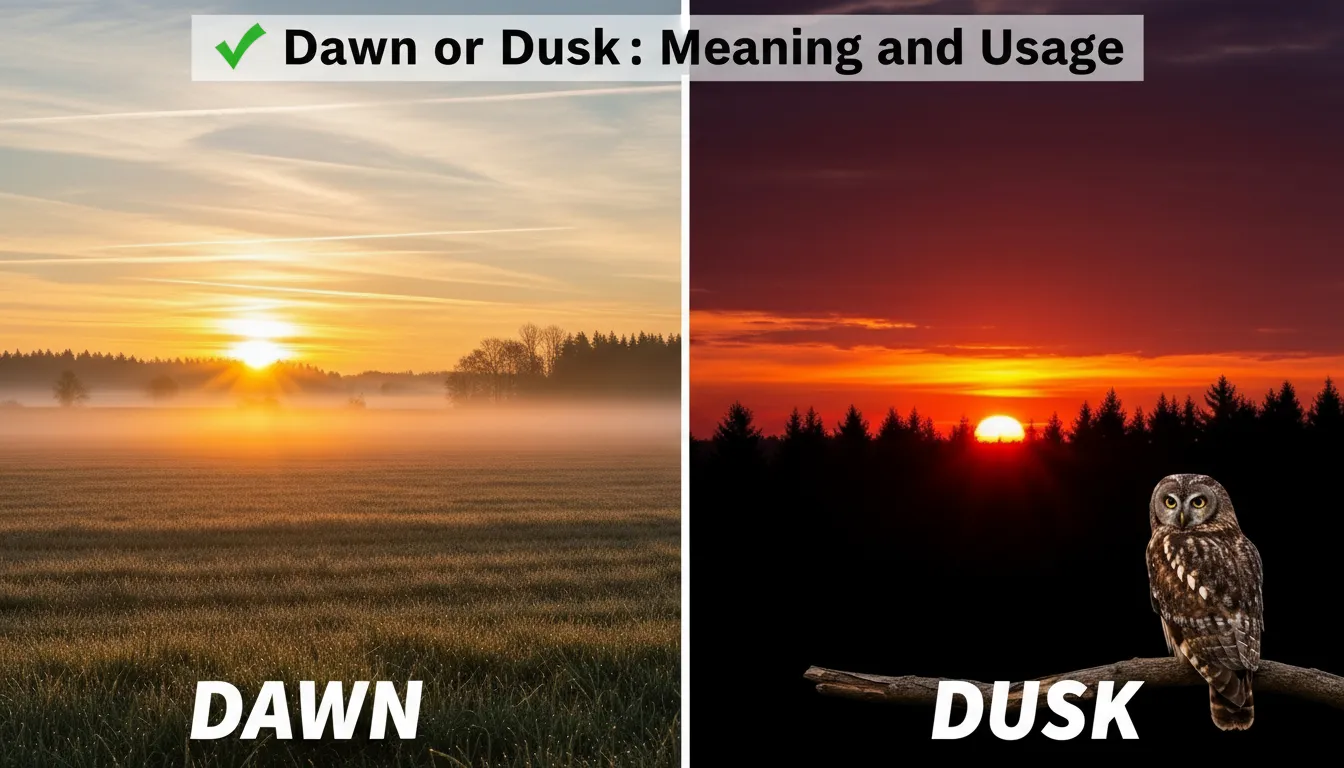
“Dawn” is the time when day begins, while “dusk” is the time when day ends.
Many people get confused between dawn and dusk, especially when talking about time, nature, or daily routines. Both words relate to light and the sun, and both describe moments when day and night meet. Because of this similarity, writers, students, and English learners often mix them up.
People search for dawn or dusk because these words are often used in stories, news, weather reports, and everyday conversation. Using the wrong one can flip the meaning of a sentence. Saying “at dawn” instead of “at dusk” can completely change when something happened.
This article explains the difference between dawn and dusk in a clear and simple way. You’ll learn their meanings, origins, correct usage, common mistakes, real-life examples, and how to choose the right word every time.
Dawn or Dusk Meaning – Quick Answer
- Dawn → The first light of the day
- Dusk → The last light of the day
Simple Examples
- Birds sing at dawn.
- Streetlights turn on at dusk.
They are opposites, not interchangeable.
The Origin of Dawn and Dusk
Origin of Dawn
- Comes from Old English dagian
- Means “to become day”
- Linked to sunrise and morning light
Origin of Dusk
- Comes from Old English dox
- Means “dark or shadowy”
- Linked to sunset and fading light
These origins clearly show why the words describe opposite times of day.
British English vs American English Spelling
There is no spelling difference between British and American English for these words.
| Word | British English | American English |
| dawn | dawn | dawn |
| dusk | dusk | dusk |
The confusion comes from meaning, not spelling rules.
Which Word Should You Use?
Choose the word based on time of day.
Use Dawn if:
- The sun is about to rise
- The day is beginning
- Light is increasing
Examples:
- We left home at dawn.
- The sky glows pink at dawn.
Use Dusk if:
- The sun has just set
- The day is ending
- Light is fading
Examples:
- The park closes at dusk.
- Bats come out at dusk.
Common Mistakes with Dawn or Dusk
Mistake 1: Mixing up start and end
❌ We watched the sunrise at dusk.
✅ We watched the sunrise at dawn.
Mistake 2: Using both for the same moment
Dawn and dusk describe different transitions.
Mistake 3: Assuming they mean night
Neither word means full night.
Dawn or Dusk in Everyday Examples
Emails
- The meeting starts at dawn.
- Please return before dusk.
News
- Rescue teams worked from dawn till night.
- Curfew begins at dusk.
Social Media
- Sunrise vibes at dawn.
- Calm skies at dusk.
Formal Writing
- Wildlife activity increases at dawn.
- Visibility drops quickly at dusk.
Dawn or Dusk – Google Trends & Usage Data
Search trends show:
- “Dawn” is often searched with sunrise and morning topics
- “Dusk” appears with sunset, evening, and nature topics
- Both words are common but used in different contexts
In SEO writing, both keywords perform well when used accurately and contextually.
Comparison Table: Dawn vs Dusk
| Aspect | Dawn | Dusk |
| Time of day | Start of day | End of day |
| Light | Increasing | Decreasing |
| Sun position | About to rise | Just set |
| Mood | Fresh, calm | Quiet, fading |
| Opposites | Yes | Yes |
FAQs: Dawn or Dusk
1. Is dawn the same as sunrise?
Not exactly. Dawn comes just before sunrise.
2. Is dusk the same as sunset?
Not exactly. Dusk comes just after sunset.
3. Which comes first, dawn or dusk?
Dawn comes first in the day.
4. Can dawn and dusk be used metaphorically?
Yes. They often symbolize beginnings and endings.
5. Are dawn and dusk used in poetry?
Very often, because they describe mood and light.
6. Do they mean night?
No. They describe transitions, not full night.
7. Which word is more positive?
Dawn is often linked to new beginnings.
Conclusion
The difference between dawn and dusk is clear once you connect them to the sun. Dawn marks the beginning of the day, when light slowly appears and the sun is about to rise. Dusk marks the end of the day, when light fades and darkness begins to take over.
These words are opposites, but both are important for describing time, mood, and nature. Mixing them up can confuse readers and change the meaning of a sentence. The simple rule is easy to remember: dawn means day starts, dusk means day ends.
With this understanding, you can now use dawn and dusk correctly and confidently in any type of writing.
✅ Beggar or Begger: Which Spelling Is Correct?

Hi, I’m Liam Rivers, author at Engglory.com.
I’m an English grammar expert who simplifies spelling confusion and tricky grammar rules to help readers write and speak with confidence.