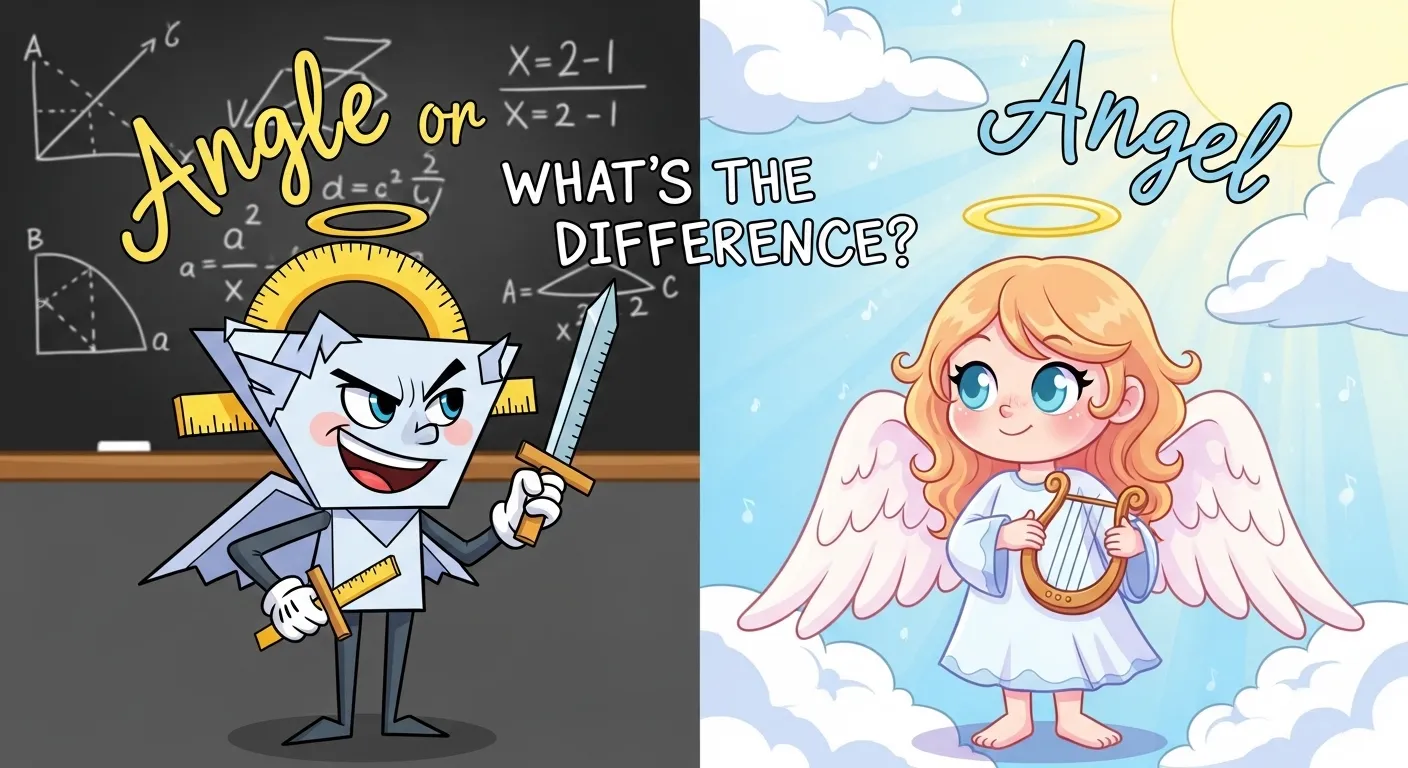
Angle means a corner, degree, or viewpoint. Angel means a spiritual being or a kind person. The words sound similar but have completely different meanings.
Have you ever typed angle when you meant angel? You’re not alone. These two words look and sound close, but their meanings are very different. Many people search for “angle or angel” because spell-check may not catch the mistake. Both words are correct English words, which makes the confusion even more common.
This mix-up happens in emails, school work, social media posts, and even business writing. Writing my little angle instead of my little angel can change the meaning completely. That’s why writers, students, and professionals often want a clear and simple explanation.
This guide will help you understand the difference between angle and angel. You’ll learn their meanings, origins, correct usage, common mistakes, and real-life examples. By the end, you’ll know exactly which word to use and when.
Angle or Angel – Quick Answer
| Word | Meaning | Example |
|---|---|---|
| Angle | A corner, degree, or point of view | The camera angle looks perfect. |
| Angel | A spiritual being or a kind person | She is an angel for helping me. |
Simple trick:
- Angle = Geometry or viewpoint
- Angel = Person or heavenly being
The Origin of Angle and Angel
Angle comes from the Latin word angulus, meaning “corner” or “bend.” It entered English through Old French and has always related to shapes, measurement, or perspective.
Angel comes from the Greek word angelos, meaning “messenger.” It passed into English through Latin and Old English. The word has strong roots in religious and spiritual texts.
The confusion happens because both words:
- Have similar spelling
- Sound almost the same when spoken quickly
- Differ by just one letter
But their meanings have never overlapped. One belongs to math and perspective. The other belongs to religion and human kindness.
British English vs American English Spelling
Good news: there is no spelling difference between British and American English for these words.
| Word | US Spelling | UK Spelling | Usage |
|---|---|---|---|
| Angle | Angle | Angle | Same meaning |
| Angel | Angel | Angel | Same meaning |
Unlike words like color/colour, these words stay the same worldwide.
Which Spelling Should You Use?
The choice is not about country. It is about meaning.
Use angle if you are talking about:
- Shapes or geometry
- Photography or camera position
- A point of view or strategy
Example:
We need a new angle for this marketing plan.
Use angel if you are talking about:
- A heavenly being
- A kind or helpful person
- Religious or emotional contexts
Example:
Thank you for your help. You’re an angel.
For global audiences, focus on context. The wrong word can make writing look careless.
Common Mistakes with Angle or Angel
Mistake 1:
My daughter is my little angle.
✔ Correct: My daughter is my little angel.
Mistake 2:
Change the camera angel.
✔ Correct: Change the camera angle.
Mistake 3:
Let’s find a new business angel.
✔ Correct: Let’s find a new business angle.
Quick memory tip:
- Angle = Lines and views
- Angel = Wings and kindness
Angle or Angel in Everyday Examples
Emails
Let’s approach this project from a different angle.
Thank you for staying late. You’re an angel.
News Writing
The story was covered from a political angle.
The charity worker was called a real-life angel.
Social Media
Trying a new selfie angle today!
My best friend is an absolute angel.
Formal Writing
Researchers studied the issue from a scientific angle.
The sculpture shows an angel from classical art.
Angle or Angel – Google Trends & Usage Data
Search data shows that many users look up “angle vs angel” because of spelling confusion.
Usage by context:
- Angle is common in photography, marketing, media, and education.
- Angel appears more in religious content, parenting posts, and emotional writing.
Popularity by region:
- High searches in the United States, India, Pakistan, and the UK.
- Students and content writers search the term often.
- Most searches come after spelling mistakes in emails or assignments.
The confusion is driven by pronunciation, not spelling rules.
Comparison Table: Angle vs Angel
| Feature | Angle | Angel |
|---|---|---|
| Meaning | Corner or viewpoint | Spiritual being or kind person |
| Field | Math, photography, strategy | Religion, emotions, people |
| Letter difference | Ends with “le” | Ends with “el” |
| Pronunciation | Similar sound | Similar sound |
| Common error | Used instead of angel | Used instead of angle |
FAQs
1. Is angle or angel correct for a kind person?
Use angel for a kind or helpful person.
2. Which word is used in photography?
Use angle to describe camera position.
3. Why do people confuse angle and angel?
They sound similar and differ by only one letter.
4. Is there a UK or US difference?
No. Both countries use the same spelling.
5. Can spell-check catch this mistake?
Not always. Both words are correct English words.
6. How can I remember the difference?
Angel has el like heaven. Angle has le like line.
7. Which word is more common?
Angle is more common in technical writing. Angel appears more in emotional or religious content.
Conclusion
The difference between angle and angel is simple but important. One small letter can change the meaning of your sentence completely. Angle relates to corners, views, and perspectives. It is used in math, photography, business, and strategy. Angel, on the other hand, refers to a spiritual being or a kind and caring person.
Since both words are correct English terms, spelling tools may not catch the mistake. That’s why understanding the meaning is the best way to avoid errors. Always check the context before you write. If you’re talking about a viewpoint or position, choose angle. If you’re describing kindness or something heavenly, choose angel.
Clear writing builds trust and professionalism. Whether you’re writing emails, articles, or social posts, using the right word makes your message stronger and easier to understand. With this guide, you can now use angle and angel with confidence.
Sempai or Senpai:Meaning & Which Spelling Is Correct?

Hi, I’m Liam Rivers, author at Engglory.com.
I’m an English grammar expert who simplifies spelling confusion and tricky grammar rules to help readers write and speak with confidence.