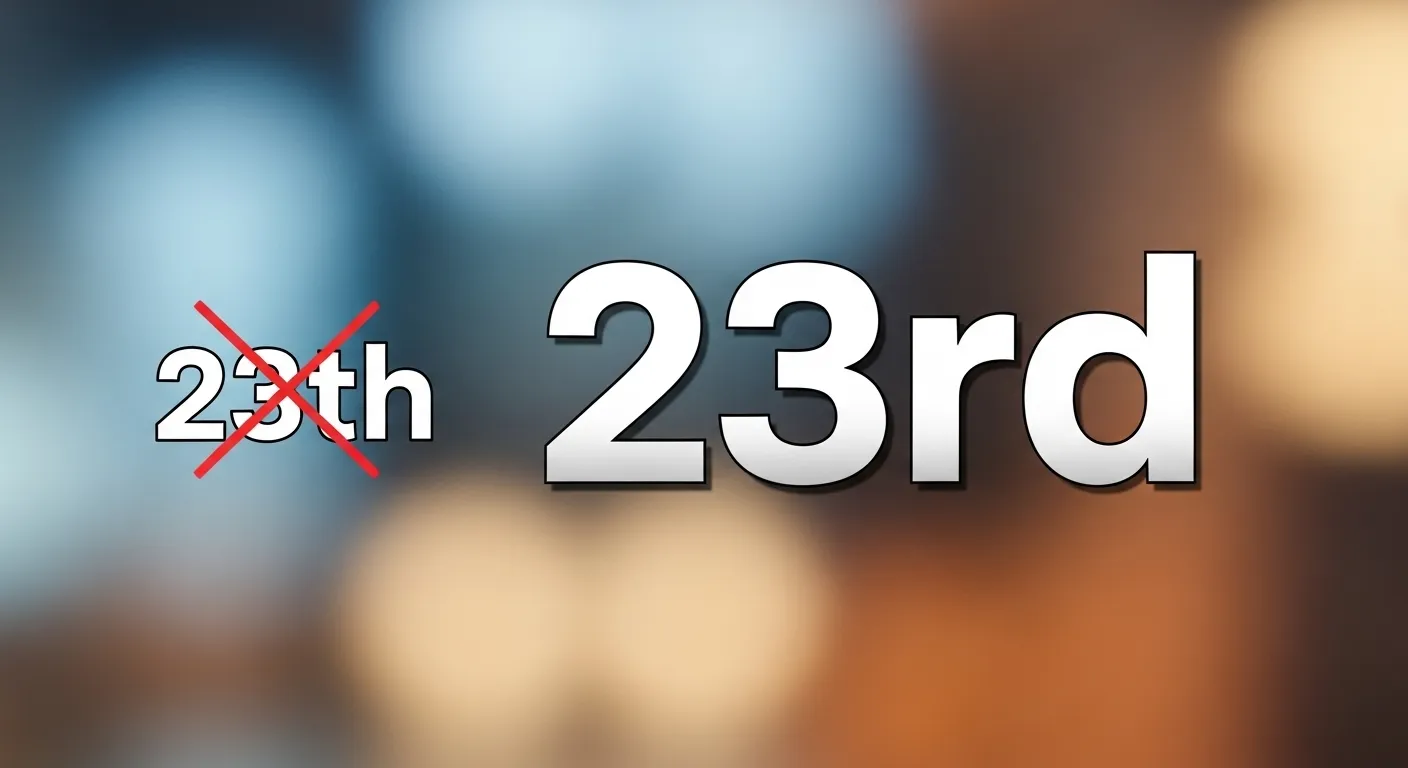
“23rd” is correct; “23th” is incorrect and never used in standard English.
Many English learners and even fluent writers often get confused between 23th and 23rd. At first glance, both may look possible, especially if you’re still learning how ordinal numbers work. This confusion is very common in dates, formal writing, invitations, schoolwork, and official documents.
People usually search for 23th or 23rd when writing dates like birthdays, deadlines, or events. Using the wrong form can make your writing look unprofessional or incorrect. Native speakers instantly notice this mistake, especially in emails and resumes.
This article explains the difference between 23th and 23rd in a simple way. You’ll learn the rules, examples, common mistakes, usage in real life, and how to never make this error again.
23th or 23rd – Quick Answer
- 23rd → ✅ Correct
- 23th → ❌ Incorrect
Simple Examples
- My birthday is on the 23rd of June.
- The meeting is scheduled for the 23rd.
“23th” is not accepted in English grammar.
The Origin of 23rd (Ordinal Numbers)
Ordinal numbers show position or order, not quantity.
- 1 → first (1st)
- 2 → second (2nd)
- 3 → third (3rd)
The word third gives us rd, which is why 23 becomes 23rd.
The ending does not change just because the number is bigger. English follows the last digit rule, not the whole number.
British English vs American English Spelling
There is no difference between British and American English here.
| Form | British English | American English |
| 23rd | 23rd | 23rd |
| 23th | Incorrect | Incorrect |
Both follow the same ordinal number rules.
Which One Should You Use?
Always use 23rd.
Use 23rd when:
- Writing dates
- Referring to positions
- Writing formal or informal English
Correct Examples:
- Today is the 23rd of March.
- She finished 23rd in the race.
Never use 23th
There is no situation where 23th is correct.
The Rule Behind 23rd (Simple Explanation)
Look at the last digit of the number:
- Ends in 1 → use st (except 11)
- Ends in 2 → use nd (except 12)
- Ends in 3 → use rd (except 13)
- All others → use th
Why 23rd?
- 23 ends in 3
- So it becomes 23rd
Common Mistakes with 23th or 23rd
Mistake 1: Using “th” for all numbers
❌ 23th birthday
✅ 23rd birthday
Mistake 2: Forgetting exceptions
❌ 13rd
✅ 13th
Mistake 3: Writing dates incorrectly
❌ April 23th
✅ April 23rd
23rd in Everyday Examples
Emails
- Please submit the form by the 23rd.
- Our call is on the 23rd.
News
- The law was passed on the 23rd of May.
- The incident happened on the 23rd.
Social Media
- Party on the 23rd.
- Countdown to the 23rd begins.
Formal Writing
- The report was finalized on the 23rd day of June.
- Payment is due on the 23rd of each month.
23th or 23rd – Google Trends & Usage Data
Search data shows:
- “23rd” is widely used in calendars, news, and documents
- “23th” is searched mainly due to confusion or mistakes
- Grammar checks always flag 23th as an error
In SEO and professional writing, 23rd is the only accepted form.
Comparison Table: 23th vs 23rd
| Aspect | 23th | 23rd |
| Grammar | Incorrect | Correct |
| Usage | Never used | Standard |
| Accepted in English | No | Yes |
| Suitable for dates | No | Yes |
| Professional writing | No | Yes |
FAQs: 23th or 23rd
1. Is 23th ever correct?
No. It is always incorrect.
2. Why do people write 23th?
Because they assume all numbers use “th.”
3. Is 23rd used in both US and UK English?
Yes, the rule is the same.
4. What about 13?
13 is an exception. It becomes 13th, not 13rd.
5. Can I write “the 23” instead?
Yes, in informal writing, but 23rd is clearer.
6. Is this mistake common?
Yes, especially among ESL learners.
7. Does pronunciation match spelling?
Yes. “23rd” is spoken as “twenty-third.”
Conclusion
The difference between 23th and 23rd is simple but important. 23rd is the only correct form, while 23th is always wrong. English ordinal numbers follow clear rules based on the last digit of a number, with a few exceptions like 11, 12, and 13.
If a number ends in 3, you use rd, which makes 23rd correct every time. This rule applies in dates, rankings, and formal writing. Learning this small detail helps your English look polished and professional.
Once you remember this rule, you’ll never hesitate again when writing dates like the 23rd.
✅ Dawn or Dusk: Meaning and Usage

Hi, I’m Evelyn Hartley. I love writing short stories that explore everyday life and the little emotions we all feel. I try to keep my words simple but meaningful, so readers can really connect with them.